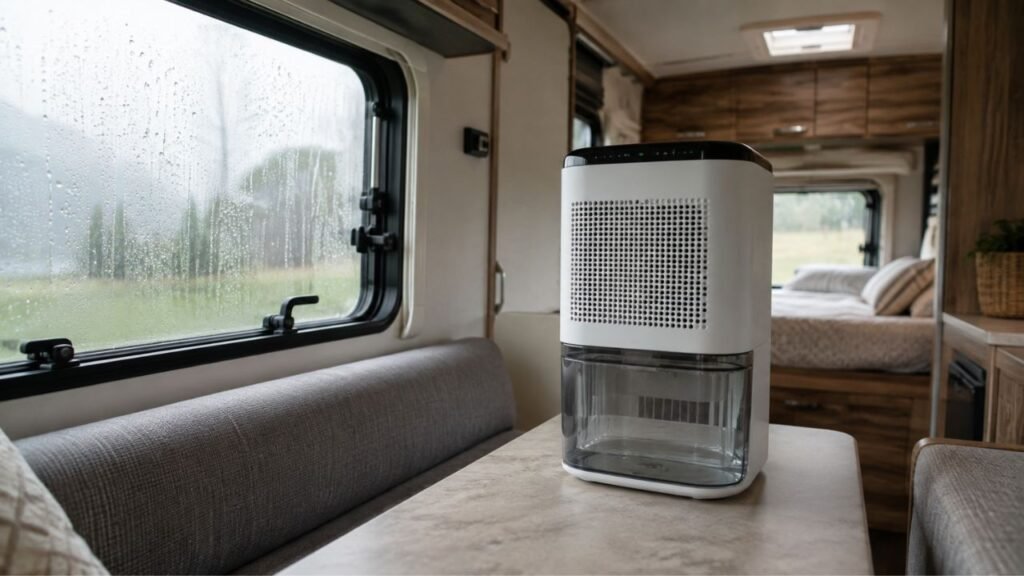
Your RV dehumidifier may not collect water because the air is already dry, the humidity setting is too high, the RV is too cold, airflow is restricted, the float switch is stuck, or the coils have frozen. Small thermoelectric dehumidifiers may also collect very little water during cooler or moderately humid conditions.
The good news is that many of these problems are easy to check. I’ll walk you through the likely causes, quick fixes, RV-specific issues, and signs that your dehumidifier may actually need repair or replacement.
Key Takeaways
- An empty water tank does not always mean your dehumidifier failed.
- Check your RV’s actual humidity before troubleshooting the appliance.
- Your target humidity should be lower than the current indoor humidity.
- Cold RV temperatures can sharply reduce compressor dehumidifier performance.
- Frozen coils, dirty filters, and blocked airflow can stop condensation.
- A stuck float switch may falsely tell the unit its tank is full.
- Small Peltier dehumidifiers collect far less water than compressor models.
- Persistent zero collection in a warm, humid RV may indicate component failure.
Why Is My RV Dehumidifier Running but Not Collecting Water?
A running fan does not necessarily mean your dehumidifier is actively removing moisture.
A compressor dehumidifier pulls humid air across a cold evaporator coil. Water vapor condenses on that coil, drips downward, and enters the tank or drain system. If the coil does not become cold enough, airflow is restricted, or the air already contains little moisture, very little water will appear.
Start by checking your RV’s relative humidity with a separate hygrometer.
Suppose your RV is already around 45% relative humidity. Your dehumidifier may collect almost nothing because there simply isn’t much excess moisture left.
However, an empty tank inside an RV sitting at 65% or 70% humidity deserves further investigation.
That difference is important.
Quick RV Dehumidifier Diagnosis
Before taking anything apart, compare the symptom you see with the likely cause below. This can save you from troubleshooting parts that are already working properly.
| What You Notice | Most Likely Cause | What to Check First | What to Do |
| Tank is dry and RV humidity is 40-50% | Air may already be dry | Separate hygrometer | Continue monitoring |
| Tank stays dry but target humidity is high | Incorrect humidity setting | Humidistat setting | Lower the target |
| Little water during cold nights | Low RV temperature | Indoor temperature | Check operating range |
| Frost appears on coils | Frozen evaporator | Filter and airflow | Turn off and thaw |
| Full-tank light appears with empty bucket | Float or bucket issue | Bucket position | Clean and reseat |
| Airflow feels weak | Dirty filter or blocked vent | Intake and filter | Clean obstructions |
| Bucket stays empty with drain hose attached | Continuous drainage | Drain outlet | Confirm normal drainage |
| Drain hose contains standing water | Poor hose routing | Hose slope | Straighten or reroute |
| RV remains humid but coils never cool | Internal system problem | Cooling operation | Consider service |
| Mini unit runs but gathers very little water | Peltier limitations | Unit capacity | Compare specifications |
Common Reasons an RV Dehumidifier Stops Collecting Water
Several conditions can produce the same empty-tank symptom. I recommend checking the simple environmental causes first before assuming an expensive component has failed.
The RV Air Is Already Dry Enough
This is one of the easiest causes to overlook.
A dehumidifier only removes moisture when indoor humidity rises above its selected target. Once it reaches that target, moisture removal slows or stops.
For example, suppose your dehumidifier is set to 50%.
If your RV is already sitting at 47% relative humidity, the machine has little reason to continue collecting water.
The bucket may remain dry for hours without anything being wrong.
This can become especially noticeable after running the unit for several days. You may initially empty the tank frequently, then suddenly notice much less water.
That can actually mean the machine has done its job.
Use a separate hygrometer instead of judging performance only by bucket volume.
The Humidity Setting Is Too High
Your humidistat setting tells the dehumidifier when moisture removal should begin.
This setting can sometimes cause confusion.
Imagine your RV currently measures 52% relative humidity. If the dehumidifier is set to maintain 60%, the machine considers the air dry enough.
It may run its fan occasionally without actively collecting moisture.
As a test, temporarily lower the target setting below your current humidity reading.
If water collection begins afterward, the appliance is probably functioning normally.
For everyday RV moisture control, you generally do not need to force humidity extremely low. Excessively dry air can also become uncomfortable.
The RV Is Too Cold for Your Dehumidifier
Temperature matters more than many RV owners realize.
Compressor-based dehumidifiers depend on refrigeration. As temperatures fall, their evaporator coils can become cold enough for moisture to freeze instead of draining away as liquid water.
Performance commonly begins declining in cooler environments.
Around 65°F is often mentioned as a caution point for conventional compressor units, but it is not a universal minimum operating temperature.
Some models are specifically designed for considerably colder conditions.
That is why I recommend checking your own dehumidifier’s manual.
Look for its listed operating temperature range.
This matters inside RVs because interior temperatures can change quickly. A camper that feels comfortable during the afternoon may become quite cold overnight.
Storage situations create the same problem.
An unheated travel trailer during winter may simply be outside the dehumidifier’s effective operating range.
The Evaporator Coils Have Frozen
Frozen coils can stop water collection almost completely.
Instead of forming droplets that fall into the bucket, moisture turns into frost or ice on the evaporator surface.
You might notice:
- White frost behind the intake grille
- Reduced airflow
- Ice covering part of the coil
- The fan running without collecting water
- Water appearing later after shutting the unit off
If you see ice, turn the dehumidifier off.
Unplug it and allow the coils to thaw naturally.
Do not scrape ice from the coils using screwdrivers, knives, or other sharp tools. The tubing and fins can be damaged surprisingly easily.
Once everything has thawed, inspect the filter and air passages.
Also check the temperature inside your RV.
If the coils repeatedly freeze while the RV remains comfortably warm, restricted airflow or an internal refrigeration problem may be involved.
The Air Filter or Intake Is Dirty
Your dehumidifier needs steady airflow to remove moisture efficiently.
A dirty filter reduces the amount of humid air reaching the cold coils. That means less condensation and less water entering the tank.
RV environments can make filters dirty surprisingly quickly.
Campground dust, pet hair, lint, cooking particles, and stored-RV debris can all accumulate around the intake.
Remove the filter according to the manufacturer’s instructions.
If it is washable, clean it and allow it to dry fully before reinstalling it.
Also inspect the surrounding air intake.
Inside a compact RV, it is easy to accidentally block airflow with:
- Bedding
- Curtains
- Furniture
- Storage bins
- Clothing
- Cabinet panels
- Walls
Give the dehumidifier enough open space around its intake and outlet.
The Water Bucket Is Not Seated Correctly
Most dehumidifiers have a safety system connected to the water bucket.
If the bucket is missing or incorrectly positioned, the unit may prevent moisture collection to avoid spilling water inside the appliance.
This can happen easily inside an RV.
You may move the dehumidifier before driving, empty the bucket, and reinstall it slightly off its normal position.
Remove the bucket completely.
Check the guides, edges, and contact points for dirt or debris.
Then slide the bucket back into position firmly.
If your unit has a tank indicator, verify that the warning disappears afterward.
The Float Switch Is Stuck
Inside many dehumidifier tanks is a small float mechanism.
Its job is simple.
As the tank fills, the float rises and eventually tells the machine to stop collecting water.
But sometimes that float becomes stuck in the raised position.
The dehumidifier then believes its tank is full even when it is completely empty.
Remove the bucket and locate the float.
Gently check whether it moves up and down freely.
Dust, mineral buildup, residue, or small debris can interfere with its movement.
Clean around it carefully.
Do not force, bend, or bypass the float mechanism.
It is an important overflow safety feature.
Water Is Going Through the Drain Hose Instead
An empty bucket may actually mean your drainage setup is working perfectly.
If your dehumidifier uses continuous drainage, collected water may bypass the bucket and flow directly through the hose.
Some models also have built-in pumps that move water automatically.
Before assuming nothing is being collected, inspect the end of your drain hose.
If water is leaving the hose normally, there may be no problem.
Remember this simple distinction:
Empty bucket with water flowing through the hose is normal.
Empty bucket with high humidity and no drainage requires troubleshooting.
The Drain Hose Is Kinked or Routed Incorrectly
Continuous drainage systems introduce another possible problem.
Many gravity-drain dehumidifiers need water to travel downhill naturally.
If the hose climbs upward after leaving the unit, water may not drain correctly.
Check the entire hose route.
Look for:
- Tight bends
- Kinks
- Clogs
- Low spots holding water
- Loose fittings
- Crushed sections
- An outlet positioned above the dehumidifier
RV layouts can make this harder than it sounds.
You may need to route the hose around furniture, through a bathroom, or toward an exterior drain location.
Keep the route simple and continuously downhill whenever gravity drainage is required.
The Dehumidifier Is Sitting Unevenly
Your RV does not always sit perfectly level.
Neither does everything inside it.
Some dehumidifiers depend on gravity to move condensation from the evaporator area toward the collection tray.
If the appliance is sitting at an unusual angle, drainage may become less reliable.
First, make sure your RV is reasonably level.
Then check the dehumidifier itself.
Place it on a stable, flat surface instead of a soft cushion, sloped shelf, or uneven stack of flooring material.
This becomes especially important after relocating your RV campsite.
The Humidity Sensor Is Giving the Wrong Reading
A dehumidifier relies on its humidity sensor to decide when moisture removal is necessary.
If that sensor reads incorrectly, the unit may believe your RV is much drier than it really is.
For example, the dehumidifier might display 45%.
Meanwhile, a separate hygrometer could show 62%.
In that situation, the dehumidifier may stop its compressor prematurely.
Place an independent hygrometer reasonably close to the unit.
Do not place it directly against the air outlet because discharged air can affect the reading.
Give both devices enough time to stabilize.
If the readings consistently remain far apart, check whether your model provides sensor cleaning or calibration instructions.
The Fan Is Running but the Compressor Is Not
A common misunderstanding happens when owners hear the fan.
They assume the entire dehumidifier is operating.
But compressor models usually have separate fan and refrigeration functions.
The fan may continue moving air even when the compressor does not start.
If your RV is genuinely humid and comfortably warm, pay attention to the cooling cycle.
You may notice:
- Normal airflow but no condensation
- Coils that never become noticeably cool
- Repeated clicking
- Compressor attempts followed by shutdown
- Continuous fan operation with no moisture removal
These symptoms can indicate a compressor, capacitor, control, sensor, or refrigeration problem.
Internal diagnosis is usually better left to qualified service professionals.
The Compressor or Refrigerant System Has Failed
Compressor or sealed-system failure is possible, but I would not start there.
Rule out the easier causes first.
Check that:
- Your RV is actually humid
- The target RH is properly selected
- The room is within the operating temperature range
- The filter is clean
- The bucket is seated properly
- The float moves correctly
- Airflow is unrestricted
- The coils are not frozen
- The drain setup works properly
If all of those conditions are correct and the evaporator still never cools, an internal refrigeration issue becomes more likely.
A refrigerant system is sealed and requires specialized tools.
Do not attempt to open or recharge it yourself.
If the unit remains under warranty, contact the manufacturer before paying for repairs.
Is Your RV Dehumidifier Actually Too Small?
An undersized dehumidifier can create moisture problems, but it usually does not explain a completely dry tank.
A dehumidifier that is too small typically removes some water while failing to reduce overall humidity enough.
For example, your bucket may contain water every day while your RV still stays around 65% relative humidity.
That points toward insufficient capacity rather than zero dehumidification.
RV moisture loads can rise quickly.
Sleeping produces moisture through breathing. Cooking, showering, wet towels, damp clothing, and humid outdoor air add even more.
A small unit may struggle to keep up.
Also look beyond the appliance.
Persistent high humidity can indicate roof leaks, plumbing leaks, wet flooring, damp insulation, or condensation trapped behind furniture.
A larger dehumidifier cannot permanently solve an active water leak.
Mini Peltier RV Dehumidifier Not Collecting Much Water
Small thermoelectric dehumidifiers are popular in RVs because they are compact and quiet. However, their expected performance differs greatly from larger compressor units.
Peltier Units Naturally Collect Less Water
A Peltier dehumidifier does not use a conventional compressor.
Instead, electricity creates temperature differences across a thermoelectric cooling element.
The system is compact and relatively quiet.
That makes these units convenient for:
- Small travel trailers
- Closets
- RV bathrooms
- Bunk areas
- Storage compartments
- Camper vans
However, their moisture-removal capacity is normally much lower than larger compressor-based machines.
A small amount of water after many hours does not automatically indicate failure.
Rated Capacity Depends on Temperature and Humidity
Pay close attention to the conditions used for advertised capacity.
A manufacturer might advertise several ounces of water collection per day.
That number is usually measured under a particular temperature and humidity level.
If those test conditions are hot and extremely humid, your real RV may produce far less water.
Consider a camper sitting around 70°F and 45% relative humidity.
A small thermoelectric unit could collect only a modest amount compared with its maximum advertised output.
That is normal physics rather than necessarily defective equipment.
Compare your actual RV conditions against the manufacturer’s rated test conditions before judging performance.
How to Tell Whether a Peltier Unit Has Failed
First, confirm that the RV is humid enough for meaningful moisture removal.
Then inspect basic operation.
Check whether:
- The fan is spinning normally
- Air is moving through the unit
- The cooling surface becomes cool
- The tank is properly installed
- The float moves freely
- The power adapter remains connected
- The unit is not overheating
If your RV stays highly humid for long periods while the unit shows no cooling or condensation, the thermoelectric module or power system could be failing.
With inexpensive mini units, replacement may be more practical than internal repair.
How to Troubleshoot an RV Dehumidifier That Collects No Water
Use this order when troubleshooting. Starting with environmental conditions helps you avoid unnecessary repairs or replacement.
- Measure your RV’s actual humidity.
Use a separate hygrometer instead of relying only on the dehumidifier display. - Compare humidity with your target setting.
Set the target below the current RV humidity during testing. - Check the temperature beside the unit.
Cold floors and exterior walls may be cooler than expected. - Check the manufacturer’s operating range.
Do not assume every compressor model shares the same temperature limit. - Empty and reinstall the water bucket.
Make sure it sits completely inside its normal position. - Inspect the float switch.
Confirm it moves freely without sticking. - Clean the air filter.
Remove dust, lint, and pet hair restricting airflow. - Clear the intake and exhaust.
Move bedding, curtains, storage items, and furniture away. - Inspect the coils for frost.
Turn the unit off and let frozen coils thaw naturally. - Inspect the drain hose.
Look for clogs, bends, poor slope, and loose connections. - Make sure the appliance sits level.
Use a stable, flat location inside the RV. - Identify your dehumidifier type.
Compressor and Peltier models have very different collection capacities. - Test again during genuinely humid conditions.
Give the machine enough time to respond.
If your RV remains warm and humid after all these checks, internal failure becomes a more realistic possibility.
How Long Should an RV Dehumidifier Take to Collect Water?
There is no universal amount of time before water should appear.
Collection speed depends heavily on your RV’s starting conditions.
Important factors include temperature, relative humidity, unit capacity, airflow, and dehumidifier technology.
A large compressor model operating inside a warm RV at 70% humidity may produce visible condensation relatively quickly.
A tiny Peltier unit in a camper sitting near 50% humidity may collect only a small amount throughout the day.
The amount of moisture entering your RV also matters.
Two people sleeping overnight, cooking dinner, showering, and drying wet clothing can create a very different moisture load than an empty stored trailer.
Instead of watching only the tank, monitor humidity.
If relative humidity gradually decreases, the dehumidifier is doing useful work even when the bucket fills slowly.
Why Your RV Dehumidifier Collects Less Water in Winter
Lower winter collection is often completely normal.
Cold weather changes both the amount of moisture in the air and how compressor dehumidifiers operate.
Cooler air generally carries less moisture than warmer air.
Running your RV furnace can also reduce relative humidity as indoor air warms.
At the same time, colder conditions make compressor coil frosting more likely.
That combination can produce dramatically less tank water during winter.
An RV placed in storage may collect even less because nobody is showering, cooking, sleeping, or introducing moisture.
Do not judge winter performance against what the same machine collected during a humid summer camping trip.
Instead, monitor the actual humidity level.
If your RV remains within a reasonable moisture range, low tank collection may simply mean there is little moisture available.
What If the Dehumidifier Collects Water but the RV Still Feels Damp?
Sometimes the appliance is removing moisture correctly but cannot keep pace. When that happens, start looking for the source of the moisture instead of blaming the dehumidifier immediately.
Possible causes include:
- A dehumidifier that is too small for the moisture load
- Open roof vents during humid weather
- Windows allowing humid outdoor air inside
- Frequent cooking without ventilation
- Long hot showers
- Wet towels or clothing drying indoors
- Moisture trapped beneath an RV mattress
- Condensation forming against exterior walls
- Poor airflow behind furniture
- Damp carpet or subfloor
- Plumbing leaks
- Roof or window leaks
- Wet insulation
- Significant outdoor air infiltration
Pay particular attention to localized damp areas.
If one wall, cabinet, floor section, or mattress area repeatedly becomes wet, you may have a condensation or leak problem rather than simple high airborne humidity.
A dehumidifier controls moisture in the air.
It cannot repair an active roof, plumbing, or exterior seal leak.
When Should You Repair or Replace the RV Dehumidifier?
Many no-water problems need nothing more than cleaning or adjustment. Internal electrical or refrigeration failures require a different approach.
Try a Simple Fix First
Start with the problems you can safely correct yourself.
These include:
- Incorrect humidity settings
- Dirty filters
- Blocked intake vents
- Poor placement
- Misaligned water bucket
- Stuck float switch
- Frozen coils
- Kinked drain hose
- Incorrect gravity-drain routing
These fixes cost little and often restore normal operation.
Consider Professional Service
Stop troubleshooting internally when the problem involves components you cannot safely access.
Professional inspection makes more sense when:
- The compressor never starts
- The unit repeatedly trips electrical protection
- You notice a burning electrical smell
- The appliance becomes unusually hot
- The compressor repeatedly clicks without starting
- The evaporator never becomes cold
- You suspect a refrigerant problem
Disconnect the appliance if you smell burning or notice abnormal electrical behavior.
Do not bypass safety switches to keep it operating.
Replacement May Make More Sense
Repair is not always financially practical.
A small Peltier RV dehumidifier may cost less to replace than diagnose internally.
The same can apply to an older portable compressor model with a sealed-system failure.
Replacement may also make sense if the current dehumidifier is simply inappropriate for your RV.
For example, a tiny thermoelectric unit designed for a closet may never manage moisture effectively throughout a large fifth wheel.
Choose replacement capacity based on your actual moisture conditions rather than tank size alone.
What Not to Do When Your RV Dehumidifier Stops Collecting Water
A few troubleshooting shortcuts can damage the appliance or create additional problems.
- Do not scrape frozen coils using sharp tools.
- Do not bypass the bucket safety switch.
- Do not force or bend the float mechanism.
- Do not open the sealed refrigerant circuit yourself.
- Do not assume every model stops working below 65°F.
- Do not block the intake inside a tight RV cabinet.
- Do not run the appliance outside its rated operating conditions.
- Do not assume advertised daily capacity applies in every environment.
- Do not ignore persistent high RV humidity because some water appears.
- Do not assume the dehumidifier caused moisture from an active leak.
Final Words
If your RV dehumidifier is not collecting water, start with humidity rather than the machine itself. Check the actual relative humidity, target setting, interior temperature, bucket, float, filter, airflow, coils, and drainage system.
Remember that different dehumidifiers behave differently. A small Peltier unit may collect only a modest amount of moisture, while a compressor model can remove considerably more under warm, humid conditions.
If your RV is warm and genuinely humid, airflow is clear, the settings are correct, and the unit still produces no condensation, an equipment failure becomes much more likely. At that point, professional service or replacement is usually the better next step.
Related FAQs
Here are a few quick answers to common questions RV owners have when their dehumidifier runs but the water tank remains empty.
Why Is My RV Dehumidifier Running but the Tank Is Empty?
Your RV may already be dry enough, the humidity setting may be too high, or water may be leaving through a continuous drain hose. If humidity remains high, check the filter, float switch, temperature, frozen coils, and compressor operation.
Is It Normal for an RV Dehumidifier to Collect No Water Overnight?
It can be normal when your RV is already near the selected humidity level or conditions are cool and relatively dry. However, no water inside a warm RV with consistently high humidity suggests you should inspect the settings, airflow, bucket, and cooling system.
At What Humidity Will a Dehumidifier Stop Collecting Water?
Most humidistat-controlled dehumidifiers slow or stop moisture removal after reaching the selected target humidity. For example, a unit set to 50% may stop collecting once indoor humidity reaches approximately that level.
Why Does My RV Dehumidifier Collect Less Water in Winter?
Winter air often contains less moisture, while colder temperatures can reduce compressor dehumidifier efficiency and encourage coil frosting. Your RV furnace may also lower relative humidity, leaving less moisture available for the dehumidifier to collect.
Can an RV Dehumidifier Stop Working Because It Is Too Cold?
Yes, especially with compressor-based models. Cold temperatures can reduce moisture removal and cause evaporator coils to frost. Check your specific model’s minimum operating temperature because the acceptable range varies between dehumidifiers.
Why Is the Fan Running but No Water Is Collecting?
The fan can operate even when the compressor or moisture-removal system is inactive. Check actual humidity, humidistat settings, room temperature, frozen coils, airflow, and whether the compressor starts before assuming the entire unit has failed.
How Do I Know If My Dehumidifier Float Switch Is Stuck?
Remove the water bucket and gently check whether the float moves freely. If it remains raised when the tank is empty, debris, mineral buildup, or misalignment may be causing the dehumidifier to falsely detect a full tank.
Do Small Peltier RV Dehumidifiers Collect Less Water?
Yes. Small Peltier or thermoelectric dehumidifiers generally remove much less moisture than larger compressor models. Their collection rate also drops considerably when the RV is cooler or the relative humidity is only moderate.
How Long Should I Run an RV Dehumidifier Before Seeing Water?
There is no fixed timeframe because water collection depends on humidity, temperature, unit size, airflow, and technology. In very humid conditions, a compressor unit may show water fairly quickly, while a small Peltier model may need many hours.

Ethan Walker writes about travel routes, outdoor exploration, and road-based adventures. His guides focus on simple planning, dependable gear, and realistic travel advice. He values comfort, safety, and practical experience over hype.