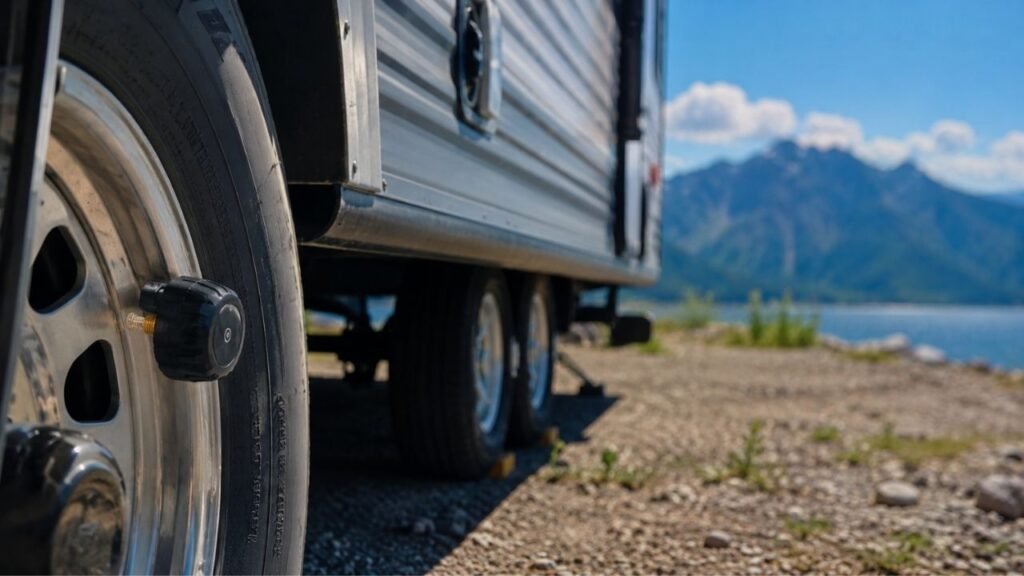
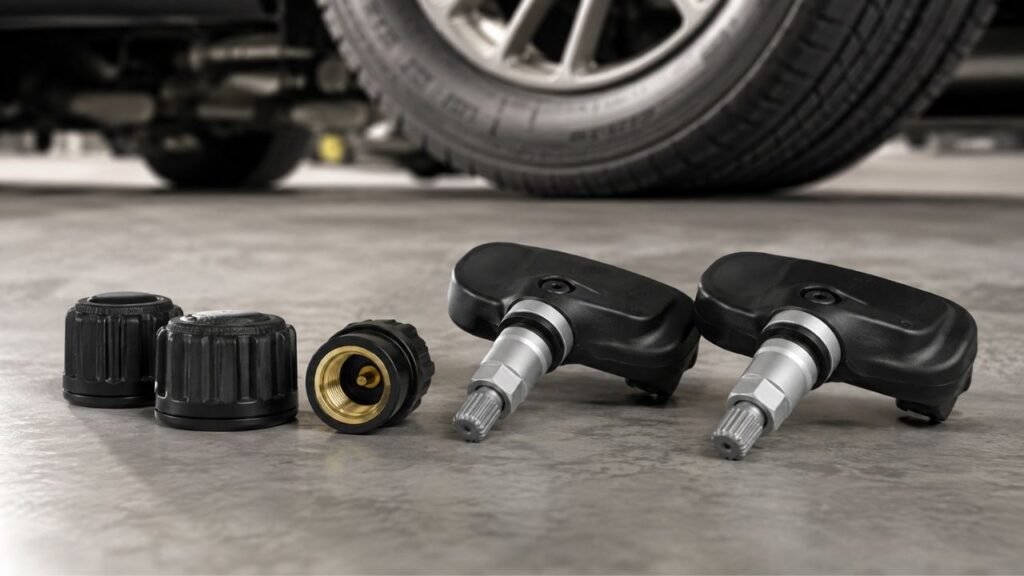
External RV TPMS sensors attach to the outside of the tire valve stem, while internal sensors sit inside the tire or wheel assembly. External sensors are easier to install, maintain, and move between vehicles. Internal sensors require more installation work but stay protected from weather, road debris, and theft.
Both designs can provide reliable tire-pressure monitoring when properly installed. Below, I’ll compare installation, accuracy, temperature readings, batteries, valve stems, dually wheels, maintenance, cost, and which sensor type makes more sense for different RV setups.
Key Takeaways
- External TPMS sensors are usually easier for RV owners to install and maintain.
- Internal sensors require tire removal but remain protected inside the wheel.
- Quality external and internal sensors can both provide dependable pressure readings.
- Internal sensors generally provide a better picture of temperature inside the tire.
- External sensor weight and valve-stem compatibility need careful consideration.
- Flow-through external sensors are different from smaller cap-style sensors.
- Your RV type, wheels, maintenance preferences, and travel habits should guide the choice.
External vs Internal RV TPMS Sensors: Quick Comparison
Both types monitor tire conditions, but the ownership experience can be quite different. This table gives you the major differences before we look at each one more closely.
| Feature | External RV TPMS Sensors | Internal RV TPMS Sensors |
| Sensor location | Outside tire on valve stem | Inside tire or wheel |
| Installation | Usually DIY | Tire service normally required |
| Tire removal | No | Yes |
| Wheel balancing | Usually unnecessary | Usually handled during installation |
| Battery access | Easy on replaceable-battery models | More difficult |
| Pressure monitoring | Very good with quality sensors | Very good |
| Temperature monitoring | Influenced more by outside airflow | Better represents internal tire conditions |
| Weather exposure | Exposed | Protected |
| Theft risk | Possible | Very low |
| Road-debris exposure | Higher | Very low |
| Transfer between RVs | Easy | Difficult |
| Adding air | Depends on sensor design | Normal valve access |
| Valve-stem considerations | Important | Depends on internal sensor design |
| Best advantage | Convenience | Protection |
| Best use | Easy aftermarket installation | Permanent installation |
What Is an External RV TPMS Sensor?
An external RV TPMS sensor replaces or attaches to the tire’s normal valve cap. It reads pressure through the valve stem and sends that information wirelessly to the TPMS monitor. There are two common external designs worth understanding.
Cap-Style External Sensors
A cap sensor is the smaller external option. You screw it onto the valve stem in place of the normal valve cap.
These sensors are popular on travel trailers, fifth wheels, motorhomes, and tow vehicles because installation is simple. You can usually install an entire set without removing a tire or visiting a tire shop.
The main inconvenience is inflation. With many cap-style sensors, you have to remove the sensor before adding air.
Because cap sensors are relatively small and light, some manufacturers allow certain models to be used with suitable rubber valve stems. Others recommend or require metal stems. Always follow the requirements for the exact sensor you purchase.
Flow-Through External Sensors
Flow-through sensors also attach to the outside of the valve stem, but they allow you to add or remove air through the sensor.
They can be useful if you regularly adjust tire pressure because you don’t have to remove every sensor whenever you need air.
However, flow-through sensors are usually larger and heavier than cap sensors. That extra weight makes valve-stem strength more important.
Before installing flow-through sensors, check:
- Whether metal valve stems are required.
- Whether the stems can support the sensor’s weight.
- Whether the sensor clears the wheel opening.
- Whether the sensor is accessible on dual rear wheels.
- Whether valve extensions are approved for the setup.
If easy inflation matters to you, flow-through sensors can be convenient. Just don’t assume they can be attached safely to every valve stem.
What Is an Internal RV TPMS Sensor?
An internal TPMS sensor sits inside the wheel and tire rather than on the exposed end of the valve stem. This keeps the electronics protected and creates a cleaner permanent installation. Internal RV systems generally use valve-mounted or band-mounted designs.
Valve-Mounted Internal Sensors
A valve-mounted internal sensor installs inside the wheel and is connected to a dedicated valve-stem assembly.
Installing one normally requires breaking the tire bead or removing the tire from the wheel. The technician installs the sensor, remounts the tire, and checks wheel balance afterward.
Once installed, there is almost nothing visible outside the wheel except the normal valve stem.
Banded Internal Sensors
Some internal systems use a sensor secured to the wheel with a band rather than attaching the sensor directly to the valve stem.
The sensor still sits inside the tire, so tire removal is necessary for installation or replacement.
The specific installation method varies between systems, which is why you should check how the sensors mount before buying an internal kit.
External vs Internal RV TPMS Sensors: The Important Differences
The physical location of the sensor affects more than appearance. It changes installation, maintenance, temperature monitoring, inflation convenience, and how easily you can move the system to another RV.
Installation
External sensors are the obvious winner if easy installation matters.
With a typical cap-style system, you program or pair the sensors, screw them onto the valve stems, set your alerts, and verify that the monitor receives each wheel.
There is no reason to dismount the tire.
Internal sensors require considerably more work. The tire must normally be removed or partially dismounted so the sensor can be installed inside the wheel.
That usually makes a tire shop the practical choice.
If you’re already replacing your RV tires, however, internal sensor installation becomes more attractive. The tires are already being removed, so much of the inconvenience is eliminated.
Installation and Long-Term Cost
External sensors usually have the lower installation cost because you can handle the job yourself.
You may still need to spend money upgrading valve stems, particularly when installing heavier external sensors.
Internal sensors involve additional tire-service labor. Depending on the wheel and sensor design, the job may include tire removal, installation, remounting, and balancing.
Long-term costs work differently too.
An external sensor with a replaceable battery may only require an inexpensive battery and a few minutes of your time.
When an internal sensor or its sealed battery eventually reaches the end of its service life, accessing it usually means opening the tire again.
That doesn’t automatically make internal sensors expensive. It simply means maintenance is less convenient.
Pressure Accuracy
You may see claims that internal sensors are always more accurate. I wouldn’t choose between the two based on that statement alone.
Both external and internal direct TPMS sensors can provide useful pressure measurements when the system is well designed.
The purpose of your RV TPMS isn’t to replace every manual pressure check. Its main job is to warn you when pressure moves outside the safe range you’ve established.
For normal RV use, factors such as sensor quality, calibration, installation, and the alert settings you choose can matter more than whether the pressure sensor sits inside or outside the tire.
When setting your cold tire pressure, I still recommend checking it with a dependable tire-pressure gauge.
Use the TPMS to watch what happens after you start driving.
Temperature Monitoring
Temperature is where the location difference becomes more important.
An internal sensor sits directly inside the tire and experiences the air and heat conditions within that wheel assembly. That generally gives you a better indication of what is happening inside the tire.
An external sensor sits at the end of the valve stem.
Its temperature can be influenced by:
- Outside air.
- Road speed.
- Airflow around the wheel.
- Valve-stem material.
- Sun exposure.
- Heat transfer through the valve.
For that reason, don’t expect an external sensor’s temperature number to exactly represent the hottest temperature inside the tire.
That doesn’t make external temperature monitoring useless. A sudden or unusual increase can still give you valuable warning information.
You simply need to understand what that reading represents.
Battery Life and Replacement
This is one of the biggest maintenance differences.
Many external RV TPMS sensors use small replaceable coin-cell batteries. When the battery gets weak, you remove the sensor, replace the battery, reinstall it, and confirm the monitor reconnects.
Internal sensor batteries generally last longer, but access is harder.
Some internal batteries are sealed into the sensor. Once the battery reaches the end of its life, the sensor itself may need replacement.
That usually requires tire access again.
Battery life varies significantly between systems, so avoid choosing one based on a universal lifespan claim.
Instead, check:
- Expected sensor battery life.
- Whether the battery is replaceable.
- Replacement battery availability.
- Replacement sensor price.
- How the monitor warns you about a low sensor battery.
For someone who likes doing maintenance at home, external sensors are generally easier to live with.
Valve Stem Stress and Compatibility
This deserves more attention than it usually receives.
An external sensor adds weight to the end of the valve stem. While the weight may seem minor, that sensor moves with the stem every time the wheel rotates and travels over bumps.
A flexible rubber stem can move considerably more than a rigid metal stem.
The concern becomes greater with larger flow-through sensors because they generally add more mass and leverage.
That does not mean every external sensor will damage a rubber valve stem.
What matters is whether that particular sensor is approved for that particular stem.
Before installing external TPMS sensors, inspect:
- Valve-stem material.
- Stem condition.
- Cracks around the stem base.
- Stem pressure rating.
- Sensor weight.
- Manufacturer requirements.
- Wheel clearance.
If the TPMS manufacturer requires metal stems, don’t ignore that recommendation.
A TPMS is supposed to reduce tire-related problems, not create another weak point at the valve.
Weather, Road Debris, and Theft
External sensors live in a harsh location.
During RV travel, they may experience rain, mud, road salt, dust, temperature swings, car washes, flying gravel, and occasional contact with brush or other objects.
Quality external sensors are designed for outdoor use, but they’re still more exposed than internal sensors.
Internal sensors remain protected inside the tire. They aren’t easy to strike, remove, or steal.
This makes internal sensors attractive if you travel frequently on rough roads or simply want everything hidden.
External sensor theft is possible because the units are visible. Many systems address this with locking or anti-theft hardware.
That won’t make them impossible to remove, but it can discourage casual tampering.
Adding or Removing Air
This difference becomes surprisingly important once you actually live with the system.
With a standard cap sensor, you normally remove the sensor whenever you add air.
That isn’t a major inconvenience if your pressures rarely need adjustment.
If you’re constantly checking and adjusting several RV tires, however, removing six, eight, or ten sensors becomes repetitive.
That’s where flow-through sensors have an advantage. You can generally attach your air chuck without removing the transmitter.
Internal sensors leave the regular valve available, so inflation works much like it would without TPMS.
If convenient inflation is important, compare sensor designs rather than simply comparing external versus internal.
Moving Sensors Between Vehicles
External sensors are much easier to transfer.
Suppose you own a travel trailer today but occasionally tow a utility trailer. With a compatible system, you may be able to move or reassign external sensors between setups.
You can physically unscrew them and install them elsewhere.
Internal sensors are effectively tied to the wheel where they’re installed until the tire is opened.
If you change trailers frequently, external sensors give you much more flexibility.
Do External RV TPMS Sensors Damage Valve Stems?
External TPMS sensors do not automatically damage valve stems, but the wrong sensor and valve-stem combination can create unnecessary stress.
The important issue is movement. A sensor mounted at the tip of a flexible stem creates additional weight that moves repeatedly as the wheel spins and hits bumps.
Small cap sensors place less load on the stem than heavier flow-through designs.
This is why you shouldn’t follow a blanket rule such as “all external sensors work on rubber stems” or “all external sensors require metal stems.”
Instead, check the requirements for your exact TPMS.
If the manufacturer calls for rigid metal stems, use them. If a lightweight sensor is specifically approved for a suitable rubber stem, follow that guidance instead.
Also inspect older stems before installing anything. If a rubber stem is already dry, cracked, or weakened, adding a sensor isn’t a good idea.
External vs Internal TPMS Sensors on Dual Rear Wheels
Motorhomes with dual rear wheels create a few additional installation challenges. Both sensor types can work, but valve access and wheel clearance can influence which setup is easier.
Before choosing sensors for a dually setup, check:
- How easily you can reach the inner valve stem.
- Whether the external sensor fits through the wheel opening.
- Whether valve extensions are installed.
- How firmly those extensions are supported.
- Whether the TPMS manufacturer approves the extension setup.
- Whether you can easily inflate the inner tire afterward.
- Whether an external sensor can move or contact nearby wheel hardware.
Rigid valve hardware is often easier to manage than long unsupported flexible extensions.
If you’re already planning to replace tires or upgrade the dually valve stems, that can also be a convenient time to consider internal sensors.
Does Sensor Type Affect TPMS Signal Range?
Being internal or external does not automatically determine how far a TPMS sensor can transmit.
Signal range depends on the entire TPMS design.
Important factors include:
- Sensor transmitter strength.
- Receiver quality.
- RV length.
- Distance from the rear axle to the monitor.
- Tow vehicle length.
- Trailer construction.
- Metal walls and compartments.
- Monitor placement.
- Repeater availability.
This is especially important with long fifth wheels, large motorhomes, and tow-vehicle-plus-trailer combinations.
If the rear sensors are regularly losing connection, a compatible repeater can help strengthen communication.
Don’t choose external sensors merely because someone says they “support repeaters.” Repeater compatibility is usually a feature of the TPMS system itself.
Check the complete system specifications.
Which Is Better: External or Internal RV TPMS Sensors?
There isn’t one winner for every RV. The better choice depends on the wheels you’re monitoring, how much maintenance you want to handle yourself, and whether convenience or protection matters more.
For Most Travel Trailers
External cap sensors make sense for many travel trailer owners.
They’re easy to install, simple to replace, and can usually be maintained without removing the tires.
Just confirm that your valve stems are suitable for the sensors.
A signal repeater may also be worth considering on longer trailer combinations.
For Fifth Wheels
External sensors are also a practical choice for many fifth wheels.
You may be monitoring four, six, or more trailer tires, so easy battery replacement and sensor servicing become valuable.
Because fifth wheels can create a long distance between the monitor and rear tires, pay close attention to signal performance and repeater support.
For Class A Motorhomes
Both designs can work well on a Class A.
External sensors are easier to service and can be particularly convenient when using flow-through models.
Internal sensors provide a clean installation and remain protected inside the wheel.
Dual rear wheels, valve-stem accessibility, tire pressure range, and maintenance preferences may ultimately determine the better option.
For Class C Motorhomes
External cap sensors offer an easy aftermarket solution for many Class C motorhomes.
The main challenge is usually the rear dual wheels.
Before buying, inspect the inner and outer valve-stem positions and make sure the sensors will remain accessible.
If the current valve arrangement is awkward, upgrading the valve hardware may make the entire system easier to use.
For RVers Replacing Their Tires Soon
This is one situation where internal sensors deserve serious consideration.
If the tires are already coming off the wheels, much of the installation disadvantage disappears.
You can have the sensors installed while the tires are being mounted and balanced.
If you prefer a permanent setup and don’t expect to move the system to another RV, this can be a sensible time to go internal.
For Owners Who Switch Trailers
External sensors are usually the easier choice.
You can remove them, reassign their positions, and install them on another compatible vehicle.
That flexibility can be valuable if you tow different trailers during the year.
For Maximum Protection From Weather or Tampering
Internal sensors have the advantage.
They aren’t sitting outside the wheel where dirt, road debris, weather, or someone with curious hands can reach them.
If you want a permanent system with almost no visible hardware, internal sensors are hard to beat.
External Sensors vs Internal Sensors: Pros and Cons
Neither design is perfect. Looking at the strengths and weaknesses together makes the trade-offs easier to see.
| Category | External Sensors | Internal Sensors |
| Biggest advantage | Easy installation and maintenance | Protected permanent installation |
| Biggest drawback | Exposed sensor and valve-stem concerns | Tire service required |
| DIY installation | Excellent | Poor |
| Battery access | Easy on many models | Difficult |
| Pressure monitoring | Excellent with a quality system | Excellent |
| Temperature indication | Less representative of internal tire heat | Better internal temperature indication |
| Weather protection | Lower | Excellent |
| Theft protection | Moderate | Excellent |
| Inflation convenience | Depends on cap or flow-through design | Excellent |
| Transferability | Excellent | Poor |
| Valve-stem considerations | Very important | Installation-specific |
| Best for frequent tire changes | Excellent | Less convenient |
| Best for permanent installation | Good | Excellent |
What Matters More Than External vs Internal Sensor Location?
Sensor location is only one part of choosing an RV TPMS. A great sensor attached in the right place isn’t very useful if the rest of the system doesn’t meet your RV’s needs.
Before buying, compare:
- Maximum supported tire pressure.
- Pressure accuracy specifications.
- Number of supported sensors.
- High-pressure alert settings.
- Low-pressure alert settings.
- High-temperature alerts.
- Rapid pressure-loss warnings.
- Sensor update frequency.
- Tow vehicle and trailer monitoring support.
- Signal repeater compatibility.
- Battery availability.
- Replacement sensor cost.
- Waterproofing.
- Monitor readability.
- Valve-stem requirements.
- Customer support.
- Warranty coverage.
Pay particular attention to maximum pressure.
A TPMS designed for a small passenger vehicle may not have the pressure range required for a large motorhome or heavy trailer tire.
You should also think about how many wheels you may monitor later.
For example, you might start with four trailer tires but eventually want to add the tow vehicle and spare tire. Choosing a system with room to expand can save you from replacing everything later.
Does TPMS Sensor Type Change the Correct RV Tire Pressure?
No. Installing an internal or external TPMS sensor does not change the correct inflation pressure for your RV tires.
Your proper cold tire pressure should be based on the RV manufacturer’s requirements, tire information, axle loads, and appropriate tire load-and-inflation guidance.
Don’t change inflation pressure merely because a TPMS reading looks different from another device.
When checking your tires, start with them cold.
Use a dependable pressure gauge to confirm inflation, and then use the TPMS to monitor changes while traveling.
Also remember that a TPMS doesn’t replace normal tire inspections.
You should still check for:
- Sidewall cracking.
- Bulges.
- Tread damage.
- Uneven wear.
- Valve-stem problems.
- Embedded objects.
- Unusual tire aging.
Think of the TPMS as an early-warning system rather than a substitute for basic tire care.
Final Verdict
For most RV owners adding an aftermarket TPMS, external sensors offer the easiest combination of installation, maintenance, battery replacement, and flexibility. That’s particularly true for travel trailers, fifth wheels, and owners who prefer handling simple maintenance themselves.
Internal sensors make more sense when you want a permanent installation, maximum protection from road exposure, a cleaner wheel appearance, and temperature readings that better reflect conditions inside the tire. They become especially appealing when you’re already replacing your RV tires.
The best choice isn’t simply external or internal. Match the sensor to your tire pressure, valve stems, wheel design, RV length, maintenance preferences, and the features of the entire monitoring system.
Related FAQs
Are External RV TPMS Sensors as Accurate as Internal Sensors?
Quality external and internal sensors can both provide dependable pressure readings for RV monitoring. Internal sensors have an advantage when measuring tire temperature because they sit inside the tire, while external temperature readings are more influenced by the valve stem and outside airflow.
Do External TPMS Sensors Need Metal Valve Stems?
Not every external sensor requires a metal valve stem. Some lightweight cap sensors may be approved for suitable rubber stems, while heavier flow-through sensors commonly require rigid metal stems. Always follow the requirements for your exact TPMS sensor.
Can External TPMS Sensors Damage Rubber Valve Stems?
They can place additional stress on flexible rubber stems, particularly if the sensor is heavy or the stem is old. Lightweight sensors approved by their manufacturer may be suitable for certain rubber stems, but damaged, cracked, or incompatible stems should be replaced before installation.
Can You Add Air With an External TPMS Sensor Installed?
It depends on the sensor. Most cap-style external sensors must be removed before adding air, while flow-through sensors are designed to let you inflate the tire without removing the transmitter.
How Long Do External RV TPMS Sensor Batteries Last?
Battery life varies by manufacturer, sensor design, travel frequency, temperature, and usage. Many external RV sensors use replaceable coin-cell batteries, making battery replacement relatively inexpensive and easy to handle yourself.
How Long Do Internal TPMS Sensors Last?
Internal TPMS sensors can operate for several years before their batteries or electronics need replacement, but lifespan varies by model. Because many internal sensors use sealed batteries, accessing or replacing them normally requires opening the tire.
Do Internal TPMS Sensors Require Tire Rebalancing?
Installing an internal sensor changes components inside the wheel, so the wheel is normally checked and balanced as part of professional installation. The exact procedure depends on the sensor, wheel, and tire-shop requirements.
Can You Use External TPMS Sensors on Dually Wheels?
Yes, external TPMS sensors can work on dual rear wheels when valve access and clearance are adequate. Check inner-wheel accessibility, valve extensions, sensor weight, and the manufacturer’s valve-stem requirements before installing them.
Do You Need a TPMS Signal Booster for an RV?
Not every RV needs one. Longer motorhomes, fifth wheels, and tow-vehicle-and-trailer combinations are more likely to benefit from a repeater because the rear sensors sit farther from the monitor and the RV structure may weaken the signal.
Can Internal and External TPMS Sensors Work on the Same Monitor?
Some TPMS systems support multiple sensor styles, while others accept only one specific type. Compatibility depends on the brand, communication protocol, and monitor, so verify supported sensor types before mixing them.
Will My Tow Vehicle’s Factory TPMS Monitor My Travel Trailer?
Usually not unless the vehicle has a dedicated trailer TPMS feature designed for compatible trailer sensors. A standard factory TPMS normally monitors only the tires paired with that vehicle, so many travel trailers need a separate aftermarket system.
Can Tire Sealant Damage an Internal TPMS Sensor?
Some tire sealants and repair compounds can coat or interfere with internal TPMS components. If you use tire sealant, check both the sealant manufacturer’s and TPMS manufacturer’s compatibility guidance before putting it inside the tire.

Ethan Walker writes about travel routes, outdoor exploration, and road-based adventures. His guides focus on simple planning, dependable gear, and realistic travel advice. He values comfort, safety, and practical experience over hype.