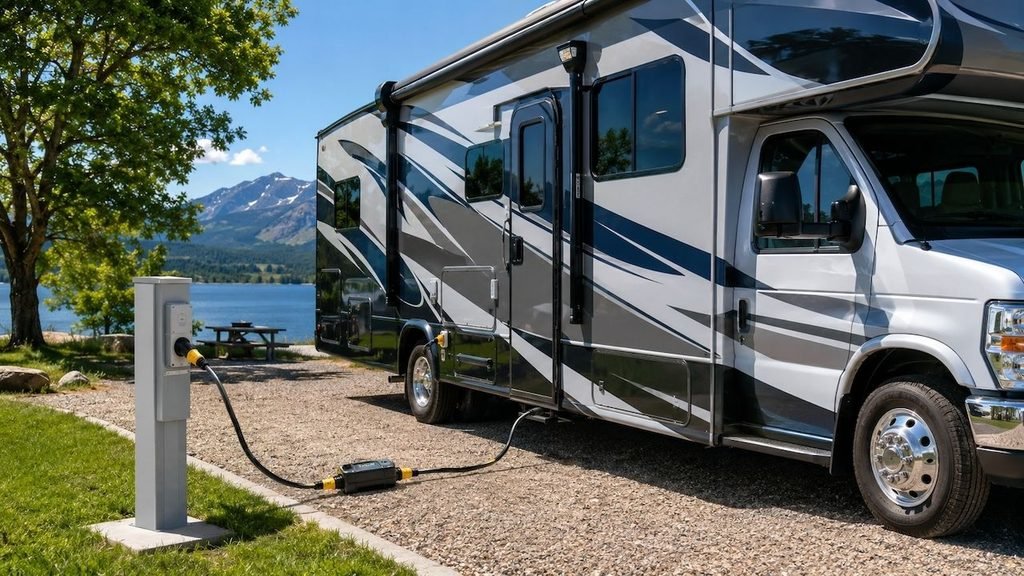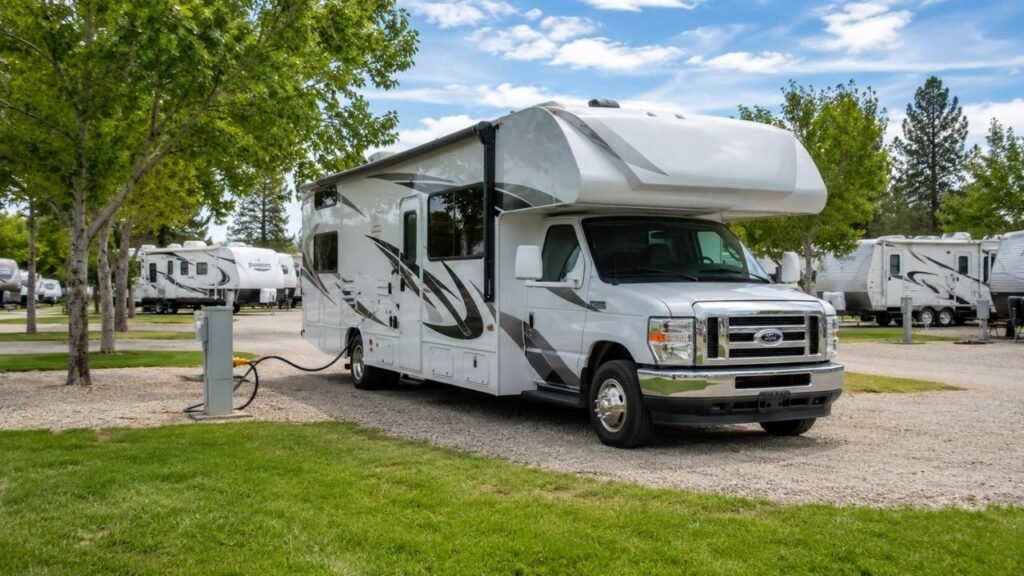
RV surge protector error codes tell you that your RV’s incoming electrical power is normal, unsafe, unstable, or improperly wired. Depending on your surge protector or electrical management system, a code may warn about low voltage, high voltage, reverse polarity, an open ground, frequency problems, or a damaged surge protection module.
In this guide, I’ll explain the common RV surge protector error codes, what each one means, which problems are dangerous, and what you should do before reconnecting your RV. I’ll also cover Progressive Industries codes, previous-error codes, generator-related faults, and some common situations where your protector shows an error even though nothing seems wrong.
Key Takeaways
- RV surge protector error codes usually warn about incoming power problems.
- Error numbers are not standardized across every surge protector brand.
- Progressive Industries commonly uses E0 through E10 error codes.
- E1 usually means reverse polarity on compatible Progressive EMS units.
- E2 usually indicates an open ground on Progressive models.
- E3 and E4 indicate high or low voltage on Line 1.
- E5 and E6 apply to Line 2 on compatible 50-amp EMS systems.
- PE codes identify a previous fault that caused the EMS to disconnect power.
- Never bypass an EMS simply because it refuses campground power.
- Always confirm an unfamiliar code using your exact surge protector model.
What Do RV Surge Protector Error Codes Mean?
An RV surge protector error code is basically your electrical protection system telling you what it detected before allowing electricity into your RV.
A basic surge protector mainly absorbs damaging voltage spikes. A more advanced electrical management system, often called an EMS or EPO system, can continuously monitor incoming shore power and shut it off when something becomes unsafe.
Depending on the model, the protector may monitor voltage, grounding, polarity, frequency, neutral wiring, current draw, receptacle temperature, and internal surge protection.
The important thing to remember is that seeing an error code does not automatically mean your surge protector has failed.
In many cases, the protector is actually working correctly because it has detected a problem at the campground pedestal, generator, extension cord, or another part of the incoming power source.
You should also avoid assuming that one error-code chart applies to every brand. An E1 code on one manufacturer’s protector may mean something completely different on another unit.
RV Surge Protector Error Codes at a Glance
The table below covers the common Progressive Industries EMS error-code system. Other manufacturers may use different numbers, words, warning lights, or app notifications.
| Error Code | Common Meaning | What Usually Causes It | What You Should Do |
| E0 | Normal operation | Incoming power is acceptable | No electrical fault detected |
| E1 | Reverse polarity | Hot and neutral wires reversed | Disconnect and report the pedestal |
| E2 | Open ground | Missing or ineffective ground connection | Do not bypass the protection |
| E3 | Line 1 high voltage | Voltage exceeds about 132 volts | Wait for voltage to normalize or change source |
| E4 | Line 1 low voltage | Voltage drops below about 104 volts | Reduce loads or use another pedestal |
| E5 | Line 2 high voltage | High voltage on the second 50-amp leg | Disconnect until power improves |
| E6 | Line 2 low voltage | Low voltage on the second 50-amp leg | Reduce demand or change power source |
| E7 | High frequency | AC frequency exceeds the acceptable range | Check generator or incoming power |
| E8 | Low frequency | AC frequency falls below the acceptable range | Check generator or incoming power |
| E9 | Data link down | Communication problem inside compatible EMS systems | Check display, wiring, or manufacturer guidance |
| E10 | Surge protection needs service | Surge module has been damaged or depleted | Service or replace the required component |
| PE Code | Previous error | Earlier fault caused a shutdown | Read the number following PE |
These codes are especially common on Progressive Industries electrical management systems. If you use another brand, confirm the meaning before troubleshooting.
What Each Progressive Industries RV Surge Protector Error Code Means
Progressive Industries is one of the RV electrical protection brands most closely associated with E0 through E10 codes. These explanations can help you understand what the EMS is seeing and what you should do next.
E0 – Normal Operating Condition
E0 means the incoming electrical conditions are within the EMS operating limits.
In other words, your surge protector is not currently detecting reverse polarity, open ground, unsafe voltage, or another monitored fault.
However, don’t assume electricity must immediately be flowing into your RV just because you see E0.
Many EMS units have a built-in startup or reconnect delay. The protector may spend a short period checking the power source before energizing your RV.
If the display shows E0 but you still have no electricity after the normal delay, check the pedestal breaker, shore-power connection, RV main breaker, and other downstream electrical components.
E1 – Reverse Polarity
An E1 code on a compatible Progressive Industries EMS usually means reverse polarity.
Reverse polarity happens when the hot and neutral conductors at the power source are wired incorrectly.
This is not something I recommend ignoring or trying to work around.
Your EMS normally prevents power from entering the RV because incorrectly wired shore power can create a serious electrical hazard.
If you get E1 at a campground pedestal, disconnect from that pedestal and notify campground management.
If another properly wired pedestal works normally, that strongly suggests the original power source needs inspection.
Don’t open or rewire a campground pedestal yourself unless you are specifically qualified and authorized to perform that electrical work.
E2 – Open Ground
E2 usually indicates an open-ground condition on compatible Progressive Industries systems.
The ground conductor provides an important safety path if electricity reaches something it should not. When the EMS cannot detect a proper grounding connection, it may refuse to energize the RV.
At a campground, an open-ground error can point to damaged wiring, a poorly connected pedestal, an adapter problem, or another shore-power issue.
You should not defeat the EMS simply to make the electricity come on.
There is one important exception worth understanding. Some portable generators use a floating-neutral electrical design, and certain RV protection systems may interpret that arrangement as an open-ground condition.
That does not automatically mean your generator is defective.
When a generator causes E2 but campground power does not, check the electrical design and approved grounding or bonding instructions for both your generator and EMS.
Never make homemade grounding modifications unless the equipment manufacturer specifically approves them.
E3 – Line 1 High Voltage
E3 means the voltage on Line 1 has climbed above the acceptable operating range.
On many Progressive Industries EMS models, shutdown occurs when voltage rises above approximately 132 volts.
High voltage can damage sensitive electronics, converter components, appliances, circuit boards, televisions, chargers, and other equipment inside your RV.
When an EMS detects high voltage, disconnecting the RV is exactly what you want it to do.
You generally cannot fix campground high voltage from inside the RV.
Wait for the voltage to return to an acceptable range or ask campground management whether another pedestal is available.
If the error occurs while using a generator, check the generator before reconnecting the RV.
E4 – Line 1 Low Voltage
E4 indicates that Line 1 voltage has fallen below the safe operating range.
Many Progressive EMS systems disconnect at approximately 104 volts.
Low voltage is especially common at busy campgrounds during hot weather when many RV owners are running air conditioners simultaneously.
You might notice the voltage looking reasonable until your air conditioner, microwave, water heater, or another high-draw appliance starts.
The added load can pull already weak incoming voltage below the EMS cutoff point.
Long or undersized extension cords can also contribute to voltage drop.
Low voltage should not be treated as a harmless inconvenience. Motors and compressors may draw more current and operate hotter when voltage becomes too low.
If you’re getting E4 repeatedly, turn off major loads and see whether the voltage improves.
If the problem continues, try a different properly wired pedestal or talk with campground management.
E5 – Line 2 High Voltage
E5 normally means Line 2 voltage is too high on compatible 50-amp Progressive EMS systems.
A 50-amp RV electrical connection provides two 120-volt hot legs. That allows the EMS to monitor Line 1 and Line 2 independently.
If only Line 2 exceeds the acceptable voltage limit, the system may report E5.
You generally won’t encounter this code on a standard 30-amp Progressive EMS because 30-amp service only provides one 120-volt hot leg.
Treat E5 just as seriously as high voltage on Line 1.
Disconnect or allow the EMS to remain disconnected until the incoming voltage becomes acceptable.
E6 – Line 2 Low Voltage
E6 means voltage on Line 2 has dropped below the safe range on a compatible 50-amp EMS.
This can happen when campground electrical demand is high or when one leg of the pedestal supply is performing poorly.
Some appliances in the RV may appear unaffected because they are connected to the other electrical leg.
That can make a Line 2 problem confusing if you are not watching the EMS display.
Don’t assume the system is malfunctioning because only part of the electrical supply looks abnormal.
If E6 continues appearing, reduce electrical demand and test another campground pedestal if one is available.
E7 – AC Frequency Too High
E7 indicates that the frequency of the incoming AC electricity is too high.
In the United States, normal AC power operates at approximately 60 Hz.
Compatible Progressive systems generally monitor frequency and disconnect when it moves significantly outside the expected range.
A campground utility connection is usually very stable in frequency, so frequency errors are particularly useful when diagnosing generator problems.
If E7 appears while using a portable generator, stop powering the RV and investigate the generator output.
A generator running at an incorrect speed or experiencing a control problem can produce unstable frequency.
E8 – AC Frequency Too Low
E8 means the incoming AC frequency has dropped below the EMS operating range.
Like E7, this problem may be more likely when the RV is connected to a generator rather than normal utility shore power.
An overloaded generator can struggle to maintain the proper engine speed and output frequency.
Try shutting off large RV loads and observe whether the generator stabilizes.
If the low-frequency condition continues, disconnect the RV and troubleshoot the generator rather than bypassing the EMS.
E9 – Data Link Down
E9 generally indicates a communication problem between parts of an applicable Progressive EMS system.
For example, an internal EMS module and remote display may no longer be communicating correctly.
This code does not necessarily indicate unsafe campground voltage.
The appropriate troubleshooting also depends heavily on your exact model.
Check remote-display wiring, connectors, and your manufacturer’s troubleshooting instructions before assuming the complete surge protector needs replacement.
Portable and permanently installed EMS models can behave differently, so model identification becomes especially important with E9.
E10 – Surge Protection Needs Service
E10 generally indicates a problem with the surge-protection portion of the EMS itself.
Surge protectors commonly use components designed to absorb short electrical spikes. Those components can eventually become damaged or depleted after exposure to electrical events.
That means the device may no longer provide the same level of surge protection.
However, E10 does not always mean you must throw away the entire EMS.
Some products have replaceable or serviceable surge-protection components.
Check your exact model before deciding whether you need a replacement module, factory service, or a completely new protector.
What Does a PE Error Code Mean on an RV Surge Protector?
A PE code usually means Previous Error on compatible Progressive Industries EMS systems. This feature is extremely helpful when your RV loses power temporarily but electricity returns before you can check the display.
For example:
- PE1 means the previous fault was reverse polarity.
- PE2 means a previous open-ground fault.
- PE3 means a previous Line 1 high-voltage event.
- PE4 means a previous Line 1 low-voltage event.
- PE5 means a previous Line 2 high-voltage event.
- PE6 means a previous Line 2 low-voltage event.
Imagine your campground voltage drops overnight.
The EMS disconnects your RV at 103 volts and records PE4.
A few minutes later, campground demand decreases and the voltage returns to 118 volts. Your EMS reconnects the RV.
When you finally look at the display, current power may appear completely normal.
Without the PE4 record, you might never know why the RV temporarily lost electricity.
That makes previous-error codes especially useful for diagnosing intermittent campground power.
Why RV Surge Protector Error Codes Are Not the Same Across Every Brand
RV electrical faults are broadly similar, but manufacturers don’t use one universal error-code standard. Before acting on any code, identify the exact brand and model installed on your RV.
Progressive Industries
Progressive Industries EMS units commonly use numbered codes such as E0, E1, E2, and E4.
Many also store previous events using PE codes.
Their displays may cycle through voltage, frequency, amperage, and error information depending on the model.
On compatible 50-amp versions, separate codes can identify problems with Line 1 and Line 2.
Southwire Surge Guard
Southwire Surge Guard products may display electrical problems differently.
Instead of relying entirely on E-numbers, some models use plain-language warnings such as open ground, reverse polarity, high voltage, low voltage, overheating, or replace-surge warnings.
Their exact voltage thresholds may also differ from those used by Progressive Industries.
This is why searching only for “E4 RV surge protector” without identifying the manufacturer can lead to the wrong diagnosis.
Hughes Power Watchdog
Hughes Power Watchdog models may communicate electrical conditions through the device display, lights, Bluetooth-connected app, or other indicators depending on the model.
Certain EPO versions can automatically disconnect unsafe incoming electricity and reconnect when conditions return to an acceptable range.
Some models also use replaceable surge-protection components.
Again, don’t interpret a Hughes warning using a Progressive Industries E-code chart.
Other Digital RV Surge Protectors
Many generic and lower-cost digital RV surge protectors also display E1, E2, E3, and similar codes.
The problem is that those numbers may represent completely different conditions.
One manufacturer might use E1 for reverse polarity while another uses E1 for low voltage.
Whenever you’re dealing with an unfamiliar protector, use this simple rule:
Match the error code to the exact brand and model before troubleshooting.
That one step can prevent a lot of unnecessary confusion.
Which RV Surge Protector Errors Mean You Should Disconnect Immediately?
Some electrical problems deserve more caution than others. If your EMS has already disconnected the RV, don’t bypass it until you understand what caused the shutdown.
Problems I would treat seriously include:
- Reverse polarity: The shore-power source may be wired incorrectly.
- Open ground: The normal grounding safety path may be missing.
- Open neutral: A damaged neutral can create dangerous voltage conditions.
- High voltage: Excessive voltage can damage RV electronics and appliances.
- Severe low voltage: Air conditioners and motors may run hotter or fail.
- Voltage on ground: Electricity may be present where it should never appear.
- Overheated plug or receptacle: Excessive heat can indicate a loose or failing connection.
- Repeated unstable voltage: Frequent changes can point to poor campground electrical conditions.
- Burning smell or visible damage: Disconnect the RV immediately and get qualified help.
Your EMS refusing to energize the RV can be frustrating, especially after a long travel day.
But don’t treat the protection system as the problem until you’ve confirmed the incoming electricity is actually safe.
What Should You Do When Your RV Surge Protector Shows an Error Code?
When an error appears, work through the problem methodically instead of repeatedly unplugging and reconnecting everything.
- Read the exact error code. Write it down or take a photo before it disappears.
- Check the displayed voltage and frequency. These readings can help explain low-voltage, high-voltage, or generator faults.
- Identify the surge protector brand and model. Don’t use another manufacturer’s error-code definitions.
- Turn off large RV loads. Shut down the air conditioner, microwave, electric water heater, and other heavy loads.
- Let the EMS complete its normal delay. Some protectors intentionally wait before reconnecting.
- Try another known-good pedestal if available. If the error disappears, the original pedestal becomes the likely suspect.
- Report campground electrical problems. Let campground staff inspect their equipment.
- Check adapters and shore cords. Loose, overheated, damaged, or poorly fitting connections can create electrical problems.
- Watch for repeat faults. A PE code or repeated shutdown pattern can reveal intermittent voltage problems.
- Get qualified help when necessary. If the same problem appears on multiple known-good power sources, the RV, cord, EMS, or transfer equipment may need further inspection.
I don’t recommend probing an energized campground pedestal unless you are comfortable and qualified to work around 120/240-volt electrical systems.
Why Does My RV Surge Protector Error Keep Appearing and Disappearing?
Intermittent EMS errors are common because campground electrical conditions can change from minute to minute. The following situations often explain why your protector disconnects and later restores power.
Campground Voltage Drops Under Heavy Demand
Campground voltage can sag when many RV owners use high-draw appliances simultaneously.
Hot afternoons are a classic example.
Hundreds of air conditioners can place a much larger load on campground electrical infrastructure than the same park experiences overnight.
Your voltage might measure 118 volts early in the morning and fall close to the EMS cutoff level later that afternoon.
If voltage falls too far, the EMS disconnects your RV.
Once demand decreases, voltage rises and the EMS may automatically reconnect.
Your RV Load Pulls Voltage Down
Sometimes the campground supply is already borderline.
Your RV may appear fine until a heavy appliance starts.
Common high-load equipment includes:
- Rooftop air conditioners
- Electric water heaters
- Microwaves
- Space heaters
- Residential refrigerators
- Hair dryers
- Electric cooking appliances
Turning off major appliances one at a time can help you determine whether your own load is contributing to the voltage drop.
A Long Extension Cord Causes Voltage Drop
Extension cords add electrical resistance.
The longer the cable and the smaller its wire gauge, the more voltage can drop under load.
This becomes especially noticeable when running an air conditioner or another high-amperage appliance.
Avoid using lightweight household extension cords for RV shore power.
Use cables, adapters, and connectors rated appropriately for your RV electrical system.
The Protector Automatically Reconnects After Power Improves
Many EMS units are designed to disconnect automatically when incoming power becomes unsafe.
When the electrical condition returns to the acceptable range, the protector waits through its programmed delay and reconnects.
This can create a confusing sequence:
Your RV loses power.
You walk outside.
The electrical problem disappears.
Your EMS reconnects.
Everything seems normal again.
This is exactly where PE or previous-error codes become useful.
Why Does My Surge Protector Show an Error When Using a Generator?
A surge protector error while using a generator does not necessarily mean the EMS or generator has failed. Generator wiring arrangements, frequency changes, and heavy loads can all cause protective shutdowns.
Floating Neutral Can Trigger an Open-Ground Error
Many portable inverter generators use what is called a floating-neutral design.
Some RV electrical management systems expect to detect a neutral-to-ground bond at the power source. When they don’t see one, they may interpret the generator supply as an open-ground condition.
This is why your EMS might show E2 on a generator while working perfectly at a campground pedestal.
Don’t modify the generator’s wiring based only on a generic internet suggestion.
Check whether your specific generator and EMS manufacturer approve a neutral-ground bonding plug or another solution.
Generator Frequency Can Trigger E7 or E8
Portable generators must maintain reasonably stable engine speed and electrical output.
If frequency becomes too high or low, the EMS may disconnect the RV.
This can happen because of:
- Generator overload
- Engine-speed problems
- Fuel-delivery problems
- Inverter/control faults
- Sudden large electrical loads
Reduce heavy RV loads and see whether generator operation stabilizes.
If frequency remains outside the acceptable range, troubleshoot the generator before reconnecting the RV.
Generator Voltage Can Drop Under Heavy RV Loads
Starting an RV air conditioner requires a significant burst of power.
If the generator is near its capacity, that starting load can pull voltage down enough to trigger the EMS.
Microwaves, electric water heaters, converters, battery chargers, and other appliances can add to the demand.
Try running fewer large appliances simultaneously.
If voltage remains too low under reasonable loads, inspect the generator rather than bypassing the surge protector.
Why Is My RV Surge Protector Blank With No Error Code?
A blank surge protector display does not always mean the unit itself is dead.
First, check whether electricity is actually reaching the protector.
Common causes include a campground pedestal breaker being off, a loose shore-power plug, a disconnected cord, a damaged adapter, or a power outage.
On some compatible EMS systems, certain wiring faults such as an open neutral may also result in no normal display.
If the protector receives confirmed power but remains completely blank, the display, communication cable, internal electronics, or EMS itself may require further troubleshooting.
Start upstream at the pedestal and work toward the RV rather than immediately replacing the protector.
Why Does My Surge Protector Say E0 but My RV Still Has No Power?
E0 usually means the EMS currently sees acceptable incoming electricity. It does not necessarily mean power should already be reaching every outlet inside the RV.
Possible reasons include:
- The EMS is still completing its startup delay.
- The pedestal breaker is not fully engaged.
- The RV main breaker has tripped.
- A shore-power connector is loose.
- The RV transfer switch has a problem.
- A downstream breaker or electrical connection has failed.
- Power recently returned after an earlier error.
- The protector display is functioning while another RV electrical component is not.
Give the EMS enough time to finish its normal reconnect cycle.
If E0 remains displayed but the RV still has no 120-volt power, troubleshoot the electrical system downstream from the protector.
30-Amp vs 50-Amp RV Surge Protector Error Codes
The biggest difference between 30-amp and 50-amp error reporting is the number of electrical legs being monitored. That is why certain Line 2 errors only appear on compatible 50-amp systems.
| Feature | 30-Amp RV Service | 50-Amp RV Service |
| Hot legs monitored | One | Two |
| Nominal voltage to neutral | About 120V | About 120V per leg |
| Line 1 voltage errors | Yes | Yes |
| Line 2 E5/E6 errors | No | Yes on compatible Progressive EMS |
| Separate leg monitoring | No | Yes |
| Model-specific code chart needed | Yes | Yes |
A 30-amp RV connection provides one 120-volt hot conductor.
A 50-amp RV connection provides two 120-volt hot legs.
That is why a 50-amp EMS can report that one leg has acceptable voltage while the other does not.
If you own a 30-amp RV and see a code chart discussing Line 2, those particular codes probably don’t apply to your setup.
Does an Error Code Mean My RV Surge Protector Is Bad?
Usually, no.
Most error codes mean your protector has detected the exact electrical problem it was designed to catch.
If the EMS reports low voltage at one campground pedestal but works normally at another, the protector is probably doing its job.
I would become more suspicious of the protector itself if you notice the same unusual internal error across several verified power sources.
Potential protector-related problems include a depleted surge module, communication failure, damaged plug, failed display, internal electronics problem, or repeated error that doesn’t match confirmed incoming power.
Always rule out the pedestal, adapters, shore cord, and generator before assuming the EMS itself has failed.
Should You Reset an RV Surge Protector After an Error?
Resetting an RV surge protector does not repair the electrical condition that triggered the shutdown.
Cycling power may restart the EMS or clear certain stored information, but it cannot correct reverse polarity, a missing ground, unsafe high voltage, low campground voltage, or a damaged neutral conductor.
If the protector disconnects because incoming power is unsafe, identify the reason first.
Once the power source is corrected, many EMS units automatically retest the electricity and reconnect after their normal delay.
Repeatedly resetting or bypassing the protector without correcting the fault defeats the reason you installed electrical protection in the first place.
When Should You Contact the Campground, an Electrician, or the Manufacturer?
Knowing who should investigate the problem can save you from chasing the wrong part of your RV electrical system.
Contact Campground Management When:
- You get reverse polarity from one pedestal.
- The pedestal shows an open ground.
- Shore voltage stays unusually high or low.
- The receptacle is damaged, loose, burned, or overheated.
- Your EMS works normally at another campsite.
- Several neighboring RV owners are experiencing voltage problems.
Campground employees should inspect and repair campground electrical infrastructure.
Contact an RV Technician or Qualified Electrician When:
- The same problem happens at several verified power sources.
- Your shore-power inlet becomes excessively hot.
- You smell burning plastic or insulation.
- The RV loses power downstream from an EMS showing normal conditions.
- Your shore cord has visible heat damage.
- You suspect a transfer-switch or internal wiring problem.
Stop using damaged electrical equipment until it has been properly inspected.
Contact the Surge Protector Manufacturer When:
- You repeatedly see a communication or data-link fault.
- The unit reports that surge protection needs replacement.
- The display behaves abnormally.
- The protector refuses verified good power without a clear reason.
- You need confirmation of a generator grounding arrangement.
- You cannot match the displayed code to the owner’s documentation.
Manufacturers can also tell you whether your particular model has replaceable surge components or requires complete replacement.
Final Words
RV surge protector error codes are there to tell you something important about the electricity trying to enter your RV.
Most of the time, an error doesn’t mean your protector is causing the problem. It means the protector caught a problem before your air conditioner, converter, refrigerator, television, charger, or other electrical equipment had to deal with it.
Start by identifying your exact surge protector brand and model.
Then read the current code, check any stored previous error, and consider whether the fault appears only at one pedestal, only with a generator, or everywhere you connect.
If campground wiring or voltage is unsafe, move to another power source rather than bypassing your protection.
That little error code may be inconvenient, but it can also be the warning that saves you from a much more expensive electrical problem.
Related FAQs
Here are a few common questions RV owners have when an EMS or surge protector suddenly displays an unfamiliar code.
What Does E1 Mean on an RV Surge Protector?
E1 commonly means reverse polarity on compatible Progressive Industries EMS units, which indicates the hot and neutral connections are reversed. However, E1 is not a universal RV surge protector code, so check your exact brand and model before troubleshooting.
What Does E2 Mean on an RV Surge Protector?
E2 usually means open ground on compatible Progressive Industries systems. The EMS cannot detect a proper grounding path, so it may block incoming power. Portable generators with floating neutrals can sometimes trigger a similar warning even when the generator itself is operating normally.
What Does PE4 Mean on an RV Surge Protector?
PE4 generally means your Progressive Industries EMS previously disconnected because Line 1 voltage dropped below its acceptable range. The voltage may already be normal again when you see PE4 because PE codes store the earlier fault for troubleshooting.
Why Does My RV Surge Protector Say Low Voltage?
Low-voltage warnings can be caused by overloaded campground electrical systems, long extension cords, loose connections, undersized wiring, or large RV appliances pulling down an already weak supply. Hot afternoons at crowded RV parks are a common time for these errors to appear.
Can I Use My RV When the Surge Protector Shows an Error?
You should not bypass a surge protector or EMS when it is reporting unsafe voltage, reverse polarity, open ground, open neutral, or another serious wiring fault. Identify and correct the incoming power problem before reconnecting your RV.
Will an RV Surge Protector Reset Itself?
Many advanced RV electrical management systems automatically reconnect after incoming voltage or frequency returns to an acceptable range. The system may also wait through a built-in safety delay before restoring power, so an immediate reconnection is not always expected.
Why Does My Surge Protector Work at One Campsite but Not Another?
If the same surge protector works normally at one pedestal but reports errors at another, the campground power source is a likely cause. Differences in wiring condition, grounding, voltage, receptacle wear, and campground electrical demand can all affect EMS readings.
Can a Generator Cause an RV Surge Protector Error?
Yes. A portable generator can trigger errors because of a floating neutral, unstable voltage, incorrect frequency, or excessive load. Always check the generator manufacturer’s instructions and your EMS requirements before using bonding accessories or changing the electrical setup.
Do All RV Surge Protectors Use the Same Error Codes?
No. RV surge protector error codes are not standardized across manufacturers. Progressive Industries, Southwire Surge Guard, Hughes Power Watchdog, and generic digital protectors may all display the same electrical problem differently, so always use the code chart for your exact model.
What Does a Blank RV Surge Protector Display Mean?
A blank display can mean no electricity is reaching the protector, the pedestal breaker is off, a connection is loose, or the display has lost communication. Certain electrical faults may also prevent a normal display on some EMS models, so confirm incoming power before assuming the protector has failed.

Ethan Walker writes about travel routes, outdoor exploration, and road-based adventures. His guides focus on simple planning, dependable gear, and realistic travel advice. He values comfort, safety, and practical experience over hype.