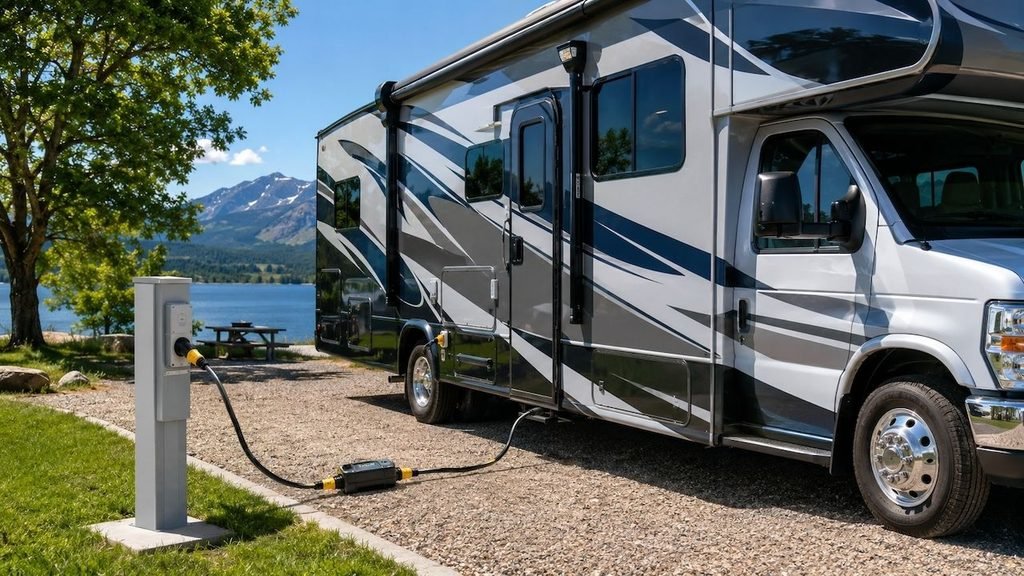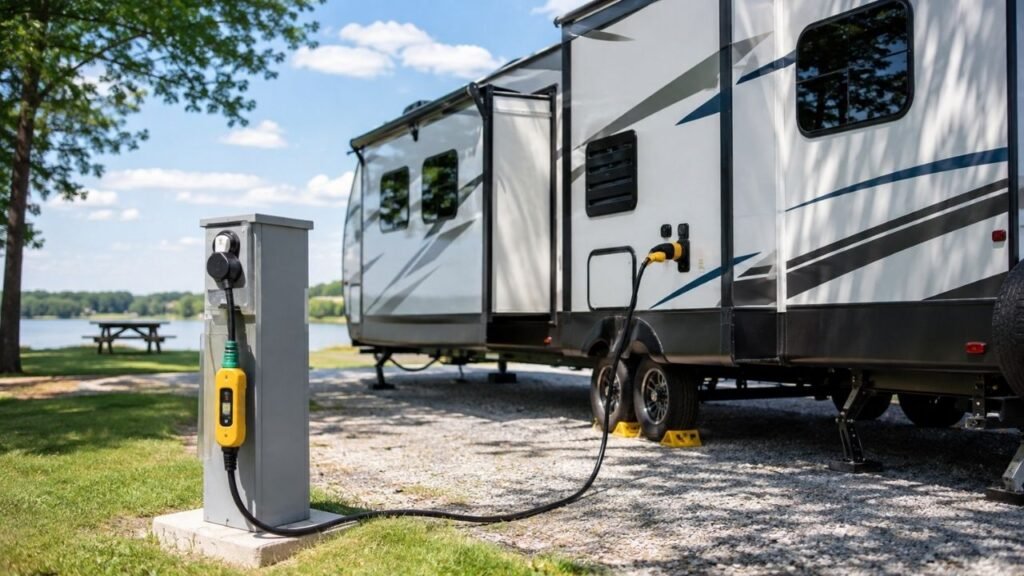
An RV surge protector mainly protects your electrical system from sudden voltage spikes, while an EMS provides broader protection by monitoring incoming shore power and disconnecting your RV when it detects unsafe conditions such as low voltage, high voltage, open ground, open neutral, or reverse polarity. A full EMS normally includes surge protection as part of the system.
The confusing part is that manufacturers do not always use these names consistently. In this guide, I’ll explain what each device actually does, which electrical problems it can handle, and how to decide which level of protection makes sense for your RV.
Key Takeaways
- A basic RV surge protector mainly protects against short electrical surges and voltage spikes.
- A full EMS usually combines surge protection with continuous shore-power monitoring.
- An EMS can automatically disconnect your RV when incoming power becomes unsafe.
- A device that detects a wiring fault does not necessarily disconnect power because of it.
- Most EMS units protect against bad voltage rather than correcting or regulating it.
- A 50-amp RV benefits from protection that monitors both incoming hot legs.
- Product names can be misleading, so compare actual protective features instead of relying only on the words “surge protector” or “EMS.”
RV Surge Protector vs EMS: The Difference at a Glance
The easiest way to understand the difference is to look at what happens when campground power goes bad. Both devices can provide useful protection, but a full EMS responds to far more electrical problems.
| Feature | Basic RV Surge Protector | Full RV EMS |
| Sudden surge protection | Yes | Yes |
| Low-voltage protection | Usually no | Yes |
| Sustained high-voltage protection | Usually no | Yes |
| Open-ground detection | Model-dependent | Usually yes |
| Open-neutral protection | Model-dependent | Usually yes |
| Reverse-polarity protection | Model-dependent | Usually yes |
| Frequency monitoring | Usually no | Model-dependent |
| Automatic power shutdown | Usually no | Yes |
| Automatic delayed reconnect | Usually no | Common |
| Voltage display | Model-dependent | Common |
| Error codes | Limited or model-dependent | Common |
| 50-amp leg monitoring | Limited | Common on 50A units |
| Corrects low voltage | No | Normally no |
| Surge components can wear out | Yes | Yes |
| Overall protection level | Basic | Comprehensive |
The biggest difference is not the display, Bluetooth connection, or number of warning lights. The most important difference is whether the device automatically prevents unsafe power from reaching your RV.
What Is an RV Surge Protector?
A basic RV surge protector is designed primarily to protect your RV from short bursts of excessive voltage.
Imagine a nearby lightning event, utility switching problem, or electrical disturbance at the campground. Voltage can briefly rise far above its normal level. That sudden surge can damage sensitive electronics inside your RV.
Most conventional surge protectors use components called metal-oxide varistors, or MOVs, to absorb or divert part of that excess electrical energy before it reaches your equipment.
You may also see a joule rating on the device. In simple terms, this indicates how much surge energy the protection circuitry is designed to absorb over its usable life.
However, this is where many RV owners misunderstand surge protection.
A basic surge protector generally does not continuously decide whether campground power is healthy enough for your RV. If the pedestal is delivering sustained low voltage, for example, the surge protector may continue passing that electricity because there is no sudden voltage spike for it to suppress.
Some modern products marketed as surge protectors include additional monitoring features, so always check the specifications instead of assuming every device works the same way.
What Is an RV Electrical Management System?
An RV Electrical Management System takes a more active approach to shore-power protection. Instead of watching mainly for transient surges, it continuously checks several characteristics of the incoming electrical supply.
A full EMS usually includes surge protection too, but its biggest advantage is its ability to disconnect your RV from unsafe shore power automatically.
It Checks Power Before Connecting Your RV
When you plug an EMS-equipped RV into a campground pedestal, the system can check the incoming electrical supply before allowing power through.
Depending on the model, it may check for:
- Low voltage
- Excessively high voltage
- Open ground
- Open neutral
- Reverse polarity
- Incorrect frequency
- Incorrect incoming voltage
- Problems on either leg of a 50-amp connection
If the source does not pass the system’s safety checks, the EMS can prevent power from reaching the RV.
That gives you a major advantage over simply plugging your shore cord into an unknown pedestal and hoping everything is wired correctly.
It Keeps Monitoring After Your RV Is Connected
A campground pedestal can test perfectly when you arrive and still develop problems later.
This happens frequently during periods of heavy electrical demand.
Suppose you plug in at noon and see perfectly normal voltage. By late afternoon, dozens of campers start running their air conditioners. Campground voltage may begin dropping as demand increases.
A full EMS keeps watching the incoming supply while your RV remains connected. If voltage eventually falls below the unit’s safe operating threshold, it can disconnect your RV.
That ongoing monitoring is one of the biggest advantages of an EMS.
It Disconnects Power When Conditions Become Unsafe
A full EMS normally contains an internal switching device that controls whether shore power is allowed into the RV.
When the EMS sees a protected fault, it opens that connection.
Your refrigerator, air conditioner, converter, television, microwave, and other equipment therefore stop receiving campground electricity until the condition becomes acceptable again.
This is very different from a simple warning light.
A warning tells you something is wrong.
An automatic disconnect prevents the unsafe source from continuing to power your RV.
It May Delay Power Before Reconnecting
Many EMS units do not restore electricity immediately after voltage returns to normal.
Instead, they wait for a short period before reconnecting the RV.
This delay is particularly useful for compressor-driven appliances such as your air conditioner. A compressor does not always respond well when power disappears and returns immediately.
The exact delay varies by manufacturer and model, so don’t assume every EMS waits the same amount of time.
What Electrical Problems Can Each One Protect Against?
Surges are only one type of electrical problem you can encounter at a campground. Understanding the other faults makes the benefit of an EMS much easier to see.
Sudden Power Surges
Both a basic surge protector and a full EMS normally provide protection against supported transient surges.
These short electrical events may result from utility switching, nearby electrical faults, or lightning-related activity.
However, no portable RV protection device should be treated as an absolute guarantee against every lightning event.
A direct or extremely severe lightning strike can contain far more energy than normal consumer surge protection is designed to handle.
Low Voltage or Brownouts
Low voltage is one of the biggest differences between basic surge protection and a full EMS.
Imagine your RV normally receives around 120 volts, but campground demand causes that voltage to fall significantly.
Your appliances may still try to operate.
Motors and compressors can struggle under poor voltage conditions, potentially creating excessive heat and stress.
A basic surge protector normally has nothing to suppress because the voltage is too low rather than suddenly too high.
A full EMS can recognize that sustained low voltage and disconnect your RV when it falls outside the device’s acceptable range.
Sustained High Voltage
A surge and sustained high voltage are not exactly the same thing.
A surge is normally a very brief spike.
Sustained high voltage means your incoming AC supply remains above the safe operating range for longer than a normal transient event.
A basic surge suppressor is primarily designed for short spikes. A full EMS also monitors the actual line voltage and can disconnect the RV if that voltage remains excessively high.
Open Ground
The grounding conductor provides an important safety path during certain electrical faults.
If a campground pedestal has an open or missing ground, the electrical system may not have the protective grounding path it should.
Some basic RV surge products can detect and display an open-ground warning.
But remember the distinction I mentioned earlier:
Detection does not always mean automatic protection.
A full EMS is designed to block or disconnect power for supported wiring faults rather than merely telling you they exist.
Open Neutral
An open neutral deserves special attention, especially on a 50-amp RV.
On a standard 50-amp RV hookup, your RV receives two 120-volt hot legs that share a neutral connection.
If that neutral connection becomes loose or opens, voltage across individual 120-volt loads can become dangerously unbalanced.
Some circuits may receive excessive voltage while others receive too little.
That can quickly become expensive.
A properly designed 50-amp EMS can monitor both legs and protect against supported neutral faults.
Reverse Polarity
Reverse polarity generally means the hot and neutral conductors have been wired incorrectly.
You should never treat this as a harmless campground quirk.
Some basic pedestal-testing devices can identify reverse polarity, while a full EMS can prevent the RV from accepting power when it detects the condition.
If your protection system reports reverse polarity, don’t bypass the warning just to get your air conditioner running. Have the pedestal checked or request another campsite.
Incorrect Frequency or Wrong Incoming Voltage
Some full electrical protection systems also monitor incoming AC frequency and dangerous voltage configurations.
These features vary considerably between models.
The important point is that you should never assume every device protects against exactly the same list of faults simply because both are described as an EMS.
Check the manufacturer’s actual protection specifications.
Detection vs Automatic Shutoff: The Feature That Matters Most
This distinction is easy to overlook when comparing RV electrical protection devices.
Some products can tell you that a problem exists without actually stopping that problem from reaching your RV.
You can roughly think of RV shore-power protection in three levels.
Level 1: Surge suppression only. The device primarily handles short transient voltage spikes.
Level 2: Surge protection plus diagnostics. The device may identify pedestal wiring problems, display voltage, or send alerts while providing limited automatic shutdown capability.
Level 3: Surge protection plus monitoring and automatic disconnection. The device continuously watches incoming power and disconnects your RV during supported unsafe conditions.
That third level is what most RV owners are really describing when they say they want an EMS.
So when comparing two devices, don’t stop at:
“Does this detect low voltage?”
Ask:
“Will it automatically disconnect my RV when low voltage occurs?”
That one question can reveal a much bigger difference between two products that look nearly identical on the shelf.
Don’t Rely on the Words “Surge Protector” or “EMS” Alone
This part of RV power protection has become unnecessarily confusing. Manufacturers use several different names for products that perform similar jobs, while completely different devices may both be advertised as surge protectors.
Some Surge Protectors Behave Like Full EMS Units
You may find a product labeled as a surge protector that includes low-voltage cutoff, high-voltage cutoff, wiring-fault detection, delayed reconnect, and automatic power shutdown.
Functionally, that device may provide the type of comprehensive protection RV owners commonly associate with an EMS.
Some manufacturers use terms such as:
- Electrical protection system
- Power protection system
- Surge Guard
- Emergency Power Off or EPO
- Smart surge protector
- Total electrical protection
The terminology is less important than the functions.
Some Smart Surge Protectors Only Monitor Power
A large display or smartphone connection can make a product look extremely advanced.
But Bluetooth does not protect your RV by itself.
Neither does Wi-Fi.
Neither does a voltage display.
Those features may help you understand what your electrical system is doing, but you still need to determine what happens when unsafe power is detected.
Does the device simply send you an alert?
Or does it disconnect the RV?
Those are very different levels of protection.
Check the Fault List and Shutoff Behavior
Before relying on any shore-power protection device, look for clear information about:
- Automatic power disconnect
- Low-voltage cutoff
- High-voltage cutoff
- Open-neutral protection
- Open-ground protection
- Reverse-polarity protection
- 50-amp L1 and L2 monitoring
- Delayed automatic reconnect
- Surge-protection status
- Error-code display
- Frequency protection, when provided
This tells you far more than the marketing name printed on the front.
Does an EMS Regulate or Fix Bad Campground Power?
No, a typical RV protection EMS does not fix poor campground electricity. It normally protects your RV by disconnecting it when incoming power moves outside the system’s acceptable range.
This distinction matters.
If campground voltage becomes too low, a conventional EMS usually does not increase that voltage back to 120 volts.
It disconnects you.
If voltage becomes too high, it normally does not reduce it.
It disconnects you.
If the pedestal has reverse polarity, the EMS does not rewire the pedestal.
It blocks the unsafe connection.
The same applies to an open neutral or open ground.
A separate device designed for voltage correction, such as an appropriate voltage booster or autoformer, performs a different job.
So think of an EMS as a gatekeeper, not a power repair system.
It decides whether the incoming electricity is acceptable enough to enter your RV.
Electrical Management System vs Energy Management System: Are They the Same?
The abbreviation EMS can mean two different things in the RV world, which creates even more confusion.
An Electrical Management System, as discussed throughout this article, protects your RV from unsafe incoming shore power.
An Energy Management System can refer to an onboard load-management system.
That second type of EMS may automatically turn certain appliances off when electrical demand becomes too high. For example, it might temporarily shed a water heater or other large load so the RV stays within the available amperage.
These two systems solve different problems.
One protects against bad incoming electricity.
The other manages how much electricity your RV is using.
Whenever you’re researching an EMS, read what the system actually does instead of relying only on the abbreviation.
Is an EMS More Important on a 50-Amp RV?
An EMS is useful for both 30-amp and 50-amp RVs. However, 50-amp electrical service adds another layer of complexity because two hot legs feed the RV instead of one.
How 30-Amp RV Power Works
A typical 30-amp RV hookup supplies:
- One 120-volt hot conductor
- One neutral
- One ground
- Up to approximately 30 amps
That gives you roughly 3,600 watts of available power under normal conditions.
An EMS can monitor the incoming 120-volt supply for unsafe voltage and supported wiring faults.
How 50-Amp RV Power Works
A standard 50-amp RV hookup supplies:
- Two 120-volt hot legs
- One neutral
- One ground
- Up to 50 amps available on each hot leg
That provides roughly 12,000 watts of total potential 120-volt capacity across the two legs.
A proper 50-amp EMS therefore needs to monitor both incoming legs.
You may see them shown as L1 and L2 on a display.
Why an Open Neutral Matters More on 50-Amp Service
The shared neutral plays an especially important role in a 50-amp RV electrical system.
If that neutral becomes loose or disconnected while uneven 120-volt loads are operating across the two legs, voltage can shift dramatically.
One side may rise while the other falls.
Your appliances were designed for roughly 120-volt service, not unpredictable voltage caused by a floating neutral.
This is one reason I consider comprehensive electrical monitoring particularly valuable on a 50-amp RV.
Surge Protector vs EMS in Common RV Power Problems
Seeing what happens in real situations can make the difference much clearer.
| RV Power Problem | Basic Surge Protector | Full EMS |
| Nearby transient electrical surge | Suppresses supported surge | Suppresses supported surge |
| Voltage falls dangerously low | Usually continues passing power | Disconnects at specified threshold |
| Voltage remains excessively high | Usually limited protection | Disconnects at specified threshold |
| Open ground at pedestal | May warn, depending on model | Usually blocks power |
| Open neutral | Limited or model-dependent | Usually protected |
| Reverse polarity | May indicate fault | Usually blocks power |
| Unsafe AC frequency | Usually no protection | Some models disconnect |
| Surge components become depleted | Surge protection may be lost | Surge section can also wear out |
| Campground voltage stays low | Cannot raise voltage | Disconnects but normally cannot raise it |
| Pedestal problem appears after hookup | Limited monitoring | Continues monitoring while connected |
The important pattern is easy to see.
A basic protector specializes in surge events.
A full EMS protects against a broader range of ongoing shore-power problems.
Which Is Better for Your RV: Surge Protector or EMS?
There isn’t anything wrong with basic surge protection. The question is whether surge protection alone matches the electrical risks your RV actually faces.
Occasional Camper With a Simple RV
If you only camp occasionally and have a relatively simple trailer, basic surge protection is still far better than connecting to unknown shore power with nothing.
Just understand what you are giving up.
A basic device may not disconnect your RV during sustained low voltage or certain pedestal wiring faults.
And remember that even a small RV can contain expensive equipment.
Your converter, refrigerator controls, air conditioner, television, microwave, and other electronics can still be vulnerable.
Frequent RV Traveler
If you’re regularly moving between campgrounds, I would lean toward full automatic protection.
Every new campground means another unknown electrical source.
One park may have recently replaced pedestals.
The next may have decades-old wiring.
Another may experience severe voltage drop every afternoon when air conditioners start running.
The more unfamiliar power sources you connect to, the more useful continuous monitoring becomes.
Full-Time RVer
For a full-time RVer, an EMS-style protection system makes even more sense.
Your RV isn’t merely something you use during occasional weekends.
Your electrical system may be supporting your refrigerator, air conditioning, work equipment, internet hardware, batteries, kitchen appliances, and everyday living.
A power problem can therefore become much more disruptive.
50-Amp RV Owner
I would also favor comprehensive monitoring on a 50-amp RV.
You have two incoming legs to watch, greater available electrical capacity, and added concern around neutral faults.
Make sure any device you use is specifically designed for 50-amp RV service.
RV With Expensive Electronics or an Inverter/Charger
Modern RVs can contain a surprising amount of sensitive equipment.
Large inverter/chargers, residential refrigerators, touchscreen control systems, entertainment systems, smart appliances, and multiple air conditioners can quickly add up to thousands of dollars.
The more equipment you are protecting, the easier it becomes to justify broader shore-power protection.
When Is a Basic Surge Protector Enough?
A basic surge protector can still make sense when you clearly understand its limitations.
It may be reasonable when:
- You need affordable baseline protection against electrical surges.
- You use campground shore power only occasionally.
- Your RV has a relatively simple electrical setup.
- Another approved system already provides additional voltage monitoring.
- You are prepared to manually test campground power before connecting.
- You understand that the device may not automatically disconnect during sustained voltage problems.
I would not describe basic surge protection as equivalent protection for less money.
It is simply a narrower type of protection.
That’s an important difference.
Can You Use a Surge Protector and EMS Together?
You normally do not need a separate surge protector in front of a full EMS if the EMS already provides adequate built-in surge suppression.
Using two devices does not automatically mean twice the protection.
In some cases, stacking electrical devices can also add extra plug-and-socket connections outside your RV. Every connection needs to remain clean, tight, weather-protected, and appropriately rated.
If you already own both devices, check the manufacturers’ instructions before combining them.
More importantly, never use another surge protector as an excuse to bypass an EMS warning.
If your EMS refuses to connect because it sees unsafe voltage, reverse polarity, an open ground, or another protected condition, investigate the electrical source.
Don’t simply remove the EMS so the power will turn on.
Portable vs Hardwired Does Not Determine Protection Level
Portable and hardwired describe how the protection system is installed, not necessarily how much electrical protection it provides. You can find both basic and comprehensive products in different installation styles.
Portable Surge Protector or EMS
A portable unit can offer several practical advantages:
- No permanent installation
- Easy to move between compatible RVs
- Easy access to the display
- Can be plugged into the pedestal before connecting the shore cord
- Simple replacement if needed
However, it remains outside the RV, so theft and weather exposure are considerations.
Hardwired Surge Protector or EMS
A hardwired unit is permanently installed inside the RV’s electrical path.
Advantages can include:
- Less risk of theft
- Protection from campground weather
- Nothing extra to remember at each campsite
- Permanent connection whenever shore power is used
Installation is more involved, and depending on the RV and device, professional installation may be the better choice.
Neither design is automatically superior electrically.
You still need to compare what conditions the actual unit detects and whether it automatically disconnects power.
What an RV Surge Protector or EMS Cannot Protect You From
Even a good electrical protection system has limits.
It is not a replacement for maintaining your RV’s wiring, shore cord, adapters, breakers, and appliances.
A surge protector or EMS generally cannot guarantee protection from:
- Every possible direct lightning strike
- Damaged wiring downstream of the protection device
- Loose terminals elsewhere inside the RV
- Defective appliances
- Overloaded individual branch circuits
- DC battery-system faults
- Solar-system faults
- Poor shore-cord connections
- Problems occurring while the protection device is bypassed
- Voltage problems that require correction rather than disconnection
This is why I prefer thinking of an EMS as one part of your RV’s electrical safety system rather than a device that makes every electrical problem impossible.
What to Check Before Relying on Any RV Power Protection Device
Marketing terms can make these products sound more similar than they really are. Instead of focusing on the product name, check the actual specifications.
Look for:
- Correct 30-amp or 50-amp rating
- Automatic shutdown capability
- Low-voltage protection
- High-voltage protection
- Open-ground protection
- Open-neutral protection
- Reverse-polarity protection
- L1 and L2 monitoring on 50-amp models
- Surge-energy protection
- Surge-protection status indicator
- Error-code display
- Delayed reconnect
- Frequency monitoring, if important to your setup
- Replaceable or serviceable surge components, when available
- Generator compatibility
- Inverter compatibility
- Appropriate electrical safety listing or certification
One specification I especially want you to pay attention to is the surge-protection status indicator.
MOV-based surge protection is sacrificial.
It can absorb electrical energy during surge events, but it does not necessarily last forever.
A device can continue looking perfectly normal from the outside even after its surge-protection section has been weakened or depleted.
If your unit provides an indicator showing whether surge protection remains active, check it periodically.
Final Verdict: Is an RV EMS Worth It Over a Surge Protector?
For most RV owners who regularly connect to campground shore power, a full EMS-style system provides substantially more protection than a basic surge protector.
A basic surge protector can defend against damaging transient voltage spikes, and that protection absolutely has value.
But campground electrical problems aren’t limited to surges.
You can encounter sustained low voltage, excessive voltage, open grounds, neutral problems, reversed polarity, and other conditions that require something more than surge suppression.
That’s where a full EMS becomes valuable.
It doesn’t simply wait for a spike.
It watches your incoming power and can refuse to let unsafe electricity continue feeding your RV.
If you’re deciding between the two, focus less on Bluetooth features, displays, or marketing terminology and focus more on one question:
Will this device automatically disconnect my RV when shore power becomes unsafe?
For me, that’s the difference that matters most.
And remember, don’t buy solely because one package says “surge protector” while another says “EMS.”
Read the actual protection specifications.
A product marketed as a surge protector may offer full automatic electrical protection, while another similarly named product may provide little more than surge suppression and warning lights.
Choose the protection capabilities, not the label.
Related FAQs
Is an RV EMS the Same as a Surge Protector?
Not exactly. A basic RV surge protector mainly suppresses short voltage spikes, while a full EMS usually includes surge protection plus continuous monitoring and automatic shutdown for conditions such as sustained low voltage, high voltage, open ground, open neutral, and reverse polarity.
Does an RV Surge Protector Protect Against Low Voltage?
A basic surge-only protector normally does not disconnect your RV during low voltage because low voltage is not a surge. However, some products marketed as surge protectors include automatic low-voltage protection, so check the individual device’s specifications.
Does an RV EMS Protect Against Lightning?
An EMS normally contains surge suppression that can help protect against supported electrical surges caused by nearby lightning activity. However, no normal RV surge device can guarantee protection against every direct or extremely powerful lightning strike.
Does an EMS Fix Low Voltage?
A standard RV protection EMS usually does not raise low campground voltage. Instead, it monitors voltage and disconnects your RV once voltage drops below its specified safe threshold. A voltage booster or autoformer performs a different function.
Does an RV EMS Protect Against an Open Neutral?
Many full RV Electrical Management Systems provide open-neutral protection. This is particularly important on 50-amp RV service because a failed neutral can create dangerous voltage imbalance between the two incoming legs.
Do I Need an EMS for a 30-Amp RV?
An EMS can still be very useful on a 30-amp RV because unsafe low voltage, high voltage, open ground, reverse polarity, and campground wiring problems can occur regardless of whether your RV uses 30-amp or 50-amp service.
Is an EMS More Important for a 50-Amp RV?
Comprehensive protection is especially valuable on a 50-amp RV because the system uses two 120-volt hot legs and a shared neutral. A proper 50-amp EMS can monitor both legs and protect against supported voltage and neutral-related faults.
Can I Use an RV EMS With a Generator?
Many RV EMS units can be used with generators, but compatibility depends on the generator’s neutral-ground configuration and the protection device’s design. If an EMS reports an open-ground or wiring fault when using a generator, check the instructions for both devices before changing anything.
Do I Need Both an EMS and a Surge Protector?
Usually not. A full EMS generally includes its own surge-protection circuitry, making a separate surge protector unnecessary in most installations. If you want to use both, verify compatibility with the manufacturers rather than assuming stacked devices provide better protection.
Can an EMS Wear Out After a Power Surge?
The surge-suppression portion of an EMS can wear out because components such as MOVs absorb surge energy over time. Some devices provide a surge-status indicator or replaceable surge module, so periodically confirm that the surge-protection section remains functional.
Why Does My EMS Keep Shutting Off Campground Power?
Repeated shutdowns often mean the EMS is detecting an unsafe condition rather than malfunctioning. Low voltage during heavy campground demand, high voltage, an open ground, wiring faults, or other protected conditions can cause the system to disconnect your RV until acceptable power returns.

Ethan Walker writes about travel routes, outdoor exploration, and road-based adventures. His guides focus on simple planning, dependable gear, and realistic travel advice. He values comfort, safety, and practical experience over hype.