RV TPMS pressure readings change while driving because your tires heat up as they roll. Tire flex, road contact, speed, load, and outside temperature warm the air inside. As that air gets hotter, tire pressure naturally rises. A gradual increase is usually normal, while a falling or unusually fast-changing reading may signal a problem.
In this guide, I’ll explain what normal pressure changes look like. I’ll also show you when a TPMS reading deserves closer attention.
Key Takeaways
- RV tire pressure normally rises as tires warm while driving.
- Tire flex and heat buildup are major reasons PSI increases.
- There is no single normal hot PSI increase for every RV.
- Never bleed air from properly inflated tires just because they get hot.
- Sunlight, load, road temperature, and speed can affect readings.
- One tire behaving differently from nearby tires deserves attention.
- A falling pressure trend is usually more concerning than rising PSI.
- Compare pressure trends instead of focusing on one isolated reading.
Why Does RV Tire Pressure Increase While Driving?
Your TPMS is showing a normal physical change inside the tire. The important thing is understanding why it happens and what pattern is expected.
Tire Flexing Generates Heat
An RV tire does not stay perfectly round while driving. Each section of the tire bends slightly as it reaches the road.
That constant flexing generates heat inside the tire structure. Heavier loads and sustained highway speeds can increase this effect.
People often describe the heat as coming from road friction. Road contact contributes, but repeated flexing inside the tire is also important.
As your tires continue rolling, their internal temperature gradually increases.
Warmer Air Inside the Tire Raises Pressure
The air inside your tire expands as its temperature increases. Because that air is trapped inside a fixed space, pressure rises.
That is why an 80 PSI tire might show higher pressure after an hour of highway driving.
This does not automatically mean the tire was overinflated.
Your recommended inflation pressure is normally based on a cold tire. The tire manufacturer expects pressure to increase after the tire warms.
Tire Pressure Eventually Begins to Stabilize
A normal TPMS pattern often looks something like this:
Cold pressure → gradual warming → gradual PSI increase → relatively stable operating pressure
Your readings may still move slightly as conditions change. Hills, braking, pavement temperature, sunlight, and speed can all influence them.
What matters most is whether every tire follows a reasonable pattern.
How Much Should RV Tire Pressure Increase While Driving?
There is no universal number that every RV tire should gain while driving. Your starting PSI, tire construction, load, temperature, and driving conditions all affect the result.
| What Your TPMS Shows | What It May Mean | What You Should Do |
| Most tires gradually gain PSI | Normal warming | Continue monitoring |
| Tires on one axle rise similarly | Usually normal | Watch the overall trend |
| One tire is slightly higher | Sun, load, or normal variation | Compare it with nearby tires |
| One tire rises much faster | Excess heat or load is possible | Monitor closely and inspect |
| One tire loses PSI while others rise | Possible leak | Stop safely and check it |
| Pressure continually climbs unusually fast | Excessive heat may be developing | Inspect tire and wheel conditions |
You may hear that tire pressure changes roughly 1 PSI for every 10°F change. That rule is mainly useful for understanding changes in ambient temperature.
Driving is different because the tire itself becomes hotter than the surrounding air.
A tire can therefore gain considerably more pressure during highway use.
Some RVers see increases around 10% or slightly more during normal operation. However, you should not treat a particular percentage as a universal safety limit.
Your TPMS alarm settings and tire manufacturer’s guidance matter more.
Why Do Some RV Tires Show Higher Pressure Than Others?
Small differences between RV tires are fairly common. Your RV’s weight distribution, sunlight, axle position, and nearby mechanical components can make tires behave differently.
One Side of the RV Is in Direct Sunlight
Sunlight can heat one side of your RV before you even start driving.
Dark tire surfaces absorb heat quickly. A tire sitting in direct afternoon sun may therefore start warmer than a shaded tire.
Once you begin driving, that warmer tire may continue showing slightly higher pressure.
If the difference becomes smaller after conditions equalize, sunlight was probably contributing.
One Tire or Corner Is Carrying More Weight
RV weight is rarely distributed perfectly across every wheel.
Water tanks, batteries, refrigerators, slide-outs, appliances, storage compartments, and personal cargo can load one corner more heavily.
A heavily loaded tire may flex more during operation.
Extra flex generates additional heat, especially when inflation is inadequate for that load.
That can make one tire’s temperature and pressure rise differently.
Whenever possible, weigh your loaded RV instead of guessing about tire loads.
Front, Rear, and Dual Tires Can Behave Differently
Not every RV tire performs the same job.
Motorhome steer tires may experience different loads than drive tires. Dual rear tires also operate differently from single tires.
Travel trailers can have uneven axle loading as well.
Because of this, you should not expect every sensor to display identical PSI.
Look for consistent behavior among comparable tires instead.
Brakes, Bearings, or Exhaust Components Can Add Heat
Heat does not always come directly from the tire.
A dragging brake can heat the wheel assembly. A wheel bearing problem can also produce excessive heat.
On some motorhomes, nearby exhaust or drivetrain components may affect temperature around a wheel.
This is why one tire becoming progressively hotter deserves attention.
Does Outside Temperature Change RV TPMS Readings?
Yes. Outside temperature can noticeably change your RV tire pressure even before you start driving.
Cold air causes tire pressure to decrease. Warmer air causes it to increase.
That is why you might wake up on a cold morning and notice every TPMS reading is lower than yesterday afternoon.
Do not assume all those tires suddenly developed leaks.
Check your tires while they are cold and adjust them to the correct cold inflation pressure when needed.
The opposite happens during warm weather.
Tires filled correctly on a cool morning may show significantly higher readings during a hot afternoon drive.
That does not mean you should release air.
Once the tires cool, their pressure will fall again.
Does Road Temperature Affect RV Tire Pressure?
Yes, road temperature can contribute to tire heating while you drive.
Summer pavement can become much hotter than the surrounding air. This is especially noticeable on sunny interstate highways and desert roads.
Your tires are continually contacting that hot surface.
However, pavement temperature is only one part of the picture. Tire flex, vehicle load, speed, and inflation pressure also affect heat generation.
That is why two trips at the same outside temperature can produce different TPMS readings.
Use your normal pressure pattern as a reference rather than chasing an exact hot PSI.
Does RV Speed Affect TPMS Pressure Readings?
Speed can affect how much heat an RV tire develops. Faster travel means the tire flexes repeatedly at a higher rate.
Several factors can make this effect more noticeable:
- Sustained highway speeds
- Heavy RV loading
- High outside temperatures
- Long uninterrupted driving periods
- Underinflation for the tire’s actual load
- Hot pavement
- Tire construction and condition
- Long climbs and repeated braking
This does not mean driving slightly faster automatically causes dangerous pressure.
It means tire operating conditions become more demanding as speed increases.
Always stay within your tire’s speed rating and your RV manufacturer’s recommendations.
Does RV Weight Change Tire Pressure While Driving?
RV weight can indirectly affect how much tire pressure changes during travel.
Adding weight does not simply force extra air into a sealed tire. Instead, heavier loading changes how much the tire flexes.
A properly inflated tire should support its intended load without excessive flexing.
An overloaded or underinflated tire can flex much more.
That extra movement creates heat, which increases internal air temperature and pressure.
Think of the process like this:
Higher load + insufficient inflation → more tire flex → more heat → greater pressure change
This is why a high hot PSI reading does not prove the tire was properly inflated when cold.
Always establish the correct cold inflation first.
Can Altitude Make RV TPMS Pressure Readings Change?
Altitude can affect the pressure your TPMS displays, although temperature usually creates a bigger day-to-day difference.
A TPMS normally reports gauge pressure. That means it measures tire pressure relative to the surrounding atmospheric pressure.
Atmospheric pressure decreases as you climb higher.
Because of that, the displayed tire pressure may increase somewhat as your RV gains significant elevation.
Mountain travel makes things more complicated because air temperature may also drop.
The altitude change might push the displayed pressure upward while colder temperatures push it downward.
For most RV trips, you do not need to constantly adjust tire pressure while climbing or descending.
Start with the correct cold inflation and monitor the overall trend.
Why Does My RV TPMS Pressure Sometimes Drop While Driving?
Pressure normally rises as a tire warms, so a tire that begins losing PSI deserves closer attention. Some drops are harmless, but others can indicate an active leak.
Slow Tire Leak
A slow leak may come from several areas, including:
- A nail or screw
- Damaged valve stem
- Loose valve core
- Tire bead leak
- Cracked wheel
- External TPMS sensor seal
Watch how that tire behaves compared with the others.
Suppose three trailer tires rise from 80 PSI toward 90 PSI. The fourth starts at 80 PSI but slowly falls toward 75 PSI.
That pattern matters far more than a small difference between tires.
The falling tire may be losing air even though its displayed PSI still appears reasonable.
Rapid Pressure Loss
A rapidly falling pressure reading requires immediate attention.
Do not wait for the tire to reach an arbitrary low number.
A tire can lose structural support quickly during a puncture or valve failure.
Avoid sudden steering movements. Slow down carefully and find a safe place to stop.
Then inspect the tire before continuing.
Cooler Conditions Can Also Reduce Pressure
Not every falling reading means you have a puncture.
Driving into cooler weather can reduce pressure. Long stops can also allow tires to cool.
Mountain travel may create additional temperature changes.
Again, compare all your tires.
If most readings fall together, weather may be involved.
If only one tire keeps losing pressure, investigate it.
Why Does One RV Tire Keep Getting Hotter Than the Others?
A small temperature difference can be normal. A gap that continually grows deserves more attention.
Possible causes include:
- Low inflation for the tire’s actual load
- Excess weight on one RV corner
- A dragging brake
- Wheel bearing problems
- Alignment issues
- Internal tire damage
- Uneven loading between dual tires
- Direct sunlight
- Nearby exhaust heat
- Road conditions affecting one side
Focus on the pattern.
One tire being five degrees warmer for a few minutes is very different from a tire becoming progressively hotter throughout the drive.
A growing difference is the pattern you should investigate.
Pressure vs Temperature: Which TPMS Reading Matters More?
Pressure and temperature work together. Neither number should be viewed completely by itself when you are diagnosing a possible tire problem.
| TPMS Pattern | Pressure Behavior | Temperature Behavior | Possible Meaning |
| All tires warming normally | Gradually rising | Gradually rising | Normal operation |
| One tire has a slow leak | Falling | May rise | Puncture or valve issue |
| One wheel becomes unusually hot | Normal or increasing | Increasing faster | Brake or bearing problem |
| Sunny-side tires run higher | Slightly higher | Slightly higher | Solar heating |
| Reading jumps or disappears | Erratic | Erratic | Sensor or signal problem |
For most RV owners, the most useful habit is watching how each reading changes over time.
You are looking for a tire that breaks the normal pattern.
Pressure is especially valuable for detecting leaks.
Temperature can provide additional clues about excessive heat, brakes, wheel bearings, or loading.
Together, they give you a much clearer picture.
How Accurate Are RV TPMS Temperature Readings?
TPMS temperature information is useful, but you need to understand what the sensor is actually measuring. External and internal sensors do not always report temperature in the same way.
External Sensors Do Not Measure the Hottest Tire Area
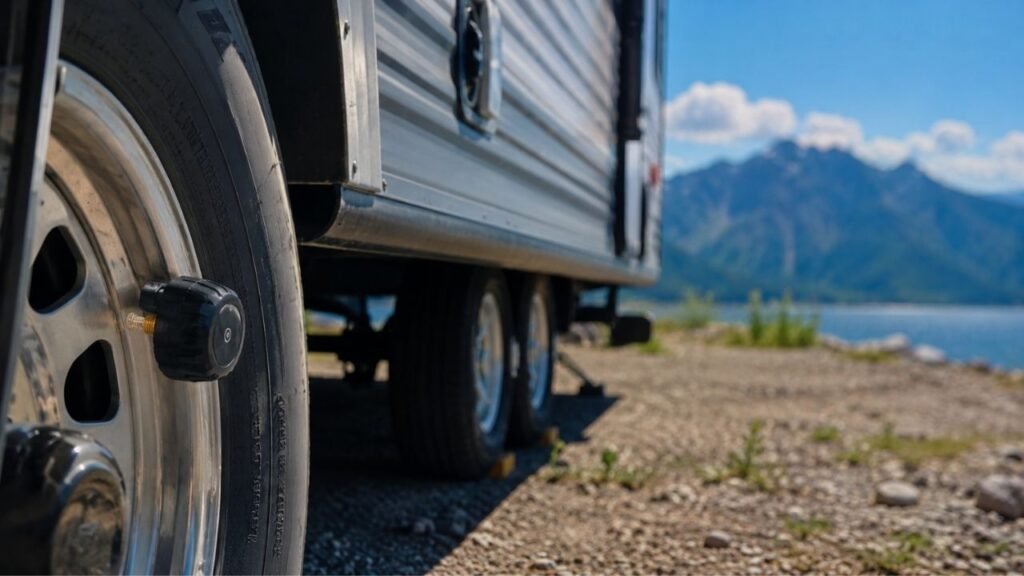
External TPMS sensors attach to the valve stem.
Their temperature reading reflects conditions near that sensor. They are not directly measuring the hottest point inside the tire carcass.
Air passing around the sensor while driving can cool it.
Sunlight can also heat an external sensor while your RV is parked.
For this reason, do not treat the displayed temperature as a perfect measurement of every part of the tire.
Internal Sensors May Show Different Temperatures
Internal TPMS sensors sit inside the wheel and tire environment.
Their readings may react differently because they are not directly exposed to outside airflow.
That does not mean every internal system produces the same reading.
Sensor placement, update frequency, and system design can all create differences.
TPMS Works Best for Watching Trends
Instead of worrying whether one sensor says 112°F and another says 116°F, watch what happens next.
Are they both gradually stabilizing?
Or is one tire continuing to climb while the others remain steady?
That trend is often more useful than the exact number.
Should You Let Air Out When RV Tires Get Hot?
Normally, no. You should not release air from a properly inflated RV tire simply because its pressure increased while driving.
Your tire’s recommended inflation pressure is normally a cold inflation pressure.
The tire is expected to gain pressure as operating temperature increases.
Suppose you correctly set a tire to 80 PSI while cold.
Later, it reaches a noticeably higher pressure after highway driving.
If you release air until it reaches 80 PSI again, the tire may become underinflated after it cools.
That can increase flexing and heat on your next drive.
If a hot pressure reading concerns you, investigate why it became unusually high instead of automatically bleeding air.
Check your load, starting pressure, tire condition, brakes, and surrounding tires.
What Should Your RV Tire Pressure Be Before Driving?
Correct cold inflation gives you the baseline needed to interpret everything your TPMS shows later. Without that baseline, hot readings become much harder to evaluate.
Start With Cold Tire Pressure
Check RV tire pressure before significant driving or heat buildup.
Early morning is usually convenient because the tires have been sitting for several hours.
Keep in mind that direct sunlight can warm tires even while parked.
If one side has been baking in the sun, those tires may already read differently.
Use the Correct Inflation Information
Do not choose tire pressure based solely on what another RVer uses.
Your proper inflation depends on your specific RV, tires, and loading.
Depending on your setup, useful information may include:
- RV tire and loading placard
- Chassis manufacturer recommendations
- Trailer manufacturer instructions
- Actual loaded axle weights
- Individual wheel-position weights when available
- Tire manufacturer’s load-and-inflation table
The maximum pressure molded on a tire sidewall is not automatically the correct operating pressure for every RV application.
Follow the requirements that apply to your particular RV.
Set Your TPMS Around the Correct Baseline
Once you establish the correct cold pressure, configure your TPMS accordingly.
Follow your TPMS manufacturer’s instructions when setting high- and low-pressure alerts.
Avoid making the alarm range unnecessarily narrow.
Normal road heating could otherwise trigger repeated nuisance warnings.
At the same time, do not set the limits so wide that meaningful changes go unnoticed.
How Can You Tell Normal TPMS Changes From a Tire Problem?
You do not need every tire to display identical numbers. Instead, look for reasonable warming patterns and identify readings that move differently from comparable tires.
| TPMS Behavior | Usually Normal? | What You Should Check |
| All tires gradually gain pressure | Yes | Continue monitoring |
| Pressure rises and then stabilizes | Usually | Normal operating heat |
| Sunny-side tires are slightly higher | Often | Compare after conditions equalize |
| One tire repeatedly runs higher | Maybe | Load, brake, bearing, sunlight |
| One tire slowly loses pressure | No | Tire, valve, bead, sensor |
| One tire suddenly loses pressure | No | Stop safely and inspect |
| One tire temperature keeps separating | Concerning | Brake, bearing, load, tire |
| Sensor suddenly stops reporting | Possibly TPMS-related | Battery, signal, repeater |
The simplest rule is this:
Compare the rate of change, not just the number.
A tire showing 95 PSI is not necessarily dangerous because another shows 91 PSI.
However, a tire dropping from 91 to 86 while every other tire is rising deserves attention.
Think in terms of patterns.
Your TPMS becomes much more useful once you know how your particular RV normally behaves.
What Should You Do When an RV TPMS Reading Changes Suddenly?
A sudden TPMS change can be stressful, but reacting calmly matters. First determine whether the reading is simply unusual or indicates active pressure loss.
- Identify the affected wheel. Make sure you know which tire triggered the alert.
- Compare nearby tires. Check both pressure and temperature readings.
- Watch the direction. Determine whether pressure is rising, stable, or falling.
- Avoid sudden maneuvers. Do not panic-brake or make sharp steering movements.
- Reduce speed carefully. This reduces stress and heat on a questionable tire.
- Find a safe stopping location. Pull completely away from moving traffic.
- Inspect the tire. Look for damage, bulges, debris, or air loss.
- Check the valve and sensor. External sensors can occasionally develop sealing problems.
- Verify pressure with a trusted gauge. Compare it with the TPMS reading.
- Check the wheel area when heat is abnormal. A hot brake or bearing may require service.
Never repeatedly silence an alarm without determining why it keeps returning.
The TPMS is there to show you developing problems before they become much worse.
What Can Cause False or Confusing RV TPMS Readings?
Not every strange number comes from the tire itself. TPMS hardware, signal quality, and sensor behavior can occasionally make readings confusing.
Weak Sensor Battery
External TPMS sensors usually contain small replaceable batteries.
As a battery weakens, the sensor may update inconsistently or disappear from the monitor.
Replace weak batteries according to the manufacturer’s instructions.
Poor Signal or Missing Repeater
Long motorhomes, fifth wheels, and travel trailers create significant distance between sensors and the monitor.
The RV structure can also interfere with wireless communication.
A properly installed signal repeater may improve reliability when your TPMS manufacturer recommends one.
The Sensor Has Not Updated Yet
TPMS systems do not necessarily transmit every reading continuously.
Some update at timed intervals or increase transmission frequency when a problem occurs.
Because of this, two sensors may appear to change at slightly different times.
External Sensors Can Be Affected by Their Environment
External sensors are exposed to sunlight, airflow, rain, and road conditions.
That matters particularly when interpreting temperature.
The displayed sensor temperature is useful, but it should be treated as part of the overall pattern.
Your TPMS and Handheld Gauge May Differ Slightly
Small differences between gauges are common.
Choose a good-quality handheld gauge and use it consistently.
If your TPMS remains several PSI different from your trusted gauge, check the manufacturer’s stated accuracy and calibration instructions.
How Should You Monitor TPMS Readings During an RV Trip?
You do not need to stare at your TPMS monitor every minute. A simple routine helps you recognize problems without becoming distracted by normal fluctuations.
- Check cold inflation before starting your trip.
- Confirm every sensor is communicating.
- Note your starting PSI values.
- Watch how the tires warm during early driving.
- Compare tires on the same axle or similar positions.
- Expect normal pressure increases during highway travel.
- Pay attention to growing differences.
- Investigate a tire that begins losing pressure.
- Watch for unusually high temperature differences.
- Recheck cold pressures after major weather changes.
- Inspect tires visually during regular travel stops.
After several trips, you will learn your RV’s normal operating pattern.
That experience makes unusual behavior easier to recognize.
Common RV TPMS Reading Scenarios
Seeing real examples makes TPMS behavior much easier to understand. These situations show why the direction and pattern of the reading matter more than one number.
80 PSI Cold Becomes 90 PSI While Driving
This can be completely normal.
The tire started at its proper cold pressure and warmed during driving.
If comparable tires show similar increases and temperatures remain reasonable, there may be nothing to correct.
Do not automatically remove air to return it to 80 PSI.
110 PSI Cold Goes Above 120 PSI
Again, a higher hot reading does not automatically indicate overinflation.
High-pressure RV tires also warm during operation.
What matters is whether the tire was correctly inflated cold and whether its behavior remains consistent with comparable tires.
If one tire climbs dramatically faster, investigate the cause.
One Trailer Tire Is 5 PSI Higher Than the Others
A five-PSI difference deserves observation but does not automatically mean something is wrong.
Sunlight, starting temperature, loading, axle position, and sensor accuracy can create differences.
Watch whether the gap remains stable.
If it continually grows, inspect that wheel more closely.
One Tire Is Losing PSI While the Others Are Increasing
This is one of the most important TPMS patterns to recognize.
The other tires are warming normally, yet one tire is moving in the opposite direction.
A puncture, valve leak, bead problem, or TPMS sensor seal could be allowing air to escape.
Find a safe place to stop and investigate.
TPMS Pressure Drops After Parking
This is usually normal.
Your tires begin cooling when the RV stops moving.
As their internal temperature falls, the pressure also decreases.
The following morning, your readings may return close to their original cold values.
Mistakes to Avoid When Watching RV TPMS Pressure
Normal pressure movement can become confusing when you focus too heavily on individual numbers. Avoid these common mistakes:
- Bleeding air from properly inflated hot tires.
- Assuming every PSI difference means tire failure.
- Ignoring a tire that steadily loses pressure.
- Comparing hot pressure directly with a cold inflation target.
- Setting TPMS alarms too close to normal pressure.
- Setting warning limits excessively wide.
- Ignoring actual RV weight distribution.
- Assuming every tire should display identical PSI.
- Treating TPMS temperature as exact carcass temperature.
- Ignoring a wheel that continually gets hotter.
- Depending on TPMS instead of routine tire inspections.
- Forgetting to check cold pressure with a reliable gauge.
Use your TPMS as an early-warning system, not as a replacement for basic tire maintenance.
Final Words
Changing RV TPMS readings while driving are usually expected. Tires naturally heat as they flex, carry weight, and roll across the road.
The key is learning the difference between normal warming and abnormal change.
Start every trip with the correct cold inflation. Then watch how each tire normally behaves.
A gradual pressure rise that eventually stabilizes is usually reassuring. A tire that loses pressure, becomes progressively hotter, or separates from the pattern deserves attention.
You do not need to chase every one-PSI movement on the monitor.
Instead, watch the trend.
That is where your RV TPMS becomes genuinely useful.
Related FAQs
Is It Normal for RV Tire Pressure to Increase While Driving?
Yes. RV tire pressure normally increases while driving because the tires generate heat as they flex and roll. That heat warms the air inside, causing PSI to rise above the cold starting pressure.
How Much Should RV Tire Pressure Increase When Hot?
There is no single correct increase for every RV tire. The change depends on starting pressure, load, tire construction, outside temperature, road conditions, speed, and operating temperature. Focus on consistent trends rather than one universal percentage.
Should I Lower My RV Tire Pressure After It Gets Hot?
No, not simply because the pressure increased during driving. Recommended tire inflation is normally based on cold pressure. Releasing air from a properly inflated hot tire can leave it underinflated after cooling.
Why Is One RV Tire Pressure Higher Than the Others?
One tire may run higher because of direct sunlight, uneven RV loading, different axle conditions, nearby heat sources, or normal sensor variation. Watch whether the difference remains stable or continues increasing.
Why Does My TPMS Pressure Go Down After I Stop Driving?
Pressure falls after parking because the tires begin cooling. Cooler air inside the tire creates less pressure, so the TPMS reading gradually moves back toward its cold value.
Can Hot Weather Cause a TPMS High-Pressure Alarm?
Yes. High outside temperatures combined with highway driving can increase operating pressure enough to trigger an alarm, especially when the high-pressure threshold is set too close to the cold baseline.
Can Mountain Elevation Change RV Tire Pressure?
Yes, significant elevation changes can slightly change displayed gauge pressure because surrounding atmospheric pressure changes. Temperature changes during mountain travel can also affect the reading at the same time.
Should All RV Tires Have the Same TPMS Reading?
Not necessarily. Different axle loads, wheel positions, sunlight exposure, and tire temperatures can create small differences. Comparable tires should generally follow similar trends even when their exact PSI readings differ.
Why Is One RV Tire Hotter Than the Others?
One tire may be hotter because of extra load, low inflation, sunlight, brake drag, bearing trouble, alignment problems, or nearby exhaust heat. A temperature difference that continually grows should be investigated.
Can a Dragging Brake Affect TPMS Temperature?
Yes. A dragging brake produces heat around the wheel and hub. That heat can increase the temperature detected by the TPMS and may also contribute to higher tire operating temperatures.
Can a Wheel Bearing Cause a TPMS Temperature Warning?
A failing or poorly lubricated wheel bearing can generate excessive hub heat. Depending on sensor location and severity, that heat may contribute to an unusually high TPMS temperature reading.
Should I Trust My RV TPMS or Tire Pressure Gauge?
Use both. A TPMS is excellent for monitoring changes while driving, while a reliable handheld gauge helps verify cold inflation. Small differences are possible, so use a consistent quality gauge as your reference.

Ethan Walker writes about travel routes, outdoor exploration, and road-based adventures. His guides focus on simple planning, dependable gear, and realistic travel advice. He values comfort, safety, and practical experience over hype.