Your RV TPMS may keep losing signal because of weak sensor batteries, long transmission distance, blocked radio signals, repeater problems, damaged sensors, or pairing issues. If only one tire disappears, the sensor is usually the first thing to check. If several rear tires disappear together, signal range or repeater trouble is more likely.
Below, I’ll help you narrow down the cause step by step. We’ll look at common signal-loss patterns, sensor testing, repeater checks, interference, cold-weather issues, and when replacement actually makes sense.
Key Takeaways
- One missing tire usually points to that sensor or its battery.
- Rear tires dropping together often indicate weak signal range.
- A dead or unpowered repeater can affect several tires at once.
- Weak batteries may cause intermittent readings before completely failing.
- Metal RV structures can weaken signals between sensors and the monitor.
- Signal loss does not mean tire pressure is automatically safe.
- Test the sensor before buying a replacement TPMS component.
What Does Signal Loss Mean on an RV TPMS?
TPMS signal loss means the monitor has stopped receiving current information from one or more tire sensors. Depending on your system, you may see dashes, a blank tire position, a missing sensor icon, or a specific signal-loss warning.
This does not necessarily mean the tire itself has lost pressure.
It simply means the monitor cannot currently confirm that tire’s pressure or temperature. That distinction matters because you should not assume the tire is fine just because there was no low-pressure alert.
If the reading stays missing, check the tire manually before continuing a long drive.
Start With the Pattern: Which TPMS Sensors Are Losing Signal?
Before replacing batteries or buying a booster, look closely at the way the problem happens. The pattern often tells you where to begin troubleshooting.
| What You Notice | Likely Problem Area | First Thing to Check |
| One tire keeps disappearing | Sensor, battery, pairing | Test that sensor |
| Same sensor fails in another wheel position | Sensor or battery | Replace battery or sensor |
| Same wheel position fails with another sensor | Signal path or valve setup | Inspect that location |
| Only rear tires lose signal | Distance or obstruction | Check the repeater |
| All trailer tires disappear | Repeater power or configuration | Verify repeater operation |
| All tires disappear | Monitor or system power | Restart and inspect monitor |
| Readings randomly come and go | Weak batteries or marginal range | Test batteries and repeater |
| Works parked but fails while towing | Marginal signal strength | Check repeater placement |
| Problems worsen in cold weather | Weak battery | Install fresh batteries |
| Warning appears after unhitching | Trailer disconnect setting | Check monitor configuration |
Use this table as your starting point. It can save you from replacing parts that are still working properly.
Why Does My RV TPMS Keep Losing Signal?
Several things can interrupt communication between your tire sensors and the monitor. Some are simple battery problems, while others involve the layout and length of the RV itself.
Weak or Dying TPMS Sensor Battery
This is one of the first things I would check.
A sensor battery does not always go from working perfectly to completely dead overnight. It may gradually lose strength.
That means the sensor may still turn on but struggle to transmit far enough to reach the monitor consistently.
You may notice:
- The reading appears and disappears.
- The sensor works when parked but not while driving.
- The tire reports after startup, then vanishes later.
- Cold mornings make the problem worse.
If your TPMS uses replaceable batteries, installing a fresh battery is an inexpensive first test.
Make sure you use the exact battery type recommended for your sensor.
Too Much Distance Between the Sensors and Monitor
RV TPMS systems sometimes have to transmit over a surprisingly long distance.
Consider a long fifth wheel, travel trailer, toy hauler, or Class A motorhome towing a car. The rear sensor may be many feet away from the dashboard monitor.
The farther the signal travels, the easier it becomes for obstructions to weaken it.
This is why front tires may display perfectly while the farthest tires keep disappearing.
RV Structure Is Blocking or Weakening the Signal
Distance is only part of the problem.
The signal may also need to pass around or through:
- Steel frames
- Axles
- Wheel wells
- Storage compartments
- Water tanks
- Appliances
- Wiring
- Metal siding
- Large mechanical components
Even if the advertised transmission range sounds sufficient, the actual RV structure can reduce usable range.
That is one reason the exact same TPMS may work better on one RV than another.
The Signal Booster or Repeater Is Not Working
Many RV TPMS systems use a repeater to improve communication between distant tire sensors and the dashboard monitor.
If that repeater loses power, several sensors may suddenly start disappearing.
Check for:
- Loose 12-volt wiring
- Failed ground connection
- Blown fuse
- Damaged wire
- No indicator light
- Failed repeater module
- Corroded connection
Do not assume the repeater is working simply because it is installed.
Verify that it actually receives power whenever you are driving.
The Repeater Is Installed in a Poor Location
A working repeater can still perform poorly if it is mounted in the wrong place.
For example, a repeater surrounded by heavy metal may struggle to receive or retransmit the signal.
The best location depends on the TPMS manufacturer and your RV type.
Travel trailers, fifth wheels, motorhomes, and motorhome-toad combinations may all need slightly different positioning.
Use the manufacturer’s recommended location whenever possible.
If the rear sensors are the only ones disappearing, repeater placement deserves extra attention.
Radio-Frequency Interference Is Disrupting Communication
Other electronic equipment can sometimes interfere with TPMS communication.
However, I would not automatically blame every phone, Bluetooth accessory, or Wi-Fi router.
Frequency matters.
Possible interference sources may include wireless thermometers, remote weather sensors, radio equipment, or other electronics operating near the same frequency as the TPMS.
If you suspect interference, turn nearby devices off one at a time.
Then watch whether the missing sensor starts reporting normally.
That is much more useful than randomly disconnecting every electronic device in the RV.
The Sensor Has Lost Its Pairing
Sometimes the sensor itself is fine, but the monitor no longer recognizes it correctly.
This can happen after:
- Replacing a sensor
- Changing batteries
- Moving sensors between tires
- Rotating tires
- Resetting the monitor
- Changing trailer configurations
- Storing the RV for a long period
If the sensor has power but refuses to report, try the relearn or pairing procedure in your TPMS manual.
Do not assume the sensor has failed until you have tried pairing it again.
The Sensor Is Damaged or Corroded
External TPMS sensors live in a difficult environment.
They are exposed to rain, road spray, dirt, heat, vibration, and occasional impacts.
Over time, you may find:
- Corroded battery contacts
- Cracked sensor housing
- Damaged O-rings
- Moisture inside the sensor
- Bent components
- Broken battery covers
If a fresh battery does not help, inspect the sensor closely.
Physical damage often causes communication problems that look like simple battery failure.
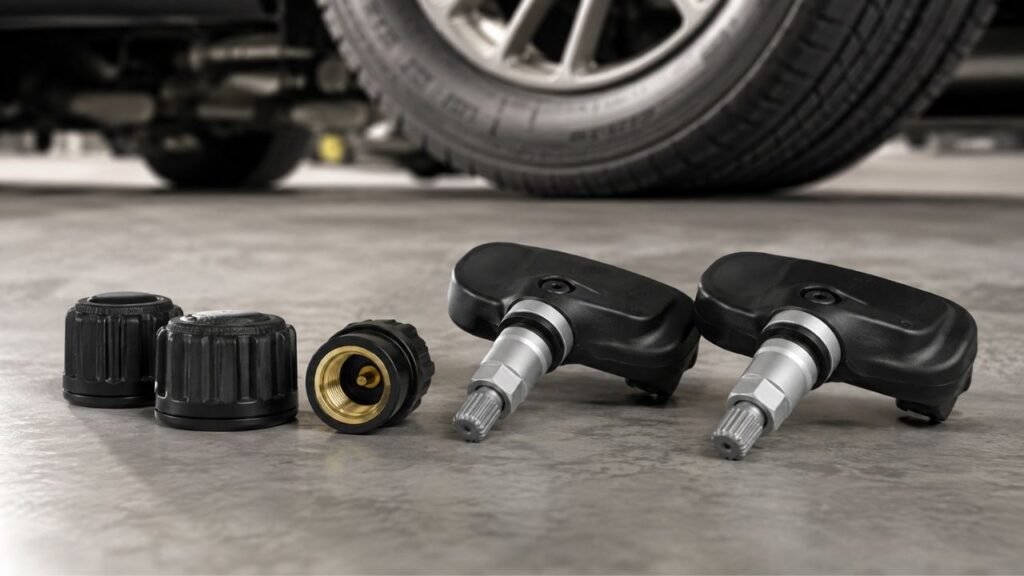
The External Sensor Is Not Seating Correctly on the Valve Stem
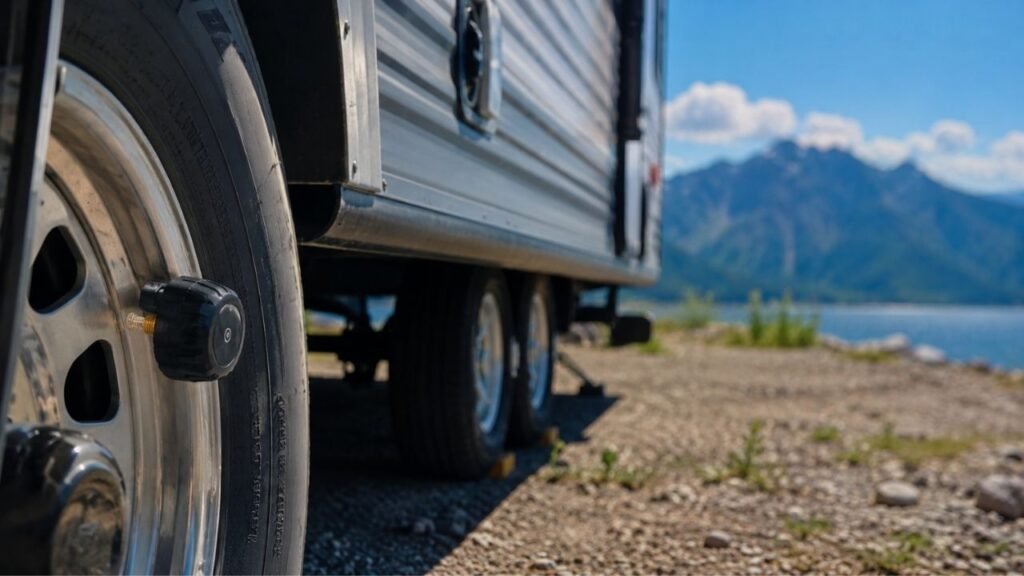
External sensors usually screw directly onto the tire valve stem.
If the sensor is loose, damaged, or not contacting the valve correctly, operation may become unreliable.
Inspect:
- Valve stem threads
- Valve extensions
- Sensor seating
- Valve-core condition
- Clearance around dual tires
- Rubber versus metal valve stems
Heavy external sensors can also place extra stress on flexible rubber valve stems.
For RV applications, properly supported metal stems are often a better match for external TPMS sensors.
The Monitor or Antenna Has a Reception Problem
The tire sensor is not always the problem.
Your monitor may have:
- Low battery power
- Poor charging
- A damaged antenna
- A weak receiver
- Incorrect settings
- Poor dashboard placement
Some TPMS monitors have an external or extendable antenna. Others do not.
Follow the instructions for your specific model rather than assuming every monitor works the same way.
Cold Weather Is Reducing an Already Weak Signal
Cold weather can expose a battery that was already near the end of its useful life.
A sensor that worked throughout summer may suddenly begin dropping out during a cold fall or winter morning.
If signal problems become noticeably worse when temperatures fall, replace the sensor battery before assuming something more serious has failed.
How Do You Fix an RV TPMS That Keeps Losing Signal?
The best way to fix intermittent TPMS communication is to troubleshoot in a logical order. Start with the tire itself, then work outward toward the sensor, repeater, and monitor.
1. Check the Actual Tire First
Before dealing with electronics, verify the tire.
Use a reliable tire pressure gauge and inspect the tire for visible damage.
If the TPMS reading is missing, you no longer have live pressure and temperature information for that wheel.
Do not assume everything is fine simply because the previous reading looked normal.
2. Identify Which Tires Keep Disappearing
Pay attention to the exact pattern.
Ask yourself:
- Is it always one tire?
- Are only the rear tires affected?
- Do all trailer tires disappear?
- Does the problem happen only while moving?
- Does cold weather make it worse?
- Does the reading return after stopping?
Write down the pattern if necessary.
It makes the next steps much easier.
3. Remove and Reinstall the Missing Sensor
If you use external sensors, remove the affected sensor and reinstall it according to your TPMS instructions.
Some systems recognize or wake a sensor after it is removed and installed again.
Make sure the sensor is secure, but do not overtighten it.
Then give the system time to receive another reading.
4. Replace or Test the Sensor Battery
Install a fresh battery if your sensor uses replaceable batteries.
Check:
- Correct battery size
- Correct polarity
- Clean contacts
- Proper battery cover installation
- Good O-ring or weather seal
If the old battery has been installed for a long time, replacing it is often easier than trying to judge its remaining life.
5. Perform a Sensor-Swap Test
This is one of the most useful troubleshooting steps.
Move the questionable sensor to another wheel position and place a known-working sensor on the problem wheel.
Then watch what happens.
If the problem follows the original sensor, the sensor or its battery is likely the issue.
If the problem stays at the same wheel position, investigate the signal path, valve stem, nearby obstructions, or repeater coverage.
This simple test can prevent you from buying the wrong replacement part.
6. Re-Pair or Relearn the Sensor
If the battery is good but the sensor still does not appear, relearn it.
Follow your manufacturer’s pairing procedure carefully.
Some monitors require you to select the exact tire position before adding the sensor.
Others may use a sensor code or automatic detection process.
7. Check the Monitor and Antenna
Make sure the monitor is charged and operating normally.
If your model uses an antenna, check that it is positioned correctly.
You can also try moving the monitor slightly within the cab.
If signal strength improves in another location, reception may be marginal.
8. Verify That the Repeater Has Power
Find the repeater and check its power connection.
Look for an indicator light if your system has one.
Inspect:
- Fuse
- Positive wire
- Ground wire
- Connectors
- Corrosion
- Damaged insulation
A repeater with no power cannot strengthen anything.
This is especially important when all trailer tires disappear at the same time.
9. Test a Better Repeater Location
If the repeater has power but rear sensors still drop out, its location may be the problem.
Avoid surrounding it with heavy metal whenever your manufacturer’s installation instructions allow another position.
The goal is to create a better communication path between the rear sensors and the cab monitor.
10. Temporarily Switch Off Possible Interference Sources
Turn off suspected wireless equipment one item at a time.
Watch the monitor after each change.
If the missing readings return consistently after one device is turned off, you may have found an interference source.
Do not change several things at once because you will not know what actually fixed the problem.
11. Inspect the Sensor and Valve Stem
Remove the sensor and inspect both components.
Look for:
- Corrosion
- Cracked plastic
- Damaged seals
- Water intrusion
- Bent valve stem
- Damaged threads
- Loose valve extensions
Correct mechanical problems before continuing your electronic troubleshooting.
12. Replace Components Only After Isolating the Failure
Do not immediately replace the entire TPMS.
A reasonable troubleshooting order is:
- Sensor battery
- Sensor
- Repeater
- Monitor or receiver
Working in that order can save you considerable money.
How Can You Tell Whether the TPMS Sensor or Signal Range Is the Problem?
You can usually separate a bad sensor from a range problem with a few simple tests. Try these before buying replacement parts.
- Bring the questionable sensor closer to the monitor.
- Install a fresh sensor battery.
- Compare it with another working sensor.
- Swap sensors between wheel positions.
- See whether the problem follows the sensor.
- Watch whether only distant tires disappear.
- Confirm that the repeater has power.
- Re-pair the sensor with the monitor.
- Inspect the sensor for corrosion or physical damage.
If the sensor still refuses to communicate when close to the monitor and powered by a fresh battery, the sensor itself becomes a stronger suspect.
If it works nearby but disappears when installed on a distant tire, focus on range, obstruction, and repeater performance.
When Does an RV TPMS Need a Signal Booster or Repeater?
Not every RV needs extra signal support. However, a repeater becomes much more useful when the distance and structure of the RV consistently prevent rear sensors from reaching the monitor.
Signs Your RV Probably Needs Better Signal Support
You may benefit from a repeater when:
- Front sensors work but rear sensors frequently disappear.
- Your travel trailer or fifth wheel is unusually long.
- You tow a vehicle behind a motorhome.
- Several trailer axles sit far from the cab.
- Sensors work when brought closer to the monitor.
- A fresh battery does not improve rear-tire communication.
The pattern matters more than the RV length alone.
Where Should an RV TPMS Repeater Be Installed?
There is no perfect universal location.
The repeater should generally sit somewhere that improves communication between the tire sensors and the monitor without being heavily shielded by metal.
However, follow your TPMS manufacturer’s instructions.
A recommended position for a travel trailer may be different from the preferred location on a motorhome or fifth wheel.
How Do You Know Whether the Repeater Is Working?
Start by checking for its power or status light.
You can also verify 12-volt power with a meter if you are comfortable doing so.
If the rear sensors communicate normally with the repeater powered but start disappearing when it is disconnected, the repeater is clearly helping.
When Will a Repeater Not Fix the Problem?
A repeater is designed to improve communication range.
It will not repair:
- A dead sensor battery
- A failed sensor
- Incorrect pairing
- Damaged valve hardware
- A broken monitor
- Incorrect tire-position programming
- Severe sensor corrosion
That is why I recommend testing the individual sensor before buying another booster.
Why Does My RV TPMS Work While Parked but Lose Signal While Driving?
If your TPMS works while parked but loses readings on the road, the system may be operating near the edge of its reliable communication range.
Movement can change the relationship between the sensors, surrounding metal, nearby vehicles, roadside electronics, and the monitor.
An aging battery may also produce enough signal under ideal conditions but struggle once the RV is moving.
Check the sensor battery first.
Then inspect repeater power and placement.
If the affected tires are always the farthest from the monitor, marginal range is especially likely.
Why Does My RV TPMS Lose Signal Only From the Rear Tires?
Rear-only signal loss usually points toward distance or obstruction rather than complete monitor failure.
The rear tires are farthest from the dashboard and may sit behind several layers of metal, storage compartments, axles, and other RV components.
This problem is particularly common with long fifth wheels, travel trailers, toy haulers, and motorhomes towing vehicles.
Check the repeater before replacing several rear sensors at once.
If all the rear sensors fail together, it is unlikely that every sensor battery suddenly died at exactly the same time.
Can Cold Weather Make an RV TPMS Lose Signal?
Yes, cold weather can make a marginal sensor battery perform worse.
You may notice that a sensor works after the day warms up but disappears during cold mornings.
That does not automatically mean cold weather is damaging the TPMS.
More often, the lower temperature exposes a battery that was already getting weak.
Installing a fresh battery is a sensible first step.
Can Other Electronics Interfere With an RV TPMS?
Yes, electronic interference is possible, but it should be diagnosed carefully.
Do not assume every Bluetooth device, smartphone, or Wi-Fi router is interfering with your TPMS.
Different wireless products use different frequencies and communication methods.
If you suspect interference, focus on nearby wireless accessories such as remote thermometers, weather sensors, radio equipment, or other transmitting devices.
Turn them off individually and watch the TPMS.
If the problem continues unchanged, move on to batteries, repeater operation, and signal range.
Is It Safe to Drive When Your RV TPMS Loses Signal?
A signal-loss warning does not automatically mean the tire is failing.
However, it does mean you are no longer receiving current pressure and temperature information from that tire.
If the reading does not return, safely stop when you can and inspect the affected tire.
Pay particular attention if you also notice:
- Vibration
- Pulling
- Tire noise
- Handling changes
- Previous pressure warnings
- Previous temperature warnings
- Visible tire damage
Never stop suddenly in an unsafe traffic location simply because the monitor briefly misses one transmission.
Move to a safe area first.
Your TPMS is an important safety tool, but it should support regular tire inspections rather than replace them.
How to Prevent RV TPMS Signal Loss Before Your Next Trip
A few quick checks before departure can prevent many intermittent TPMS problems.
- Confirm every tire is showing on the monitor.
- Check tire pressure manually before traveling.
- Replace aging sensor batteries proactively.
- Carry spare sensor batteries.
- Carry spare O-rings when your sensors use them.
- Check the repeater indicator before leaving.
- Inspect repeater wiring periodically.
- Keep external sensors clean.
- Check sensor housings for cracks or corrosion.
- Keep sensors assigned to the correct wheel positions.
- Check valve extensions for looseness.
- Relearn sensors after changing their positions when required.
- Use the appropriate trailer disconnect mode when unhitching.
These checks only take a few minutes and can make troubleshooting on the road much easier.
When Should You Replace a TPMS Sensor Instead of Troubleshooting It?
Replacement makes sense when you have already eliminated the common battery, pairing, and signal-range problems.
Consider replacing the sensor if it still fails with a verified fresh battery, cannot pair with the monitor, refuses to communicate even at close range, or continues failing when moved to another tire position.
Physical condition matters too.
A badly cracked housing, corroded battery compartment, damaged contacts, or repeated water intrusion can make replacement more practical than continued troubleshooting.
The sensor-swap test is especially helpful here.
If the problem consistently follows that sensor, you have much stronger evidence that replacement is justified.
Final Words
RV TPMS signal loss becomes much easier to diagnose when you stop treating every missing reading as the same problem.
If one tire disappears, start with that sensor and its battery.
If several distant tires disappear together, check the repeater, signal path, and RV layout.
If every tire vanishes, look more closely at the monitor, power, or overall system setup.
Work through the problem in that order and you have a much better chance of fixing the real cause without replacing good equipment.
Related FAQs
Why Does My RV TPMS Keep Losing Signal From One Tire?
If the same tire repeatedly loses communication while the others stay connected, start with that sensor. Replace its battery, reinstall it, re-pair it, and swap it with another wheel position to see whether the problem follows the sensor.
Why Does My TPMS Keep Losing the Rear Trailer Sensors?
Rear trailer sensors are farther from the monitor and their signals must travel around more metal and RV structure. If several rear sensors disappear together, check repeater power, repeater placement, and overall transmission distance.
Will a New Battery Fix Intermittent TPMS Signal Loss?
It can. Weak sensor batteries often cause intermittent communication before they fail completely. A fresh battery is one of the cheapest and easiest things to test when only one or two sensors keep disappearing.
Where Should I Put the TPMS Signal Booster on My RV?
Install the booster where your TPMS manufacturer recommends and where it has a clear communication path between the tire sensors and monitor. Avoid heavily shielded metal areas when the installation instructions allow another location.
How Do I Know Whether My TPMS Repeater Is Working?
Check its status light, fuse, wiring, ground, and 12-volt power supply. You can also compare sensor performance with the repeater powered and disconnected to see whether rear-tire communication changes.
Can Cold Weather Cause an RV TPMS Sensor to Stop Reading?
Yes. Cold weather can reduce the performance of an already weak battery and shorten reliable transmission distance. If a sensor begins disappearing during cold mornings, try a fresh battery before replacing the sensor.
Can a Bad Valve Stem Cause a TPMS Sensor Not to Read?
It can contribute to problems, especially with external sensors. Damaged threads, loose extensions, poor seating, or a bent valve stem can affect how securely the sensor mounts and may interfere with normal operation.
Why Does My TPMS Lose Signal Only While Towing?
The system may be operating near its usable transmission limit. Vehicle movement, changing obstructions, weak batteries, and poor repeater placement can turn a marginal connection into repeated dropouts once you start driving.
Can Wireless Electronics Interfere With an RV TPMS?
Some wireless electronics can interfere, particularly when they operate near the same radio frequency. Test suspected devices individually instead of assuming every phone, Bluetooth accessory, or Wi-Fi device is responsible.
How Do I Know Whether My RV TPMS Sensor Is Bad?
Install a fresh battery and move the sensor to another tire position. If the communication problem follows the sensor and it also fails when close to the monitor, the sensor itself is probably faulty.
Do All Travel Trailers Need a TPMS Signal Booster?
No. Shorter trailers may communicate reliably without one. A booster becomes more useful when rear sensors frequently disappear because of long distance, metal obstructions, or the overall trailer and tow-vehicle layout.
Should I Re-Pair My TPMS After Replacing the Sensor Battery?
Not every system requires it, but re-pairing can help when a sensor does not return after battery replacement. Follow your specific TPMS instructions because pairing procedures vary between brands and models.

Ethan Walker writes about travel routes, outdoor exploration, and road-based adventures. His guides focus on simple planning, dependable gear, and realistic travel advice. He values comfort, safety, and practical experience over hype.