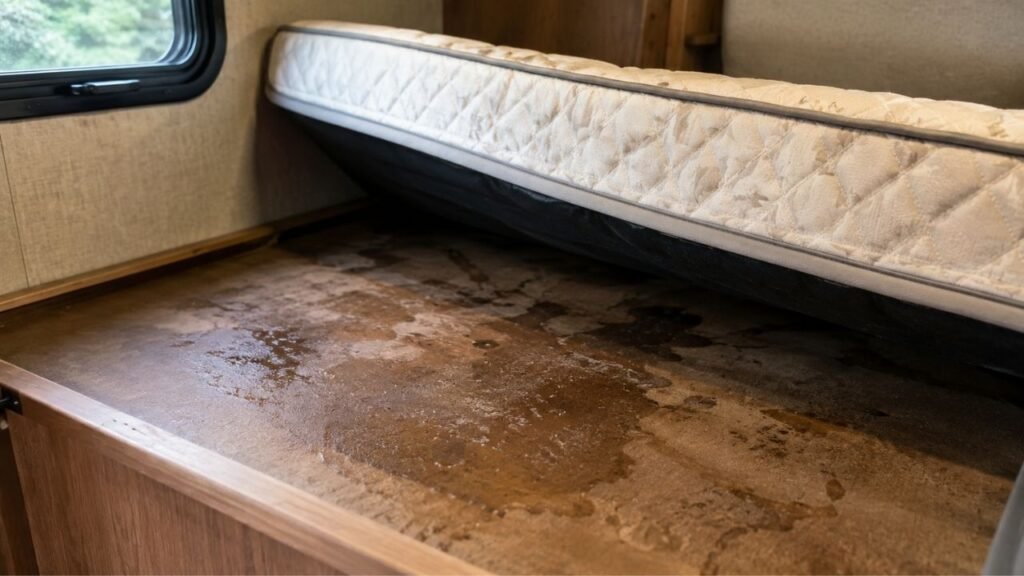
Moisture builds up under an RV mattress when warm, humid air reaches the colder bed platform and turns into condensation. Because most RV mattresses sit directly on solid plywood or another non-breathable surface, that moisture cannot escape easily. Cold weather, high indoor humidity, and poor airflow can make the problem much worse.
The good news is that you can usually control this problem without replacing your mattress. I’ll show you why the moisture forms, how to tell condensation from a leak, and what you can do to keep your RV bed dry.
Key Takeaways
- Moisture under an RV mattress is usually caused by condensation.
- Warm, humid air condenses when it reaches a cold bed platform.
- Solid plywood platforms can trap moisture beneath the mattress.
- Beds above exterior storage compartments often get colder overnight.
- Poor ventilation and high indoor humidity increase condensation risk.
- Localized water after rain or plumbing use may indicate a leak.
- Adding airflow beneath the mattress is one of the best solutions.
- Humidity control and regular inspections help prevent mold growth.
Why Does Moisture Build Up Under an RV Mattress?
Several conditions usually work together to create moisture under your mattress. Understanding that process makes choosing the right solution much easier.
Warm, Humid Air Reaches a Cold Bed Platform
Your RV stays relatively warm while you sleep. Your body also releases heat and moisture throughout the night.
Meanwhile, the plywood platform underneath your mattress may remain much colder.
This is especially common when the bed sits above:
- An exterior storage compartment
- An unheated pass-through compartment
- An RV slide-out
- A poorly insulated floor
- An exterior-facing section of the RV
Warm indoor air naturally moves around the mattress and sleeping area. When that humid air reaches the colder platform, its temperature drops.
That is when condensation can begin forming.
The Surface Drops Below the Dew Point
You do not need to understand complicated weather science here.
Think about a cold glass of water on a warm day. Water droplets eventually appear outside the glass.
The glass is not leaking. Moisture from the surrounding air is condensing on its cold surface.
Something similar happens underneath your RV mattress.
Warm air holds water vapor. As that air cools against the bed platform, it may eventually reach its dew point.
Once that happens, some water vapor becomes liquid.
You may wake up and find:
- Damp plywood
- Water droplets
- A clammy mattress bottom
- Moisture along exterior edges
The mattress top can still feel completely dry.
Your Mattress Traps Moisture Against the Platform
Condensation creates the water, but poor airflow keeps it there.
Most household mattresses sit on box springs, slats, or ventilated foundations. Air can move underneath them relatively easily.
Many RV mattresses are different.
They often sit directly on a solid sheet of plywood.
Once moisture forms between these two surfaces, there is very little airflow available to dry it.
The mattress also presses tightly against the platform.
That creates a dark, enclosed area where evaporation happens slowly.
If this continues night after night, the moisture can eventually create staining, odors, mildew, and mold.
Everyday RV Living Adds More Humidity
Your mattress is not the only source of moisture.
Normal RV living can release plenty of water vapor into a relatively small interior.
Common sources include:
- Sleeping and breathing
- Body perspiration
- Showering
- Boiling water
- Cooking meals
- Washing dishes
- Damp towels
- Wet jackets and shoes
- Drying clothes indoors
- Multiple occupants
- Pets
Because an RV has much less interior space than a house, humidity can rise surprisingly quickly.
Closing every window and roof vent during cold weather can make matters worse.
Why Is This Problem More Common in RVs Than Houses?
Condensation can happen in houses, boats, vans, and cabins. However, several parts of RV construction make under-mattress moisture particularly common.
Compared with most houses, RVs usually have:
- Less interior air volume
- Thinner walls and floors
- More rapid temperature changes
- Solid plywood bed platforms
- Limited ventilation underneath mattresses
- Storage compartments directly below beds
- Mattresses positioned against exterior walls
- Bedrooms located inside slide-outs
The problem often becomes more noticeable during cooler camping.
You may heat the inside of your RV to a comfortable temperature while the bed platform remains exposed to cold air underneath.
That creates a significant temperature difference.
There is another issue.
When outside temperatures fall, your natural reaction may be closing every opening inside the RV.
That keeps heat inside, but it can also trap moisture.
A small amount of controlled ventilation can actually help keep your RV drier.
Is the Water Under Your RV Mattress Condensation or a Leak?
Do not immediately assume your RV is leaking when you discover water underneath the mattress. However, you should not automatically assume it is condensation either.
Use the pattern of moisture to narrow down the likely source.
| What You Notice | More Likely Condensation | More Likely RV Leak |
| Moisture appears after sleeping overnight | Yes | Less likely |
| Problem gets worse during cold weather | Yes | Sometimes |
| Moisture covers a broad area under mattress | Common | Less common |
| Exterior edge feels wetter than center | Common | Possible |
| Windows also have heavy condensation | Strong clue | Not necessarily |
| Moisture appears immediately after rain | Possible | Strong warning sign |
| Same small area repeatedly becomes soaked | Less typical | More likely |
| Ceiling or wall has visible water stains | Unlikely | More likely |
| Plywood is soft around one specific area | Possible over time | Strong warning sign |
| Water appears after using plumbing | Unlikely | Likely plumbing issue |
| Moisture stops during warmer, drier weather | Common | Depends on leak |
If water appears in exactly the same location after rain, inspect nearby seals, windows, roof openings, and exterior joints.
Plumbing also deserves attention.
Water showing up after using a sink, shower, toilet, or water pump may point toward a plumbing leak instead.
Condensation is usually more widespread and strongly connected with temperature and humidity.
What RV Bed Setups Are Most Likely to Trap Moisture?
Some RV sleeping areas experience condensation much more easily than others. Your bed location and platform design can tell you a lot about your risk.
Mattress Directly on a Solid Plywood Platform
This is probably the most common setup.
The platform provides excellent support, but almost no under-mattress airflow.
Your mattress can essentially seal the plywood surface.
Any condensation that develops may stay trapped for hours.
Bed Above an Exterior Storage Compartment
Take a look underneath your bed.
If you find a large pass-through storage compartment, you may have identified part of the problem.
Those compartments can become considerably colder than the heated RV interior.
The plywood separating your mattress from the compartment may therefore stay cold overnight.
Warm air above meets cold plywood below.
That temperature difference creates ideal condensation conditions.
Mattress Inside an RV Slide-Out
Slide-outs are another common trouble spot.
They contain more exterior-facing surfaces than many central sleeping areas.
Their floors and walls can also become colder during chilly weather.
If your mattress sits directly against those surfaces, moisture may develop underneath or around the edges.
Mattress Pressed Against an Exterior Wall
Sometimes the platform is dry, but the mattress edge becomes damp.
That often happens when foam sits tightly against an exterior wall.
Leave some space between the mattress and wall whenever your floorplan allows it.
Even a modest air gap can improve circulation around that cold surface.
Foam or Memory Foam RV Mattress
Memory foam does not magically create condensation.
The real problem remains moisture, surface temperature, and airflow.
However, dense foam can restrict air movement where it contacts the platform.
It may also take longer to dry after becoming damp.
That is another reason airflow underneath foam mattresses matters.
When Is Under-Mattress Condensation Usually the Worst?
You may use the same RV mattress for months without seeing moisture. Then one particular trip suddenly leaves the plywood soaking wet.
Certain conditions increase the risk significantly.
Watch more carefully during:
- Winter camping
- Cold spring nights
- Late-fall trips
- Coastal camping
- Rainy weather
- Very humid summers
- Large daytime and nighttime temperature swings
- Trips with several occupants
- Extended indoor cooking
- Frequent showering
- Long periods with every vent closed
Cold-weather camping deserves special attention.
Keeping every window and roof vent sealed may feel logical when temperatures drop.
However, your breathing, cooking, and showering continue producing moisture.
Without ventilation, that water vapor remains inside.
Eventually, some of it finds the coldest available surfaces.
Your mattress platform can become one of them.
How Can You Tell Moisture Is Already Building Up?
You do not need to see standing water before taking action. Early moisture problems often produce smaller warning signs first.
Look for:
- Dampness underneath the mattress
- Wet or clammy plywood
- Musty odors
- Dark spots
- Mildew staining
- Swollen plywood
- Warped platform sections
- Damp mattress edges
- Moist exterior walls
- Heavy window condensation
- Damp storage compartments below the bed
One important detail often surprises RV owners.
The top of your mattress can feel completely dry while the bottom remains damp.
That is why occasionally lifting the mattress matters.
You cannot reliably diagnose this problem by checking your sheets.
What Should You Do Immediately If You Find Water Under the Mattress?
Finding a wet RV mattress does not mean the mattress is ruined. However, you should dry everything quickly and identify the source before putting the bed back together.
- Remove the bedding. Pull away sheets, blankets, mattress pads, and anything holding moisture.
- Lift the mattress completely. Prop it upright or move it somewhere dry with good airflow.
- Check the mattress underside. Feel around the entire bottom, especially corners and edges.
- Dry the platform. Wipe away visible water and expose the surface to moving air.
- Run a fan if possible. Air movement can dramatically speed up drying.
- Use a dehumidifier when needed. This helps remove moisture from the surrounding air.
- Inspect nearby walls and compartments. Check underneath and around the bed for additional damp areas.
- Look for leak evidence. Search for stains, swollen wood, damaged seals, or water trails.
- Leave everything open until completely dry. Do not immediately place the mattress back onto damp plywood.
Try to dry wet materials as quickly as practical.
The longer moisture remains trapped, the greater your chances of developing mildew, odors, or mold.
How Do You Stop Moisture From Building Up Under an RV Mattress?
The best long-term approach combines two ideas. You need to give moisture somewhere to escape while also reducing how much humidity builds inside your RV.
Create an Air Gap Under the Mattress
For many RV owners, this is the most important improvement.
A purpose-built mattress ventilation mat sits between your mattress and bed platform.
These products usually use an open three-dimensional structure.
Instead of the mattress sitting flat against plywood, the mat creates a narrow air channel underneath it.
That helps moisture evaporate.
You may see these products described as:
- Mattress ventilation mats
- Under-mattress airflow mats
- 3D mesh underlays
- Polymer ventilation mats
- Marine mattress underlays
The exact brand matters less than the basic design.
You want a material that stays open under the mattress’s weight.
A thin fabric pad that becomes completely compressed will not create much ventilation.
Use Slats or a Ventilated Bed Base
Wooden slats can also create an airflow path underneath your mattress.
This approach can work particularly well when renovating an existing bed platform.
However, support still matters.
Different mattresses have different foundation requirements.
Before removing plywood or dramatically changing your platform, check your mattress support recommendations.
You do not want to solve a moisture problem by creating mattress sagging.
You should also consider how any modifications affect:
- Platform strength
- Bed hinges
- Lift mechanisms
- Storage access
- Wiring
- Plumbing
- Manufacturer warranties
A ventilated foundation needs to support the mattress evenly.
Add Ventilation Holes Only When the Platform Allows It
Some RV owners drill ventilation holes into plywood platforms.
That can help improve air movement.
However, holes alone are not always enough.
A mattress sitting directly on the platform can partially block them.
They work better when combined with an under-mattress air gap.
Before drilling anything, inspect underneath the platform carefully.
You could have:
- Electrical wiring
- Plumbing lines
- Gas lines
- Storage structures
- Mechanical hardware
Avoid weakening structural areas.
If you are unsure whether the platform can safely be modified, leave it intact and use a removable ventilation underlay instead.
Improve Air Movement Around the Bed
Airflow should not stop at the mattress bottom.
Try to keep the entire sleeping area ventilated.
You can:
- Leave a small space beside exterior walls.
- Prop the mattress up during the day.
- Open a lift-up bed platform periodically.
- Run a small fan near the sleeping area.
- Avoid packing storage compartments completely full.
- Keep bedding from sealing every mattress edge.
If you find moisture after a cold night, prop the mattress up the following morning.
Even thirty minutes of good air movement can help.
Reduce Humidity Inside the RV
An airflow mat handles moisture beneath the bed.
Humidity control helps stop excessive moisture from forming initially.
Start with the moisture-producing activities you already do every day.
Run the bathroom exhaust fan during showers.
Leave it running afterward until the humid air clears.
Use your range hood while cooking.
Boiling pasta or water can release plenty of moisture into a small RV.
You can also:
- Crack an appropriate roof vent.
- Open windows briefly when weather allows.
- Run an electric dehumidifier.
- Use your air conditioner during humid weather.
- Avoid drying wet towels around the sleeping area.
- Move wet clothing outside when possible.
- Monitor humidity with a digital hygrometer.
The goal is not making your RV uncomfortably dry.
You simply want to prevent humidity from staying excessively high.
Insulate a Very Cold Bed Platform
Airflow addresses trapped moisture.
Insulation addresses the cold surface creating condensation.
Some RV beds sit directly above unheated storage compartments.
Adding appropriate insulation underneath that platform can help keep its sleeping surface warmer.
That reduces the temperature difference between your mattress and bed deck.
However, insulation should not completely replace ventilation.
A better approach is often:
reduce the cold surface + maintain airflow beneath the mattress.
That combination attacks both sides of the condensation problem.
What Indoor Humidity Should You Maintain in an RV?
Indoor humidity provides a useful clue, but there is no single percentage that guarantees your mattress will remain completely dry.
As a practical target, keeping relative humidity somewhere around 30% to 50% is usually reasonable. Try to avoid consistently exceeding approximately 60%.
A digital hygrometer makes monitoring easy.
Place one near your bedroom for several nights.
If the humidity remains high and your windows constantly collect water, you probably need more ventilation or dehumidification.
However, do not become obsessed with one number.
Imagine your RV humidity is 48%.
That sounds reasonable.
But your bed platform could still become extremely cold during a winter night.
If that surface becomes cold enough, condensation may still occur.
That is why I recommend checking three things together:
- Your humidity reading
- Condensation on windows and walls
- Moisture beneath the mattress
Those observations tell you more than one hygrometer reading alone.
Are Moisture Absorbers Enough to Keep an RV Mattress Dry?
Moisture-absorbing products can help, especially inside closets, storage compartments, and other small enclosed areas.
However, they are not my first choice for solving heavy under-mattress condensation.
Passive moisture absorbers have limited capacity.
They cannot continuously remove large amounts of humidity created by people showering, cooking, breathing, and sleeping.
Treat them as a supporting tool.
For occupied RVs with persistent humidity problems, ventilation and an appropriately sized electric dehumidifier usually provide stronger moisture control.
Most importantly, moisture absorbers do not create airflow under your mattress.
You still need to address that trapped space.
Should You Put Plastic Under an RV Mattress?
I would not use a solid plastic sheet as the main solution.
Plastic may stop moisture from reaching one particular surface, but it does not create ventilation.
Instead, water vapor may simply condense somewhere else or remain trapped between layers.
It helps to separate three different products people often confuse.
A ventilation mat creates airflow underneath the mattress.
A breathable waterproof mattress protector helps protect the mattress from spills and body moisture above.
A solid plastic sheet underneath the mattress creates a non-breathable barrier.
For under-mattress condensation, airflow usually matters more than simply covering the plywood with plastic.
Can You Prevent Condensation by Insulating Under the Mattress?
Insulation can help, especially when your mattress platform becomes extremely cold.
However, I would not rely on insulation alone.
Remember what creates the problem.
Warm, humid air meets a cold surface.
Insulation can help keep that surface warmer.
Ventilation helps any remaining moisture escape.
That means these solutions perform different jobs.
If your mattress sits above an unheated pass-through storage compartment, adding suitable insulation beneath the platform may reduce condensation.
Pairing that improvement with an airflow mat often produces better results.
Can Moisture Under an RV Mattress Cause Mold?
Yes. Persistent moisture can eventually create conditions where mold and mildew can grow.
That does not mean every damp mattress immediately becomes moldy.
The bigger concern is repeated moisture that never fully dries.
Over time, you may notice:
- Musty odors
- Dark spotting
- Mattress staining
- Mildew
- Swollen plywood
- Softened wood
- Surface deterioration
- Mold growth
This is one reason I encourage checking underneath your mattress periodically.
Catching moisture early is much easier than dealing with a damaged platform later.
What Should You Do If Mold Has Already Formed?
Start by addressing the moisture source.
Cleaning visible mold while leaving the condensation problem unchanged will probably bring it back.
Remove the mattress and allow everything to dry.
Then inspect how extensively the mattress and platform are affected.
For light surface contamination on a cleanable platform, follow cleaning instructions appropriate for that material.
Avoid randomly mixing household chemicals.
Mattresses are more complicated because they are porous.
Once extensive mold develops inside foam or fabric layers, completely cleaning and drying those materials can become difficult.
A heavily affected mattress may need replacement.
You should also investigate serious platform damage.
Swollen, soft, or deteriorated plywood may need repair rather than cosmetic cleaning.
If mold covers a large area or you cannot determine how deeply it has spread, professional assessment is the safer choice.
A Simple Routine to Keep Your RV Mattress Dry
You do not need to lift your mattress every hour. A few consistent habits can prevent most moisture problems before they become expensive repairs.
Before Sleeping
Try these simple habits:
- Run the bathroom vent after showering.
- Use the kitchen exhaust while cooking.
- Remove wet clothes from the bedroom.
- Check for heavy window condensation.
- Run your dehumidifier when humidity stays high.
- Keep appropriate ventilation open when conditions allow.
Each Morning
Before completely making your bed:
- Pull blankets back temporarily.
- Let the mattress surface breathe.
- Check underneath during cold or humid trips.
- Wipe away any small moisture spots.
- Prop the mattress up if damp.
- Increase ventilation when condensation appears.
This matters most after especially cold nights.
Every Few Weeks During Heavy RV Use
Take a closer look underneath the bed.
Check:
- Mattress bottom
- Plywood platform
- Exterior wall edges
- Ventilation underlay
- Pass-through storage
- Slide-out floor
- Nearby seals
- Plumbing connections
Also clean your ventilation mat when necessary.
Keeping those air channels open helps the system perform correctly.
Final Words
Moisture under an RV mattress usually does not mean your mattress is defective. In most cases, warm and humid indoor air is reaching a colder bed platform and turning into condensation.
The problem becomes persistent when the mattress sits tightly against solid plywood and prevents that moisture from evaporating.
Your most reliable solution is combining under-mattress airflow, sensible humidity control, and regular inspections.
Add insulation when the bed platform becomes unusually cold. Use ventilation while showering and cooking. Prop the mattress up whenever you discover dampness.
And remember one important distinction.
If the water appears after rain, plumbing use, or always develops in one isolated location, investigate for an RV leak rather than treating it only as condensation.
Related FAQs
Why Is My RV Mattress Wet Underneath but Dry on Top?
The bottom can become wet because condensation forms where the warm mattress meets the colder bed platform. Since the moisture is trapped underneath, your sheets and sleeping surface may remain completely dry while the plywood becomes damp.
Does Memory Foam Cause More Moisture Under an RV Mattress?
Memory foam does not directly create condensation, but dense foam can restrict airflow where it contacts solid plywood. If moisture forms underneath, the limited ventilation can make drying slower and allow dampness to remain trapped longer.
Will a Dehumidifier Stop Moisture Under an RV Mattress?
A dehumidifier can greatly reduce the amount of moisture available for condensation, but it may not completely solve a cold, unventilated bed platform. You will usually get better results by combining dehumidification with airflow beneath the mattress.
Should I Put an Airflow Mat Under My RV Mattress?
An airflow mat can be one of the most effective solutions because it keeps the mattress slightly elevated above solid plywood. This creates air channels that help moisture evaporate instead of remaining trapped against the mattress bottom.
Will Drilling Holes in the RV Bed Platform Stop Condensation?
Ventilation holes can improve airflow, but they may not solve the problem alone because the mattress can partially block them. Combining platform ventilation with a raised airflow layer usually provides better circulation.
Why Is Moisture Worse Under My RV Mattress in Winter?
Winter creates a larger temperature difference between your heated RV interior and the cold bed platform. Warm, humid indoor air can cool rapidly against that surface, making condensation much more likely.
Why Does My RV Mattress Get Wet When the Furnace Is Running?
The furnace can keep your living space warm while the floor, exterior walls, and storage compartments remain much colder. Meanwhile, occupants continue adding humidity through breathing and normal activities, allowing condensation to form on those cold surfaces.
Does a Mattress Protector Prevent Under-Mattress Condensation?
A mattress protector can protect the mattress from spills and body moisture, but it does not create airflow underneath the bed. You still need adequate ventilation beneath the mattress to manage condensation forming against the platform.
Can Reflective Insulation Stop RV Mattress Condensation?
Reflective or other appropriate insulation may reduce how cold the mattress platform becomes, which can lower condensation risk. However, insulation works best when you also maintain airflow beneath the mattress.
Should I Leave My RV Roof Vent Open at Night?
A slightly open roof vent can help humid indoor air escape when weather conditions and equipment instructions allow it. You do not need a huge opening, but some controlled ventilation can significantly reduce condensation during cold-weather camping.
How Often Should I Check Under My RV Mattress for Moisture?
Check frequently during cold, rainy, or very humid trips, especially when you first notice window condensation. During normal conditions, adding the mattress underside to your regular RV inspection routine is usually enough.
Can Moisture Under the Mattress Damage the Plywood Platform?
Yes. Repeated exposure to moisture can cause staining, swelling, warping, odors, and eventual deterioration. Keeping the platform dry also reduces the conditions that allow mold and mildew to develop.

Ethan Walker writes about travel routes, outdoor exploration, and road-based adventures. His guides focus on simple planning, dependable gear, and realistic travel advice. He values comfort, safety, and practical experience over hype.