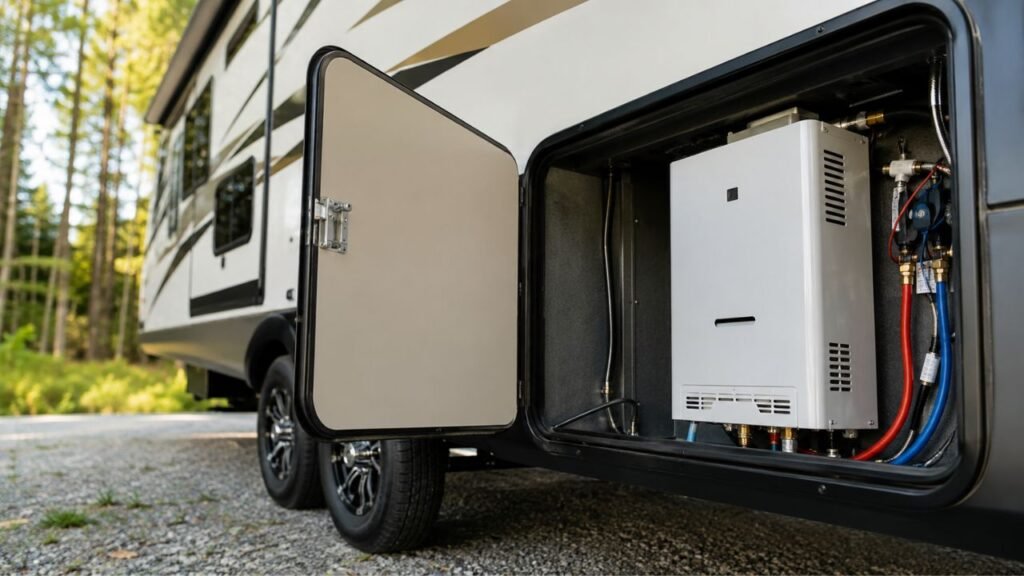
An RV tankless water heater usually uses less propane than a traditional tank water heater when both are heating the same amount of water with propane. Tankless models fire only when you need hot water, while tank heaters may burn propane again to reheat stored water and maintain its temperature. However, your shower length, heater settings, camping style, and electric hookups can change the result.
If you are trying to stretch a propane tank between refills, the difference is worth understanding. Below, I’ll compare burner ratings, standby losses, daily hot-water habits, boondocking, electric operation, and the situations where a traditional tank heater can actually use less propane.
Key Takeaways
- Tankless RV water heaters generally use less propane for comparable hot-water use.
- A higher BTU rating does not automatically mean higher daily propane consumption.
- Tank heaters can consume propane reheating and maintaining stored hot water.
- Long tankless showers can eliminate much of the expected fuel savings.
- A propane/electric tank heater may use no propane while operating on shore power.
- Turning a tank heater off between uses can greatly reduce standby fuel consumption.
- Boondockers should consider water conservation along with propane efficiency.
RV Tankless vs Tank Water Heater Propane Use at a Glance
The main difference is not simply the size of the burner. What matters is how long that burner operates during an entire day.
| Propane Factor | Tankless RV Water Heater | Tank RV Water Heater |
| Typical burner input | Often around 42,000–60,000 BTU/h | Often around 10,000–12,000 BTU/h |
| When burner operates | Mainly while hot water flows | During initial heating, recovery, and temperature maintenance |
| Standby propane use | Usually very low in normal operation | Possible when left switched on |
| Fuel burned per firing minute | Higher | Lower |
| Typical firing duration | Short and demand-based | Can cycle throughout the day |
| Long showers | Burner can run continuously | Hot-water supply eventually becomes depleted |
| Electric heating option | Usually not used as the main heat source | Common on many combination models |
| Best propane-saving situation | Intermittent hot-water use | Heating one batch and switching off afterward |
| Typical propane winner | Tankless | Depends on how it is operated |
That last row is important. Tankless usually wins, but there are enough exceptions that I would not choose a heater based on that statement alone.
Why a 60,000 BTU Tankless Heater Can Still Use Less Propane
A common source of confusion is seeing a 50,000 or 60,000 BTU rating on a tankless heater while a traditional RV tank heater might have a burner around 10,000 to 12,000 BTU.
It looks like the tankless unit must use several times more propane.
That is not necessarily what happens.
BTU per hour describes how quickly the burner can consume energy while operating. It does not tell you how many hours or minutes the burner will actually run.
One gallon of propane contains roughly 91,500 BTU of energy. That gives us a useful basic calculation:
Estimated propane used = total BTUs consumed ÷ 91,500
For example, if a 60,000 BTU/h heater somehow ran at full output continuously for one hour, it could theoretically consume around 0.66 gallon of propane.
A 12,000 BTU/h tank heater running continuously for one hour would use roughly 0.13 gallon.
But an RV tankless heater normally does not run continuously for an hour. It may fire for five minutes during a shower, stop completely, run for two minutes while dishes are washed, and remain off for several hours.
Meanwhile, a tank heater may need to heat its stored water initially, recover after use, and occasionally cycle again to replace heat escaping from the tank.
That is why burner size and total propane consumption are two different measurements.
How Does a Tankless RV Water Heater Use Propane?
A tankless heater does not normally maintain several gallons of hot water throughout the day. It waits until the plumbing system tells it that hot water is actually needed.
It Burns Propane When Hot Water Is Requested
When you open a hot-water faucet, water begins flowing through the heater.
A flow sensor recognizes that demand and tells the heater to ignite. Water then passes through a heat exchanger where the propane burner rapidly raises its temperature.
Close the faucet, and the burner shuts down.
That demand-based operation is where most of the propane-saving potential comes from.
Its Burner Is Powerful but Runs for Shorter Periods
Many RV tankless water heaters have considerably higher burner ratings than traditional tank models.
You may see ratings around:
- 42,000 BTU/h
- 50,000 BTU/h
- 55,000 BTU/h
- 60,000 BTU/h
That powerful burner is necessary because water is moving through the heater instead of sitting inside a tank waiting to warm up.
The heater must add enough heat in only a few seconds to bring incoming cold water to your selected temperature.
Burner Modulation Can Reduce Unnecessary Fuel Use
Many modern tankless heaters can adjust burner output instead of operating at maximum flame constantly.
Suppose your incoming water is already relatively warm. The heater does not necessarily need maximum burner output to bring it to shower temperature.
Likewise, lower water flow may require less heat than a high-flow shower.
How well this works depends on the heater design, so you should not assume every tankless unit controls propane consumption exactly the same way.
How Does a Tank RV Water Heater Use Propane?
A tank heater works differently because it stores several gallons of heated water. Its burner is usually smaller, but that burner may operate at several different times throughout the day.
Propane Heats the Initial Tank of Water
When you switch on a cold tank water heater, the burner starts warming the entire stored volume.
Traditional RV heaters commonly hold around six or ten gallons.
Heating that water takes time, although the exact recovery period depends on tank size, starting water temperature, burner output, and whether electric heating is also being used.
The Burner Runs Again During Recovery
When you take a shower, hot water leaves the tank.
Cold water enters to replace it.
As that incoming water lowers the tank temperature, the thermostat calls for heat again. The propane burner then runs until the tank returns to its operating temperature.
Several people showering back-to-back can therefore cause repeated or extended recovery cycles.
Standby Heating Can Add Propane Consumption
Even when nobody is using water, a tank of hot water slowly loses heat.
The tank is insulated, but insulation cannot completely stop heat transfer.
If the heater remains switched on, the thermostat may eventually detect that the stored water has cooled enough to require another heating cycle.
Each maintenance cycle may be small, but repeated cycles over a long camping day can add unnecessary propane use.
Turning the Tank Heater Off Changes the Comparison
This is where the tankless-versus-tank debate becomes more interesting.
Imagine you switch your tank water heater on before showering, allow it to heat one tank, take your shower, and then switch it back off.
You have greatly reduced standby losses.
In that situation, the propane difference between tank and tankless can become much smaller.
For campers who use very little hot water each day, operating a tank heater this way can be surprisingly economical.
When Does a Tankless RV Water Heater Use Less Propane?
Tankless heaters tend to show their biggest propane advantage when hot water is needed several times throughout the day.
You are more likely to save propane with tankless when:
- You normally leave a traditional tank heater switched on all day.
- Several people use hot water at different times.
- You primarily rely on propane rather than campground electricity.
- Your showers remain reasonably short.
- You wash dishes or use hot water in short, separated sessions.
- The heater adjusts burner output according to demand.
- You camp off-grid and propane is your primary water-heating source.
- You avoid unnecessary comfort or recirculation modes that consume extra energy.
The common theme is simple: the heater spends much of the day completely idle instead of maintaining stored hot water.
When Can a Tank Water Heater Use Less Propane?
Tankless is not automatically the lowest-propane option in every RV.
A traditional tank heater can compete surprisingly well when:
- You heat one tank before use and switch the heater off afterward.
- Your daily hot-water demand is extremely low.
- You take very short showers.
- You camp with full hookups and use the electric heating element.
- Tankless hot-water availability encourages you to take much longer showers.
- Your tankless heater uses additional fuel for cold-weather protection or comfort functions.
- You only need hot water once each day.
The electric-heating situation is especially important.
If your tank heater has a 120V electric element and your campsite provides shore power, you can heat water electrically instead of burning propane.
At that point, the traditional tank heater may clearly win the propane comparison.
How Much Propane Could Each Type Use in a Typical Day?
There is no single trustworthy number for daily RV water-heater propane consumption. Two campers with identical heaters can use dramatically different amounts simply because their shower habits are different.
| Usage Scenario | Tankless Propane Pattern | Tank Heater Propane Pattern | Likely Propane Winner |
| One short shower | Burns only during shower | Heats one stored batch | Very close |
| Several brief uses throughout day | Fires briefly each time | May repeatedly recover or maintain temperature | Tankless |
| Several back-to-back showers | Burner runs during each shower | Requires repeated recovery cycles | Depends on total water used |
| One very long shower | Burner runs continuously | Tank eventually runs out of hot water | Tank may burn less, but provides less hot water |
| Heater left available all day | Little normal standby burning | Can cycle to maintain tank temperature | Tankless |
| Full hookups with electric tank mode | Still uses propane for heating | Can use shore power instead | Tank heater |
| Short boondocking showers | Burns only during actual flow | Heats stored batch | Usually tankless for propane |
You should therefore compare both heaters based on equal hot-water use.
It is not really fair to compare propane consumption from a five-minute tank-heater shower with a twenty-minute tankless shower. The tankless system is providing considerably more hot water.
What Factors Change RV Water Heater Propane Consumption the Most?
Heater design matters, but your actual camping conditions can change propane consumption just as much. These are the variables I would watch first.
Shower Length and Hot-Water Volume
Every gallon of water you heat requires energy.
A tankless system cannot get around that basic rule.
Longer showers mean the burner operates longer. If switching to tankless doubles or triples your shower time, some or all of its efficiency advantage can disappear.
Incoming Water Temperature
Water entering an RV in Florida during summer may already be relatively warm.
Campground water in Colorado during cold weather can be much colder.
The colder that incoming water is, the more energy your heater must add before it reaches a comfortable shower temperature.
That affects both tank and tankless systems.
Water Flow Rate
Higher flow means more water passes through the heater every minute.
A tankless burner may therefore need to work harder to maintain your selected outlet temperature.
Flow also matters because tankless heaters generally need a minimum amount of water movement before they activate.
Desired Outlet Temperature
The greater the temperature increase, the more heat is required.
Heating 55°F water to 105°F requires less energy than heating that same water to a much higher setting.
Choose a comfortable setting within the operating guidance for your heater rather than unnecessarily overheating water and mixing large amounts of cold water afterward.
Number of Hot-Water Uses Per Day
Tankless systems work especially well when water use is scattered across an entire day.
You might shower in the morning, wash dishes at lunch, and use hot water again at night.
The tankless heater can sit idle between those uses.
A tank heater left switched on may maintain its stored temperature during all those inactive hours.
Tank Standby Time
The longer hot water remains stored without being used, the more opportunity there is for heat to escape.
Good insulation reduces this loss but does not eliminate it completely.
Leaving a propane tank heater operating twenty-four hours a day will generally consume more propane than heating one batch immediately before use.
Burner Modulation and Heater Design
Not every tankless heater behaves the same way.
Some can adjust propane input over a wide range. Others may have less sophisticated control.
Efficiency can also be influenced by heat-exchanger design, water flow, temperature settings, maintenance condition, and operating mode.
That is why manufacturer specifications matter more than simply seeing the word “tankless” on the front panel.
The Long-Shower Catch: Can Tankless Actually Burn More Propane?
Yes, a tankless RV water heater can end up using more propane if unlimited hot water dramatically changes how long you shower.
Imagine you previously had a six-gallon tank.
You learned to finish a shower in five or six minutes because you knew the hot water would eventually disappear.
Then you install a tankless heater.
Suddenly there is no six-gallon limit, so that five-minute shower becomes fifteen or twenty minutes.
Your tankless heater may be more efficient at converting propane into useful hot water, but it is now heating much more water.
That distinction is important:
Better equipment efficiency does not guarantee lower propane consumption when your behavior changes.
If saving propane is your main goal, treat endless hot water as convenience rather than an invitation to leave the shower running indefinitely.
What About Tankless RV Heaters With a Small Internal Reservoir?
The word “tankless” can make it sound like every unit contains absolutely no stored water.
That is not always true.
Some RV on-demand systems use a very small internal reservoir or mixing chamber to stabilize temperature and improve comfort. The amount is tiny compared with a traditional six- or ten-gallon heater, but it means the operating strategy may differ between models.
Certain heaters also offer Eco, Comfort, antifreeze, or temperature-maintenance modes.
Those features can influence propane consumption.
So I would avoid assuming that every tankless heater has absolutely zero standby energy use under every setting.
Check the operating manual for your specific model, particularly if propane conservation is important while boondocking.
Boondocking: Is Tankless Still Better for Saving Propane?
Tankless often has a propane advantage off-grid because you are not paying to keep several gallons of water hot between uses. However, propane is only one resource a boondocker needs to manage.
Propane Efficiency Usually Favors On-Demand Heating
If propane is your only practical water-heating fuel, using it only when hot water is flowing makes sense.
Short showers and brief dishwashing sessions can keep total burner runtime relatively low.
This is where tankless operation can be especially attractive.
Water Conservation Can Change the Decision
Boondocking introduces another issue: fresh water.
Some campers use Navy showers by turning the shower flow off while soaping and then restarting it to rinse.
Certain tankless heaters handle very low or interrupted flow better than others. If yours requires a specific minimum flow to ignite reliably, conserving water can become slightly less convenient.
A traditional tank heater already has hot water stored, so very low faucet flow usually does not affect burner activation in the same way.
Fresh and Gray Tank Capacity May Matter More Than Propane
Your propane tank may not actually be the first resource you run out of.
For many boondockers, the tighter limits are:
- Fresh-water capacity
- Gray-tank capacity
- Battery capacity
- Propane supply
Tankless can therefore be the more propane-efficient heater while still encouraging greater water consumption.
If you camp away from hookups for several days, I would consider both sides of that equation.
Full Hookups: Which Uses Less Propane at an RV Park?
A traditional propane/electric tank water heater can have a major advantage when you are connected to campground shore power.
Many combination tank heaters include a 120V electric element.
Switch to electric heating, and your water heater can operate without consuming propane for normal heating.
A propane tankless RV water heater will still need LP gas whenever it heats water.
So at a full-hookup campsite, a tank water heater operating on electricity can use less propane than a propane tankless heater, potentially none at all for water heating.
That does not necessarily make the tank heater more energy-efficient overall. You are simply moving the energy source from propane to electricity.
Still, if your specific goal is making a propane cylinder last longer, it is an important advantage.
How to Reduce Propane Use With Either RV Water Heater
You do not necessarily need to replace your water heater to reduce propane consumption. Small changes to how you operate the system can make a noticeable difference.
- Keep showers reasonably short.
- Avoid setting water temperature unnecessarily high.
- Use the heater according to the manufacturer’s recommended operating method.
- Repair dripping hot-water faucets promptly.
- Keep water flow within the heater’s intended range.
- Descale a tankless heat exchanger when the manufacturer recommends it.
- Flush and maintain tank heaters as required.
- Turn a tank heater off during long periods when hot water is unnecessary.
- Use an electric heating element when campground shore power is available.
- Keep burner, vent, and combustion components properly maintained.
- Have propane pressure or combustion problems serviced professionally.
- Never modify a gas valve, regulator, burner, or safety control to reduce fuel consumption.
A dirty or poorly operating heater can waste fuel and create safety problems, so maintenance should always come before experimenting with operating settings.
Should You Switch From a Tank Water Heater to Tankless Just to Save Propane?
Probably not if propane savings are your only reason.
A tankless heater can reduce standby losses, but replacing a working tank heater involves buying the new unit and potentially changing the exterior door, plumbing, wiring, propane connections, or control panel.
For occasional campers, the dollar value of the propane saved may take a very long time to recover that installation expense.
Tankless makes more sense when propane efficiency comes together with other benefits you already want, such as continuous hot water, less waiting between showers, modern temperature controls, or replacement of a failing tank heater.
If your existing propane/electric tank water heater works well and you usually camp with shore power, switching purely to save propane may offer very little practical benefit.
Tankless vs Tank RV Water Heater: Which Is Better for Different RVers?
Your travel style often tells you more than a burner specification. Here is how I would look at the choice for several common RV situations.
| Type of RVer | Better Choice for Propane | Why |
| Weekend camper | Either | Total hot-water use may be too small for a major difference |
| Full-time RVer | Usually tankless | Frequent use increases the benefit of avoiding standby heating |
| Frequent boondocker | Usually tankless | Demand heating can conserve propane between uses |
| Full-hookup camper | Tank with electric mode | Shore power can replace propane for water heating |
| Large family | Usually tankless | Handles repeated hot-water demands without reheating a full tank |
| Solo camper | Either | Very low usage can make the propane difference small |
| Long-shower user | Depends | Unlimited hot water can greatly increase burner runtime |
There is no perfect winner for every RV.
If propane efficiency matters most, look at your actual shower habits, hookup availability, and daily hot-water schedule before making the decision.
Final Verdict: Which RV Water Heater Uses Less Propane?
For the same amount of hot water heated with propane, an RV tankless water heater will generally use less propane over time because it heats on demand and avoids most of the standby heat loss associated with maintaining a tank of hot water.
But that does not mean tankless always wins.
A traditional tank heater can use very little propane when you heat one batch and switch it off afterward. A propane/electric tank heater may use essentially no propane for water heating when connected to campground electricity. And if endless tankless hot water turns a five-minute shower into a twenty-minute shower, your fuel consumption can actually increase.
My advice is to avoid choosing based on BTU rating alone. Look at burner runtime, shower length, standby operation, electric availability, and your camping style. Those factors will determine how much propane actually leaves your cylinder.
Related FAQs
How Much Propane Does an RV Tankless Water Heater Use?
Propane consumption depends on the heater’s BTU input and how long its burner operates. A 60,000 BTU/h heater running at maximum output theoretically burns much more propane per hour than a 12,000 BTU/h tank burner, but tankless systems normally fire only during hot-water demand rather than operating continuously.
Does an RV Tankless Water Heater Use Propane When No Water Is Running?
Most tankless RV water heaters do not run their main burner when there is no hot-water demand. However, certain models may use energy for freeze protection, comfort settings, or small internal temperature-maintenance functions, so check your specific heater’s operating manual.
Does a 6-Gallon RV Water Heater Use a Lot of Propane?
A six-gallon RV water heater does not necessarily use a large amount of propane if you heat one batch and switch it off. Propane use increases when the heater remains operating all day, repeatedly recovers after hot-water use, or cycles to maintain the stored water temperature.
Does a 60,000 BTU Tankless Water Heater Use More Propane Than a 12,000 BTU Tank Heater?
Not necessarily. The 60,000 BTU figure describes how quickly the tankless heater can burn fuel while operating, while total propane consumption depends on burner runtime. A high-output tankless heater operating only a few minutes may consume less propane over a day than a smaller tank burner cycling repeatedly.
Can I Run My RV Water Heater on Electric to Save Propane?
Yes, if your RV has a tank water heater with a built-in electric heating element. When connected to suitable shore power, using electric mode can reduce or eliminate propane consumption for water heating while still providing normal hot-water service.
Is a Tankless RV Water Heater Better for Boondocking?
Tankless can be excellent for conserving propane because it only heats water during demand, but boondockers must also consider fresh-water and gray-tank capacity. Endless hot water can encourage longer showers, and some models require minimum water flow that may complicate extremely low-flow shower techniques.
Does a Tankless RV Water Heater Save Propane During Long Showers?
Not necessarily. A tankless heater keeps burning propane for as long as hot water continues flowing. If unlimited hot water causes you to shower much longer than you would with a six- or ten-gallon tank, total propane consumption can equal or exceed what you previously used.
Should I Turn My RV Tank Water Heater Off When I Am Not Using It?
Turning a propane tank water heater off during long periods when hot water is unnecessary can reduce standby heating and propane use. However, follow the operating guidance for your specific heater, especially during freezing weather or when using combination propane-and-electric modes.

Ethan Walker writes about travel routes, outdoor exploration, and road-based adventures. His guides focus on simple planning, dependable gear, and realistic travel advice. He values comfort, safety, and practical experience over hype.