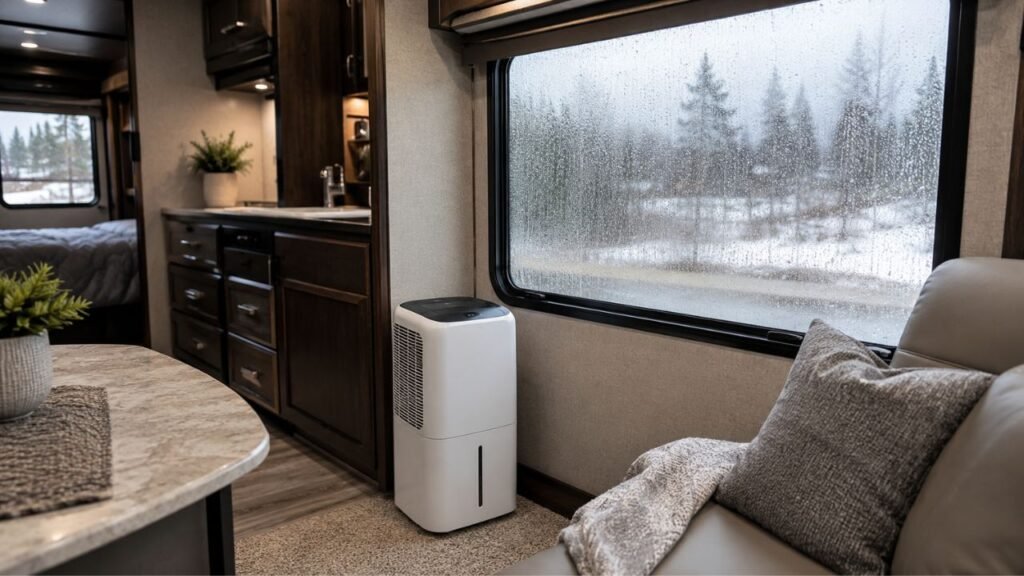
Yes, an RV dehumidifier can significantly reduce and often prevent window condensation. It removes moisture from the indoor air, lowers the dew point, and makes it harder for water droplets to form on cold RV windows. However, very cold single-pane windows may still develop some condensation.
The key is using the dehumidifier correctly and controlling moisture sources. Below, I’ll show you the best humidity range, proper setup, cold-weather limitations, and what to check when your windows remain wet.
Key Takeaways
- An RV dehumidifier can greatly reduce window condensation.
- Lower indoor humidity means less moisture available to reach cold glass.
- Around 30% to 50% relative humidity works for most RV conditions.
- Cold winter weather may require humidity closer to 30% to 40%.
- Single-pane windows usually condense sooner than double-pane windows.
- Ventilation during cooking and showering reduces the dehumidifier’s workload.
- Window insulation and dehumidification work better when used together.
- Moisture between double panes usually indicates a failed window seal.
Can a Dehumidifier Really Stop Condensation on RV Windows?
Yes, it can in many situations. A dehumidifier directly removes water vapor from the air inside your RV.
When there is less moisture in the air, the dew point drops. Your window glass must then become colder before condensation begins forming.
That makes a dehumidifier especially useful during cool and cold-weather camping. It can also help when several people are staying inside a small RV.
However, I would not expect completely dry windows under every condition.
If outdoor temperatures become extremely cold, your window glass can become cold enough for condensation to form even at relatively low indoor humidity.
Your results will depend on several things, including:
- Outdoor temperature
- Indoor temperature
- Window construction
- RV insulation
- Number of occupants
- Cooking and showering habits
- Dehumidifier capacity
- Air circulation around windows
Think of the dehumidifier as one part of the solution. It controls moisture, while insulation and airflow help keep window surfaces warmer.
Why Does Condensation Form on RV Windows?
RV window condensation happens when moist indoor air touches a surface cold enough to cool that air below its dew point. Windows usually become one of the coldest surfaces inside an RV, especially during winter.
Warm, Moist Air Meets Cold Glass
Your RV air always contains some water vapor.
Activities like showering, cooking, washing dishes, breathing, and drying clothes add even more moisture.
When that warm air reaches cold window glass, the nearby air cools.
Once it cools enough, it can no longer hold the same amount of moisture. Some water vapor changes into liquid droplets on the glass.
That is the condensation you see.
Why RV Windows Condense So Easily
RVs have much less interior air volume than houses.
That means moisture levels can rise surprisingly fast.
Two people sleeping inside an RV all night can add moisture simply through breathing. Add cooking, hot showers, wet jackets, or damp towels, and humidity climbs further.
RV windows also tend to have less insulation than residential windows. Many campers still use single-pane glass and metal frames.
Those surfaces cool quickly when outdoor temperatures fall.
Why Condensation Is Often Worse Overnight
Morning window condensation is especially common.
Several conditions come together overnight.
You are breathing for many hours inside a closed RV. Outdoor temperatures are often dropping at the same time.
You may also have blinds or curtains completely closed against the glass.
That reduces warm interior airflow around the window.
If you lower the thermostat significantly before sleeping, the interior surfaces can cool even more.
By morning, you may find droplets running down the windows and collecting inside the tracks.
What Humidity Level Helps Prevent RV Window Condensation?
There is no single humidity percentage that guarantees condensation-free windows. The colder your window becomes, the lower your indoor humidity may need to be.
A practical starting point looks like this:
| RV Condition | Practical Indoor RH | What You May Notice |
| Mild weather | 40% to 50% | Usually comfortable with little condensation |
| Cool-weather camping | 35% to 45% | Better control around windows |
| Cold winter camping | 30% to 40% | Helps protect colder glass surfaces |
| Very cold single-pane windows | Around 30% to 35% | May be necessary to reduce heavy sweating |
| Above 60% | Generally too humid | Greater risk of condensation and dampness |
These numbers should be treated as starting ranges rather than strict rules.
If your hygrometer says 45% but your windows remain soaked every morning, lower the target gradually.
If the windows stay dry at 45%, you probably do not need to force the RV down to 30%.
Your goal is finding the lowest humidity needed to prevent excessive condensation while keeping the RV comfortable.
This is also why simply saying “stay below 60%” can be misleading.
An RV can have 50% indoor humidity and still develop window condensation when the outside temperature becomes extremely cold.
How Does an RV Dehumidifier Prevent Window Condensation?
A dehumidifier does more than collect water inside a plastic tank. It changes the indoor conditions that allow condensation to form.
It Removes Water Vapor From the Air
A powered dehumidifier continuously pulls moist room air through the unit.
The machine removes some of that moisture and returns drier air.
As it continues running, the overall humidity inside your RV gradually decreases.
There is then less water vapor available to collect on your windows.
It Lowers the Dew Point Inside the RV
This is the part that really matters.
The dew point is the temperature where air becomes saturated enough for condensation to begin.
Higher humidity produces a higher dew point.
Lower humidity produces a lower dew point.
So when your dehumidifier reduces indoor moisture, your window glass must become colder before water starts forming.
That is why even a small drop in relative humidity can sometimes make a noticeable difference.
It Controls Moisture Before Water Reaches the Windows
Wiping your windows removes condensation after it forms.
A dehumidifier takes a more preventive approach.
It removes moisture from the air before that moisture becomes droplets.
You may still need to wipe a window occasionally during extremely cold weather. However, you should see less water collecting overall.
How Should You Use a Dehumidifier to Stop RV Window Condensation?
You will get better results when the unit is positioned and adjusted properly. Simply placing a dehumidifier anywhere inside the RV may not solve persistent condensation.
1. Measure the Humidity First
Start with a small digital hygrometer.
This tells you the actual relative humidity inside the RV.
Place it somewhere near the living area instead of directly beside the dehumidifier.
Avoid placing the hygrometer beside:
- The stove
- The shower
- An open roof vent
- A heating outlet
- The dehumidifier’s dry-air exhaust
Those locations can give readings that do not represent the whole RV.
2. Start Around 40% to 45% RH
For cool weather, I would start around 40% to 45%.
Watch your windows the following morning.
If they remain dry or only slightly damp, the setting may be enough.
If heavy water still forms, lower the target several percentage points.
3. Lower the Setting During Colder Weather
Your normal setting may stop working when temperatures suddenly fall.
That does not necessarily mean something is wrong with the dehumidifier.
The glass has simply become colder.
Try lowering the target closer to 35% to 40%.
Severe winter conditions and single-pane windows may require something near 30% to 35%.
4. Give the Unit Enough Airflow
Do not wedge the dehumidifier inside a tight corner.
Its air inlet and outlet need room.
A relatively central position usually works best because dry air can circulate throughout the RV.
If your bedroom windows are always wet while the living area stays dry, moving the unit closer overnight may also help.
5. Run It Before the Windows Become Soaked
Do not wait for water to start running down the glass.
Run the dehumidifier whenever indoor moisture is likely to rise.
That can include:
- Rainy days
- Cold nights
- After showering
- During extended cooking
- When several people are inside
- When wet clothing enters the RV
Preventive operation usually works better than trying to remove a large moisture buildup afterward.
6. Use Continuous Drainage When Possible
Frequent bucket emptying gets annoying quickly.
A full collection tank can also cause many units to shut down automatically.
Continuous drainage solves that problem when your RV setup allows it.
It can be especially useful for full-time RVers and extended winter stays.
Just make sure the drain hose has proper fall and cannot freeze outside.
Why Are My RV Windows Still Wet With a Dehumidifier Running?
A running dehumidifier does not automatically mean the RV is dry enough. If your windows remain wet, something else may be limiting the system.
Common causes include:
- The dehumidifier is too small for your RV.
- Your humidity setting is still too high.
- The unit has not been running long enough.
- Outdoor temperatures dropped significantly.
- Your RV has very cold single-pane windows.
- Curtains are trapping cold air against the glass.
- Reflective covers are hiding condensation behind them.
- Cooking produces moisture faster than the unit removes it.
- Hot showers are adding large amounts of water vapor.
- Wet towels or clothes are drying indoors.
- The collection tank is full.
- The dehumidifier filter is dirty.
- Furniture is blocking airflow.
- The unit performs poorly at your current temperature.
Check the hygrometer instead of judging the machine only by its water tank.
A dehumidifier may collect less water after successfully lowering indoor humidity.
The opposite can also happen. A full tank does not necessarily mean your indoor humidity has reached a safe level.
Can a Dehumidifier Completely Prevent Condensation in Freezing Weather?
Not always.
A dehumidifier controls one side of the condensation problem. It lowers the moisture level inside your RV.
It cannot directly stop window glass from becoming extremely cold.
Imagine camping when the outside temperature is 15°F.
A single-pane window may become much colder than the interior walls. Even indoor air at a reasonable humidity level can reach its dew point against that glass.
That is when you need to attack both parts of the problem.
Lower the indoor humidity with your dehumidifier.
Then try to keep the interior window surface warmer using better insulation and airflow.
You may also notice moisture around aluminum window frames. Metal transfers heat quickly, so those frames can become colder than nearby walls.
Does Window Type Affect How Well a Dehumidifier Works?
Yes. Window construction has a major effect on when condensation begins. Better-insulated windows usually stay warmer on their interior surfaces.
Single-Pane RV Windows
Single-pane glass provides very little thermal separation.
Cold outdoor temperatures quickly lower the temperature of the inside glass.
That means single-pane windows may start sweating even when the RV does not feel particularly humid.
A dehumidifier still helps, but you may need a lower RH setting during winter.
Double-Pane RV Windows
Double-pane windows create an insulating space between two pieces of glass.
The interior pane generally stays warmer than single-pane glass.
That gives you more protection from condensation.
You may still see some moisture during extreme weather, but it should usually require colder conditions or higher indoor humidity before appearing.
Condensation Between Double-Pane Glass
This is a different problem.
If the moisture is trapped between the panes instead of sitting on the interior surface, your dehumidifier will usually not fix it.
Condensation between sealed panes often points to a failed window seal.
Indoor humidity control cannot remove moisture trapped inside that sealed glass assembly.
Dehumidifier vs Ventilation vs Window Insulation for RV Condensation
Each method solves a different part of the condensation problem. You will usually get the best results by combining them instead of relying on one solution.
| Method | What It Changes | Best Use | Main Limitation |
| Dehumidifier | Lowers indoor moisture | Continuous humidity control | Requires electricity |
| Roof or exhaust fan | Removes moist air | Cooking and showering | Removes heated air too |
| Cracked window | Exchanges indoor air | Cool and dry conditions | Can add moisture in humid weather |
| Window insulation | Keeps glass warmer | Cold-weather camping | Does not remove indoor moisture |
| Double-pane windows | Reduces glass heat loss | Long-term condensation control | Expensive upgrade |
| Moisture absorbers | Slowly collect moisture | Cabinets and storage | Limited capacity |
The easiest way to remember this is simple.
A dehumidifier lowers the amount of moisture available.
Ventilation removes moisture when you produce it.
Window insulation makes the surface less likely to become cold enough for condensation.
Should You Vent the RV While Running a Dehumidifier?
Yes, but you do not necessarily need every vent open all day.
I recommend using ventilation heavily when you are creating moisture.
Run the bathroom exhaust fan during showers and afterward.
Use the range hood or roof vent while cooking.
Once the moisture-producing activity stops, you can close things up and let the dehumidifier maintain the indoor humidity.
You should also consider the outdoor conditions.
Opening a window works well when outdoor air is cool and relatively dry.
It may work poorly during warm, muggy weather because you can actually bring more moisture inside.
In other words, ventilation is most useful as source control.
The dehumidifier can then handle the remaining moisture.
What Moisture Sources Should You Control Along With the Dehumidifier?
Your dehumidifier has an easier job when you reduce unnecessary moisture first.
Watch these common RV moisture sources:
- Hot showers
- Boiling pasta or water
- Cooking without ventilation
- Washing dishes
- Wet towels
- Damp jackets
- Wet shoes and boots
- Drying laundry indoors
- Multiple sleeping occupants
- Pets
- Plumbing leaks
- Roof or window leaks
- Vent-free propane heaters
One heater detail is worth mentioning here.
A normal forced-air RV furnace usually vents its combustion gases outside. It should not be treated the same as an unvented propane heater.
A vent-free propane heater burns fuel directly inside the occupied space. That type of heater can add substantial moisture indoors.
So if condensation becomes dramatically worse whenever you use a portable unvented propane heater, the heater may be contributing to the problem.
Does Insulating RV Windows Help the Dehumidifier?
Yes, and this is one of the best combinations for winter camping.
Your dehumidifier lowers the dew point.
Window insulation helps keep the inside glass warmer.
Together, they make condensation less likely from both directions.
Common options include:
- Removable window film
- Insulated curtains
- Thermal window covers
- Reflective insulation
- Double-pane window upgrades
Just be careful when covering windows tightly.
A reflective panel pressed against cold glass can sometimes hide condensation behind it.
Remove the covering periodically and check for trapped moisture.
You do not want water sitting unnoticed inside window tracks or against wall materials.
Is a Compressor or Desiccant Dehumidifier Better for Window Condensation?
Both can work, but their strengths are slightly different. The best choice depends on the temperature inside your RV and how much moisture you need removed.
Compressor Dehumidifier
A compressor model is usually a good choice when your RV stays comfortably heated.
Benefits include:
- Strong moisture removal
- Good efficiency in warmer rooms
- Widely available sizes
- Built-in humidistats on many units
- Continuous-drain options
However, compressor units can become less effective when the surrounding air gets very cold.
Desiccant Dehumidifier
A desiccant unit removes moisture differently and often performs better at lower temperatures.
Common advantages include:
- Better cold-temperature performance
- No compressor
- Often lightweight
- Adds some warmth to discharged air
The tradeoff is electrical consumption. Some desiccant units can draw significant power.
Whichever type you choose, avoid focusing only on how small the machine looks.
A tiny unit may be convenient, but convenience means little if it cannot remove moisture fast enough for your RV.
How Long Should You Run a Dehumidifier in an RV?
There is no fixed number of hours that works for every camper.
Runtime depends on:
- RV size
- Starting humidity
- Number of occupants
- Outdoor temperature
- Weather
- Cooking habits
- Shower use
- Window type
- Dehumidifier capacity
If your unit has a humidistat, set your target and let the machine cycle automatically.
During winter, you may find that overnight operation makes the biggest difference.
That is when outdoor temperatures usually fall and several hours of breathing add moisture.
Instead of saying, “Run it for three hours,” watch the actual humidity level.
The hygrometer gives you a much better answer.
How Can You Tell Whether the Dehumidifier Is Working?
You should look for changes throughout the RV rather than only checking the collection bucket.
Good signs include:
- Indoor RH gradually drops.
- Morning window condensation decreases.
- Window tracks remain drier.
- Cabinets feel less damp.
- Musty smells become weaker.
- Water stops running down the glass.
- Condensation takes longer to appear after cooking.
- The dehumidifier cycles off after reaching its target.
Remember that water collection may eventually slow down.
That can actually be a good sign.
Once indoor air becomes drier, there is simply less moisture available for the machine to collect.
When Is Window Condensation Actually a Different Problem?
Not every wet RV window is caused by ordinary interior humidity. Before increasing dehumidifier runtime, look carefully at where the water appears.
Water on the Inside Surface of the Glass
This is the classic condensation pattern.
It usually becomes worse during cold weather and improves when humidity falls.
A dehumidifier should help.
Moisture Between Double-Pane Windows
This usually suggests a failed seal inside the window assembly.
The moisture is trapped where your indoor dehumidifier cannot reach it.
The window may eventually need repair or replacement.
Water Around the Frame After Rain
If the area becomes wet mainly during rain, investigate a leak.
Check:
- Exterior window sealant
- Frame seals
- Drainage openings
- Nearby wall joints
- Roof-to-wall seams
A dehumidifier cannot fix incoming rainwater.
Water Stains Below the Window
Repeated condensation can create stains below a window.
However, exterior water intrusion can produce similar damage.
Do not automatically assume humidity is responsible.
Inspect the area after rain and compare it with dry-weather conditions.
Common Mistakes That Keep RV Windows Condensing
Many condensation problems continue because small moisture-control mistakes happen every day.
Common mistakes include:
- Waiting until the windows are already soaked
- Assuming below 60% RH guarantees dry windows
- Using an undersized dehumidifier
- Never checking indoor humidity
- Closing curtains tightly against cold glass
- Leaving Reflectix installed without checking behind it
- Showering without the exhaust fan
- Cooking without ventilation
- Drying wet clothes inside the RV
- Ignoring a full dehumidifier tank
- Blocking the dehumidifier’s airflow
- Turning the thermostat much lower overnight
- Mistaking between-pane fogging for indoor condensation
- Ignoring possible window leaks
I would start with the easiest correction first.
Check the humidity level tonight, then inspect your windows tomorrow morning.
That simple comparison can tell you a lot about what needs changing.
Final Verdict: Can an RV Dehumidifier Prevent Window Condensation?
Yes. A properly sized dehumidifier is one of the most effective ways to reduce and prevent RV window condensation.
It works because it removes water vapor and lowers the indoor dew point. For many RVs, keeping relative humidity somewhere between 30% and 50% can dramatically reduce condensation.
During colder weather, you may need to stay closer to 30% to 40%.
Still, I would not rely on the dehumidifier alone.
Very cold single-pane windows can continue sweating because the glass temperature becomes extremely low.
For the best results, combine dehumidification, targeted ventilation, good airflow, and window insulation.
Control moisture when showering and cooking. Keep wet clothing from drying inside whenever possible. Monitor humidity with a hygrometer instead of guessing.
If you do those things together, you have a much better chance of waking up to dry windows instead of puddles running into the tracks.
Related FAQs
Will a Dehumidifier Stop Condensation on RV Windows Overnight?
A dehumidifier can greatly reduce overnight condensation if it lowers your RV humidity enough. Run it before bedtime and monitor RH with a hygrometer. Extremely cold single-pane windows may still develop light moisture.
What Humidity Should My RV Be to Stop Window Condensation?
Around 30% to 50% RH is a useful working range. During cold winter camping, you may need roughly 30% to 40% RH because colder glass reaches the condensation point sooner.
Is 60% Humidity Too High for an RV?
Sixty percent RH is generally higher than I would want for ongoing RV moisture control. It increases the chance of condensation on cold windows and can encourage damp conditions in poorly ventilated areas.
Why Do My RV Windows Sweat Even at 40% Humidity?
Your windows may simply be cold enough to reach the dew point at 40% RH. Single-pane glass, aluminum frames, freezing outdoor temperatures, and blocked airflow can all make condensation appear even at moderate humidity.
Should I Run My RV Dehumidifier All Night?
You can run a suitable dehumidifier overnight when needed, especially during cold or damp weather. A humidistat-equipped model is convenient because it can cycle automatically after reaching your target humidity.
Where Should I Put a Dehumidifier Inside an RV?
Place it where air can circulate freely around the unit. A fairly central location often works well. Keep the inlet and outlet away from walls, furniture, curtains, and other airflow restrictions.
Should I Crack a Window While Running an RV Dehumidifier?
Cracking a window can help when outdoor air is cool and dry, especially after cooking or showering. In humid weather, however, leaving a window open may bring additional moisture inside and increase the dehumidifier’s workload.
Does a Dehumidifier Help During Winter RV Camping?
Yes. Winter is often when a dehumidifier becomes most useful because warm indoor air repeatedly contacts cold windows and walls. Lower humidity reduces the chance of that moisture condensing on cold surfaces.
Will DampRid Stop Condensation on RV Windows?
DampRid can help control moisture in cabinets and other small enclosed spaces. However, it usually cannot remove moisture quickly enough to replace a powered dehumidifier in an occupied RV with persistent window condensation.
Do Double-Pane RV Windows Still Get Condensation?
They can, but usually less easily than single-pane windows. The interior pane normally remains warmer. Extreme cold, high indoor humidity, or poor airflow can still cause surface condensation.
Why Is There Moisture Between My RV Window Panes?
Moisture trapped between double-pane windows usually indicates that the sealed glass assembly has failed. An indoor dehumidifier generally cannot remove that moisture because it is trapped between the panes.
Does Propane Heat Cause RV Window Condensation?
Unvented propane heaters can add substantial moisture directly to RV air. A typical forced-air RV furnace vents combustion gases outside, so it should not be treated the same as an unvented portable propane heater.
Can Reflectix Make RV Window Condensation Worse?
Reflectix can reduce heat loss, but tightly covering cold glass may trap moisture behind the panel. Remove it periodically and inspect the glass and window tracks so hidden condensation does not remain for long periods.
Can RV Window Condensation Cause Mold?
Yes. Occasional droplets are usually manageable, but repeated moisture around window tracks, walls, curtains, and trim can create damp conditions where mold and mildew are more likely to develop.

Ethan Walker writes about travel routes, outdoor exploration, and road-based adventures. His guides focus on simple planning, dependable gear, and realistic travel advice. He values comfort, safety, and practical experience over hype.