Yes, you can leave an RV sewer hose connected at a full-hookup campsite during your stay. The important part is keeping the black tank valve closed until you are ready to dump. You can also keep the gray valve closed, which is usually the simplest approach for most RV owners.
Below, I’ll explain how to manage both valves, set up the hose safely, prevent odors and clogs, handle long stays, and dump your tanks correctly.
Key Takeaways
- You can usually leave your RV sewer hose connected at full hookups.
- Keep the black tank valve closed between dumping sessions.
- Keeping the gray valve closed is also helpful for most campers.
- Dump the black tank first, then use gray water afterward.
- Secure the campground connection so sewage and odors cannot escape.
- Support the hose so wastewater does not collect in low spots.
- Campground rules may require specific sewer fittings or hose supports.
- Freezing weather may make continuous hose connection a poor choice.
Can You Leave an RV Sewer Hose Hooked Up for Your Entire Stay?
You can normally keep the sewer hose connected throughout your stay when you have a dedicated sewer hookup at your campsite.
I often think of the hose as simply being ready for use. Connecting it does not mean wastewater needs to flow through it continuously.
Your holding tanks can remain closed while the sewer hose stays attached.
When a tank needs emptying, you simply open the appropriate valve. Once dumping finishes, close the valve again.
That saves you from handling and reconnecting the sewer hose repeatedly.
It makes especially good sense during week-long or extended campground stays.
However, there is an important distinction:
Leaving the sewer hose connected is usually fine. Leaving the black tank valve open is not.
Those are two completely different things.
For an overnight stay, you might not need the sewer hose connected at all. If your tanks are nearly empty, you could simply dump before departure.
For longer stays, leaving everything properly connected is usually more convenient.
Should RV Black and Gray Tank Valves Stay Open or Closed?
Leaving your hose connected raises another question: what should you do with the two holding-tank valves? Black and gray tanks should not necessarily be managed the same way.
Black Tank Valve: Keep It Closed
Your black tank valve should normally remain closed while camping.
The black tank needs enough water inside to keep toilet waste suspended. That liquid also helps move everything quickly during dumping.
If you leave the valve open, liquids can continuously drain away.
Solid waste and toilet paper may remain behind.
Over time, waste can accumulate underneath the toilet and eventually create a stubborn blockage commonly called a poop pyramid.
You may also notice:
- Stronger tank odors
- Incorrect tank-level readings
- Poor tank drainage
- Waste buildup
- Difficult tank cleaning
Keeping the valve closed prevents most of these problems.
Allow waste and water to accumulate normally. Then dump the tank when it has enough volume for a strong discharge.
Gray Tank Valve: Open or Closed?
The gray valve gives you more flexibility.
Technically, many RV owners leave it open while connected to full hookups. Shower and sink water can then drain directly into the sewer.
However, I generally recommend keeping it closed unless you have a reason not to.
Keeping gray water gives you something valuable: a large amount of relatively cleaner wastewater for rinsing your sewer hose after dumping the black tank.
A closed gray valve can also help reduce sewer odors.
There are situations where temporarily leaving it open makes sense.
You might consider it when:
- Taking several showers each day
- Using an RV washing machine
- Staying several weeks
- Having a particularly small gray tank
Just remember to close it before your final black-tank dump.
That gives you enough gray water to rinse afterward.
Quick Valve-Position Guide
| Camping Situation | Black Valve | Gray Valve | Sewer Hose |
| Normal full-hookup stay | Closed | Preferably closed | Connected |
| Dumping black tank | Open temporarily | Closed | Connected |
| Rinsing after black dump | Closed | Open temporarily | Connected |
| Heavy shower or washer use | Closed | Can be open | Connected |
| Freezing weather | Closed | Closed | Connect mainly when needed |
| Preparing to leave | Closed after dumping | Closed after dumping | Disconnect |
What Happens If You Leave the Black Tank Valve Open?
Leaving the black valve open may seem convenient, but it changes how waste behaves inside your holding tank. Understanding what happens makes the closed-valve recommendation easier to remember.
Liquids Drain Faster Than Solids
Liquid waste can easily flow toward the sewer outlet.
Solid waste cannot move as easily without enough surrounding liquid.
With the valve continuously open, water leaves before it can help carry solids away.
That is exactly what you do not want inside a black tank.
Solid Waste Starts Accumulating
Eventually, toilet paper and solid waste can begin collecting on the tank floor.
More waste gets deposited in the same area each time.
The pile can gradually become harder and more difficult to remove.
Once severe buildup develops, simply opening the valve might accomplish very little.
Odors and Clogs Become More Likely
Waste buildup does more than reduce tank capacity.
It can also interfere with sensors and contribute to persistent odors.
Your black tank may appear full even after dumping.
In more serious cases, waste can restrict the tank outlet completely.
What If You Already Left the Black Valve Open?
Don’t assume the tank is ruined.
Start by closing the black valve.
Add plenty of water through the toilet so waste can soak.
Allow the tank to accumulate enough liquid before dumping again.
Afterward, use your RV’s built-in black-tank flush system if equipped.
Several cycles may be needed for moderate buildup.
If the tank remains blocked, professional tank cleaning may become necessary.
The key is correcting the problem before buildup gets worse.
Should You Keep the Gray Tank Valve Closed Too?
You have more freedom with the gray tank, but keeping it closed is usually the easiest system for beginners.
Some campers prefer leaving it open so showers and sinks drain continuously.
That can be convenient during an extended stay.
However, closing it provides several advantages:
- You save water for rinsing the sewer hose.
- Wastewater exits with stronger flushing force.
- Soap and food residue spend less time inside the hose.
- You add another barrier between your RV and campground sewer.
- You maintain better control over when wastewater leaves the RV.
My preferred routine is simple.
Keep both valves closed during normal camping.
Dump the black tank when needed.
Then dump the gray tank immediately afterward.
You get a predictable routine without constantly thinking about valve positions.
If your gray tank fills quickly, you can always adjust later.
How Should You Set Up a Sewer Hose If You Leave It Connected?
If the hose will sit outside for several days, proper setup becomes more important. A secure connection protects your campsite from leaks, odors, accidental separation, and standing wastewater.
Secure the Hose to the RV Outlet
Start at the RV waste outlet.
Make sure the bayonet-style fitting fully engages with the connection tabs.
Don’t stop after partially twisting it into place.
Inspect the gasket inside the fitting as well.
A flattened, missing, or damaged seal can cause leaks around the connection.
Replace questionable seals before beginning a long campsite stay.
Make a Secure Connection at the Sewer Inlet
The opposite end needs a secure campground sewer connection.
Many sewer hose kits include an elbow or threaded adapter.
Use the connection system required by your campground.
The goal is to prevent:
- Wastewater leaks
- Sewer-gas escape
- Accidental disconnection
- Loose hoses moving around the campsite
Never simply push an unsecured hose into an open sewer pipe.
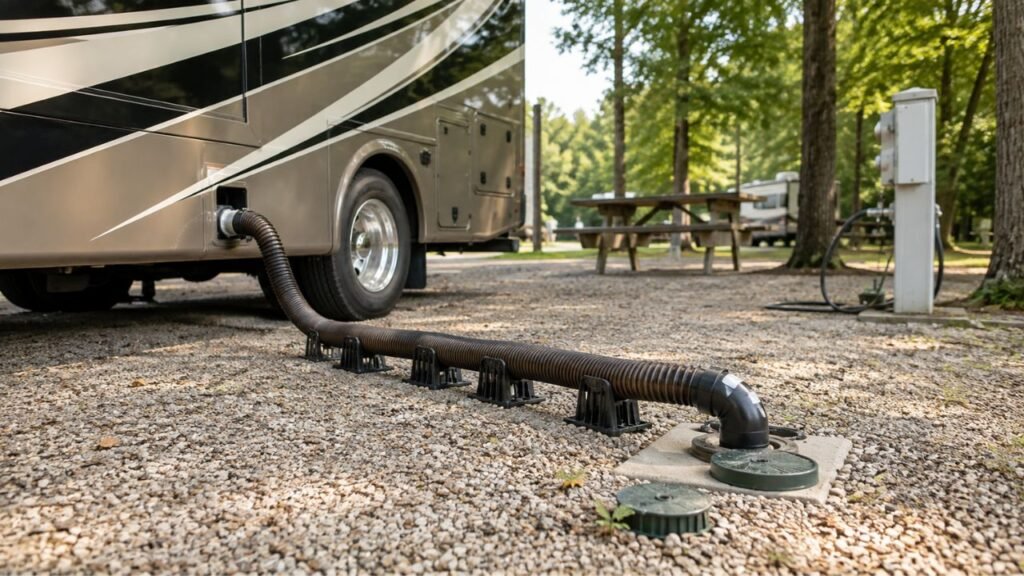
Support the Hose With a Downhill Slope
Use a sewer-hose support when practical or required.
The hose should gradually slope downward toward the campground sewer inlet.
Try to avoid deep dips.
Low areas can collect gray water and waste instead of allowing complete drainage.
Standing wastewater also becomes a bigger problem during freezing temperatures.
A consistent slope makes each dump quicker and cleaner.
Keep the Hose Away From Traffic
Think about where people and vehicles move around your site.
Avoid running the sewer hose across:
- Walking paths
- Driveways
- Vehicle tire paths
- Outdoor seating areas
- Children’s play areas
Also consider campground landscaping equipment.
A hose that sits somewhere harmless today could be damaged during mowing tomorrow.
Check the Connection Occasionally
Don’t connect the hose on arrival and ignore it for three weeks.
Take a quick look occasionally.
Check for:
- Wet spots
- Loose fittings
- Sagging supports
- Small cracks
- Sewer odors
- Hose movement
Catching a small problem early prevents a much less pleasant cleanup.
Do Campgrounds Allow Sewer Hoses to Stay Connected?
Most full-hookup campsites are designed for RV sewer connections, but individual campground rules still matter.
There is no single setup requirement used by every campground in America.
Before leaving your hose connected, check campground rules concerning:
- Airtight sewer connections
- Threaded adapters
- Sewer donuts
- Hose supports
- Hose placement
- Gray-water discharge
- Long-term connections
- Wastewater leaks
Some RV parks require the sewer connection to be properly sealed.
Others may also require the hose to remain elevated.
If you are unsure, ask campground staff before setting everything up.
Following their rules protects both you and neighboring campers.
Is It Better to Leave the Hose Connected or Connect Only When Dumping?
Both approaches can work. The better choice depends mainly on your stay length, campsite layout, weather, and how often you expect to dump.
| Setup | Advantages | Drawbacks | Best For |
| Leave hose connected | Convenient and ready for dumping | More weather exposure and potential damage | Week-long or extended stays |
| Connect only when dumping | Protects hose while stored | Requires repeated setup and handling | Overnight trips and short weekends |
For one night, I would not feel obligated to connect everything immediately.
You might use only a small portion of your tank capacity.
Simply dump before leaving if necessary.
For a week or longer, however, keeping the hose properly connected usually becomes worthwhile.
The important part is not the number of days.
It is whether the hose remains secure and your valves stay properly managed.
How Often Should You Dump While the Hose Stays Connected?
There is no fixed schedule that works for every RV.
A couple using a large black tank may go much longer between dumps than a family traveling with children.
Your dumping frequency depends on:
- Holding-tank capacity
- Number of campers
- Toilet usage
- Shower frequency
- Dishwashing habits
- Washing-machine use
Avoid dumping the black tank every time only a small amount enters it.
You want enough liquid inside to create a strong flushing action.
Many RVers wait until the tank is substantially filled before dumping.
You do not need to chase an exact percentage.
More importantly, don’t let the tank become completely full and risk backup.
Learn how quickly your particular RV fills during normal camping.
After several trips, your dumping schedule becomes much easier to predict.
What Is the Correct Dumping Order at a Full-Hookup Campsite?
Dumping in the right order keeps the process cleaner. The basic idea is simple: let the dirtiest wastewater leave first, then use gray water to help rinse everything afterward.
- Put on dedicated sanitation gloves.
- Verify both sewer-hose connections are secure.
- Make sure the gray valve remains closed.
- Open the black tank valve completely.
- Let the black tank finish draining.
- Flush the black tank if your RV allows it.
- Close the black tank valve completely.
- Open the gray tank valve.
- Let gray water rinse through the sewer hose.
- Close the gray valve after drainage finishes.
Once you remember black first, gray second, the routine becomes simple.
The gray water will not sanitize the hose.
However, it can help move remaining black-water residue toward the sewer.
Can Sewer Gas Enter the RV Through a Connected Hose?
A properly functioning RV should not constantly smell like the campground sewer simply because the hose is connected.
Your plumbing system contains traps and vents designed to control odors.
Problems can still occur, though.
An open gray valve can create a more direct pathway between your RV drainage system and the campground sewer.
Normally, water inside sink and shower P-traps helps block that pathway.
However, odors may become noticeable when:
- A P-trap dries out
- Plumbing seals leak
- A sewer fitting is loose
- The roof vent has problems
- A gray tank contains heavy residue
- Air pressure pulls odors inside
Keeping the gray valve closed creates another barrier.
If you repeatedly smell sewage inside your RV, investigate the cause.
A constant sewer smell should not simply be considered normal camping.
Should You Leave the Sewer Hose Connected During Hot or Freezing Weather?
Weather matters when your sewer hose will remain exposed for days. Heat mainly affects durability, while freezing temperatures can interfere with drainage and damage fittings.
Leaving the Hose Connected in Hot Weather
Hot summer temperatures do not automatically require disconnection.
However, direct sunlight can gradually age flexible sewer-hose material.
Check older hoses for:
- Brittle sections
- Cracks
- Discolored plastic
- Weak fittings
- Damaged seals
Avoid stretching the hose extremely tight.
Give it enough flexibility to handle small movements without pulling on fittings.
This becomes especially important during long seasonal stays.
Leaving the Hose Connected in Freezing Weather
Freezing weather requires more caution.
Any wastewater remaining inside a low section of hose can freeze.
Ice may block drainage or stress fittings and flexible hose material.
During freezing conditions, I prefer keeping both valves closed.
Connect or use the exposed sewer hose mainly when dumping.
If you leave it attached, maintain a good downhill slope.
Make sure wastewater drains completely after each use.
Don’t leave either tank valve open continuously just because temperatures are cold.
That can create more problems instead of preventing freezing.
When Should You Not Leave an RV Sewer Hose Connected?
Leaving the hose connected is convenient, but it is not always appropriate.
Consider disconnecting it when:
- The campsite has no individual sewer hookup.
- Campground rules prohibit unattended connections.
- Your hose has cracks or weak fittings.
- Wastewater is leaking around either connection.
- The sewer inlet cannot be properly secured.
- The hose must cross a busy walking path.
- Vehicles could drive across the hose.
- Severe freezing conditions are expected.
- You are using a shared dump station.
- You will leave the RV unattended for an extended period.
A dump station is especially important to distinguish from a full-hookup campsite.
Dump stations are shared facilities.
Connect, empty your tanks, clean up, and move away when finished.
Do not leave your RV permanently connected there.
What Should You Do Before Leaving the Campsite?
Before pulling away, perform one final dump and store your sewer equipment carefully.
- Verify the sewer hose remains securely connected.
- Dump the black tank first.
- Flush the black tank if appropriate.
- Close the black valve completely.
- Open and drain the gray tank.
- Close the gray valve completely.
- Disconnect the campground end carefully.
- Allow remaining water to drain from the hose.
- Disconnect the hose from your RV.
- Replace the RV waste-outlet cap.
- Secure the campground sewer cover.
- Store the sewer hose in its dedicated location.
Keep sewer equipment separated from your fresh-water equipment.
Your potable-water hose, filters, and drinking-water fittings should never be stored loose with sewer equipment.
Final Words
Yes, you can leave an RV sewer hose connected at a campsite when you have a proper full-hookup sewer connection.
Just remember that hose connected does not mean valves open.
Keep your black tank valve closed between dumps.
For most campers, keeping the gray valve closed is also convenient.
When it is time to empty your tanks, dump black first and gray second.
Secure the hose, maintain a downhill slope, watch for leaks, and follow campground rules.
Once you follow that routine, leaving the sewer hose connected can make full-hookup camping much easier without creating unnecessary tank problems.
Related FAQs
Can I Leave My RV Sewer Hose Connected Overnight?
Yes. If you have a dedicated full-hookup campsite, you can normally leave the sewer hose connected overnight. Keep the black tank valve closed and make sure both hose connections remain secure.
Can I Leave My Black Tank Open at a Full-Hookup Campsite?
No. Keep the black tank valve closed until you are ready to dump. Continuous drainage can allow liquids to escape while toilet paper and solid waste remain inside the tank.
Can I Leave My Gray Tank Open at a Full-Hookup Campsite?
You can, but keeping it closed is often more useful. Stored gray water gives you a strong rinse after dumping your black tank and can provide another barrier against campground sewer odors.
How Full Should an RV Black Tank Be Before Dumping?
Let the tank collect enough wastewater for a strong dump instead of emptying tiny amounts frequently. Many RVers dump when the tank is substantially full while avoiding the risk of completely overfilling it.
Should I Leave Both RV Tank Valves Closed?
For most campers, yes. Keeping both valves closed provides predictable tank management, prevents black-tank waste buildup, and saves gray water for rinsing the sewer hose after dumping.
Does an RV Sewer Hose Need a Support at a Campsite?
A support is highly useful and may be required by your campground. It helps maintain a downhill slope, reduces low spots, and keeps the hose positioned neatly between your RV and sewer inlet.
Why Does My RV Smell Like Sewer When the Hose Is Connected?
A sewer smell can come from an open gray valve, dry P-traps, loose sewer fittings, plumbing vent problems, or tank residue. Check the plumbing system instead of assuming the smell is unavoidable.
Can an RV Sewer Hose Freeze While Connected?
Yes. Wastewater trapped inside low spots can freeze during cold weather. Maintain a continuous slope, keep tank valves closed, and consider connecting the exposed hose only when you need to dump.
Should I Disconnect My Sewer Hose When Leaving the RV for the Day?
Usually, you do not need to disconnect it for a normal day trip when your campsite connection is secure. However, disconnect it if campground rules, weather, damage risks, or site conditions make leaving it unattended unsafe.
Can You Leave an RV Sewer Hose Connected for a Month?
Yes, provided the campground allows it and the connection remains secure. Inspect the hose periodically for leaks, cracks, UV damage, sagging supports, and loose fittings during an extended stay.
Do You Dump the Black or Gray Tank First?
Dump the black tank first. Close its valve after drainage finishes, then empty your gray tank so the gray wastewater can help rinse residue from the RV outlet and sewer hose.
Do RV Campgrounds Require an Airtight Sewer Connection?
Some do, while requirements vary between campgrounds. Check the campground’s wastewater rules before arriving because you may need a threaded fitting, sewer adapter, seal, or approved hose support.

Ethan Walker writes about travel routes, outdoor exploration, and road-based adventures. His guides focus on simple planning, dependable gear, and realistic travel advice. He values comfort, safety, and practical experience over hype.