Yes, low water pressure can stop an RV tankless water heater. When pressure becomes too weak, water flow through the heater may fall below its minimum activation rate. The flow sensor then cannot detect enough demand, so the burner may not ignite or may shut off during use.
The tricky part is figuring out whether pressure is actually responsible. I’ll show you how pressure and flow work together, what commonly restricts water, and how you can narrow down the problem without replacing parts unnecessarily.
Key Takeaways
- Low water pressure can prevent an RV tankless heater from starting.
- Tankless heaters respond mainly to water flow measured in GPM.
- Each heater has its own minimum activation flow requirement.
- Filters, regulators, screens, hoses, and fixtures can restrict water flow.
- Comparing city water with your RV pump helps locate the problem.
- Never increase RV water pressure beyond your system’s safe limit.
- A heater that works only at full faucet flow likely has marginal flow.
How Does Low Water Pressure Stop an RV Tankless Water Heater?
An RV tankless water heater does not simply heat water constantly. It waits until you open a hot-water faucet.
Water then begins moving through the heater. An internal flow sensor detects that movement and signals the control system. Once enough flow is detected, the burner can ignite and begin heating the water.
If water movement is too weak, that sequence can stop.
The faucet may be open, but the heater does not recognize enough demand. You may get completely cold water, intermittent hot water, or a burner that starts and quickly shuts down.
This is where two terms become important.
PSI measures water pressure.
GPM measures how much water actually flows each minute.
Your tankless heater is particularly concerned with the second measurement.
Low PSI can certainly reduce GPM. However, you can also have reasonable pressure and poor flow because something inside the plumbing is restricting the water.
That distinction can save you considerable troubleshooting time.
How Much Water Flow Does an RV Tankless Water Heater Need?
Different tankless heaters have different minimum flow requirements. Because of that, you should always check the specifications for your exact model before deciding that your water pressure is inadequate.
| RV Tankless Heater Example | Approximate Minimum Flow | What It Means for You |
| Some Furrion RV tankless models | Around 0.32 GPM | Very low flow may prevent proper activation |
| Suburban IW60/IW60RL | Around 0.5 GPM | Flow below this level may stop heating |
| Truma AquaGo | Around 0.4 GPM | Burner requires sufficient water movement |
| Some Fogatti RV models | Around 0.5 GPM | Minimum requirements vary by specific model |
These numbers are examples rather than universal specifications.
One heater might operate happily at a flow rate where another struggles. Model updates can also change specifications.
For that reason, I would use these figures only as references. Check your owner’s manual for the actual minimum flow and pressure limits.
What Are the Signs That Water Flow Is Too Low?
Low-flow problems often create recognizable symptoms. Watching exactly when your heater fails can give you a strong clue before you start taking anything apart.
- The heater does nothing after opening the hot faucet.
- Water stays cold even though propane and power are available.
- The burner starts but shuts down several seconds later.
- Hot water repeatedly changes from hot to cold.
- The heater works only with the hot faucet fully open.
- The kitchen faucet works, but the shower does not.
- Hot water disappears when someone flushes the RV toilet.
- The heater works from the freshwater tank but not city water.
- Increasing faucet flow suddenly causes the burner to start.
- A low-flow or similar fault appears on the controller.
These symptoms point toward a flow problem, but they do not automatically prove that campground water pressure is low.
A clogged filter, restrictive showerhead, dirty heater screen, or failing regulator can create nearly identical symptoms.
What Causes Low Water Flow Through an RV Tankless Heater?
Low campground pressure is only one possible cause. Before blaming the heater, I would work through the water system from the campground connection toward the appliance.
Weak Campground Water Pressure
Some campgrounds simply have weak or inconsistent water pressure.
The problem may become worse during busy periods when many RVs use water simultaneously. You might notice good pressure early in the morning but weak flow later.
One useful clue is location.
If your heater performs normally at one campground but struggles at another, the campsite supply should move high on your troubleshooting list.
A Restrictive or Faulty Water Pressure Regulator
Your RV water pressure regulator protects the plumbing from excessive pressure.
However, it can also become a restriction.
Sediment can collect inside older regulators. Cheap fixed regulators may also provide adequate pressure while limiting the volume of water passing through them.
An adjustable regulator can create similar problems when incorrectly adjusted.
Remember that a regulator cannot create pressure. If the campground provides weak water pressure, adjusting the regulator higher will not magically increase the available supply.
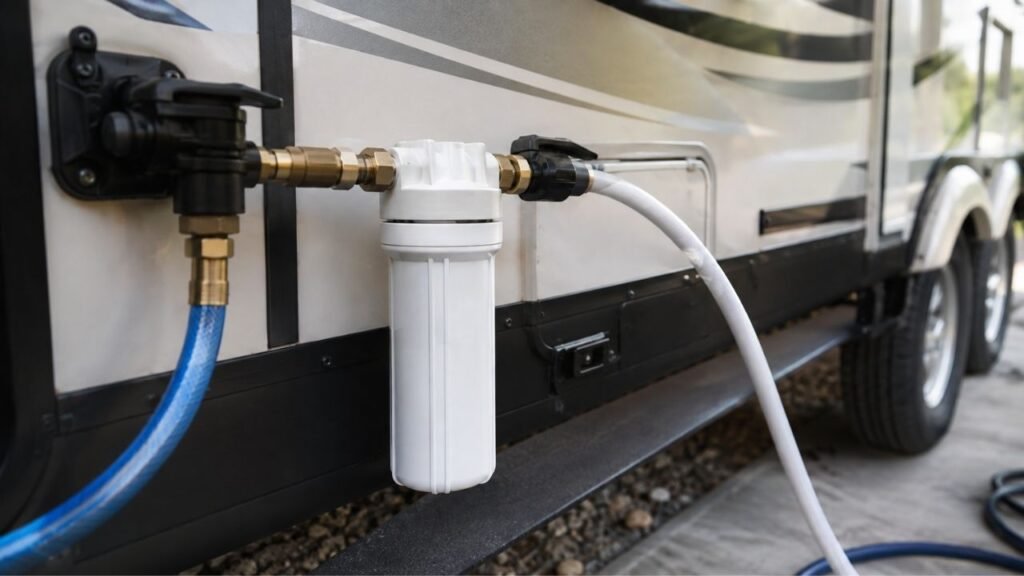
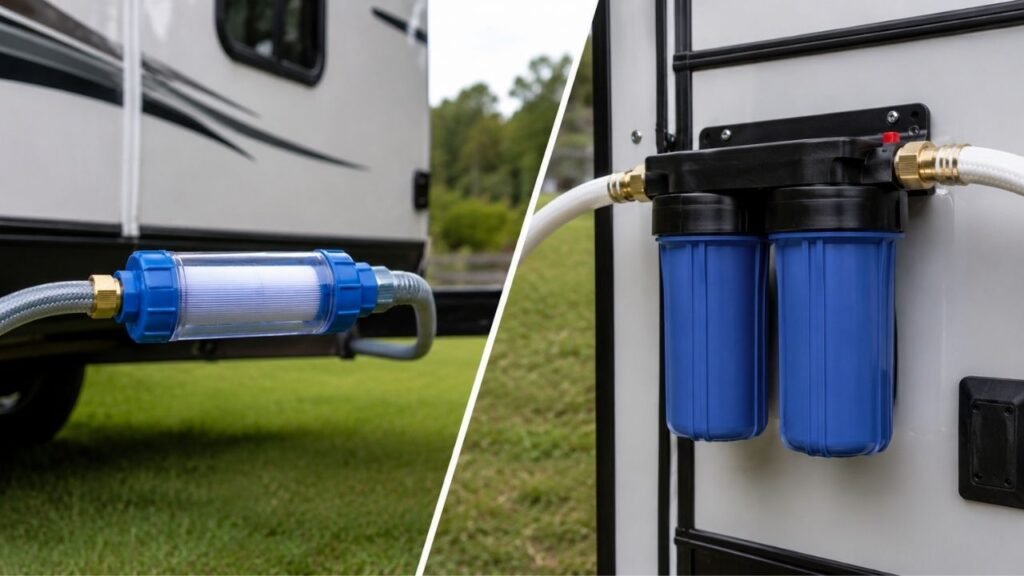
A Clogged RV Water Filter
Water filters gradually collect sediment, rust, minerals, and other debris.
As the cartridge becomes clogged, water has more difficulty passing through it.
You may still see water coming from the faucet, but the available GPM can fall enough to affect your tankless heater.
Multiple filters installed together can create even more restriction.
If the problem started after installing a new filter, check whether that cartridge is designed for adequate RV flow.
A Dirty Water Heater Inlet Screen
Many tankless heaters have a small screen near their water inlet.
Its job is to stop debris before that material reaches sensitive internal components.
Unfortunately, that screen can eventually become clogged itself.
This is an especially important place to check when cold-water pressure seems strong while hot-water flow throughout the RV feels noticeably weaker.
Turn off the water supply and relieve system pressure before removing any inlet screen. Follow the procedure provided for your particular heater.
A Restrictive Showerhead or Faucet Aerator
A tankless heater may work perfectly at your kitchen faucet and fail during showers.
That usually tells you something useful.
The showerhead may be restricting water enough to drop below the heater’s required flow rate.
Low-flow showerheads, mineral buildup, clogged screens, and aggressive water-saving restrictors can all reduce GPM.
The same thing can happen with a faucet aerator.
If only one fixture causes trouble, inspect that fixture before assuming the heater is defective.
A Kinked Hose or Partially Closed Valve
Sometimes the problem is surprisingly simple.
Walk along your freshwater hose and look for sharp bends, flattened areas, or sections trapped beneath something heavy.
Then check your valves.
Make sure the campground spigot is fully open. Also verify that your RV’s water valves and heater bypass valves are positioned correctly.
A partially closed valve can restrict volume without stopping water completely.
A Weak or Cycling RV Water Pump
When boondocking, your onboard pump becomes the source of water pressure.
A weak pump may struggle to maintain enough flow for a tankless heater.
Before replacing it, check simpler causes.
Make sure your freshwater tank contains enough water. Clean the pump strainer and inspect the suction line for air leaks.
Listen to the pump while running hot water.
A pump that rapidly cycles on and off may not be supplying the smooth flow your heater needs.
Air Trapped in the Water Lines
Air can enter RV plumbing after winterization, freshwater tank refilling, filter changes, or plumbing repairs.
That trapped air can cause sputtering and unstable water movement.
Open your faucets and let water run until the stream becomes steady.
Do this before moving toward more complicated heater diagnosis.
Scale Buildup Inside the Water Heater
Hard water can leave mineral deposits inside the tankless heater.
Over time, those deposits can narrow internal water passages.
This creates an interesting situation.
Your campground pressure may be perfectly acceptable, yet water flow through the heater remains weak.
Scale becomes more likely when hot-water flow has gradually decreased over months rather than failing suddenly.
Follow your heater manufacturer’s descaling instructions rather than improvising a chemical cleaning procedure.
A Dirty or Failing Flow Sensor
The flow sensor itself can eventually become dirty or defective.
Consider this possibility after confirming that adequate water is actually passing through the heater.
If measured flow is comfortably above the manufacturer’s minimum but the heater still does not recognize demand, the sensor may require inspection.
Internal gas, combustion, and electrical repairs are better left to a qualified RV technician.
How to Check Whether Water Pressure Is Really the Problem
You do not need to guess. A few simple tests can help separate campground pressure problems from restrictions inside your RV.
Open Only One Hot-Water Faucet
Start with the easiest test.
Turn off every other water fixture inside the RV. Then open one hot-water faucet.
Try opening it farther than usual.
Watch what the heater does.
If the burner suddenly starts when water flow increases, you are probably dealing with a marginal-flow condition.
Now reduce the flow slowly.
If the burner shuts down at lower flow, your heater may simply be falling below its activation threshold.
Measure the Hot-Water Flow Rate
You can perform a basic flow test with a one-gallon container and timer.
Run only hot water into the container and measure how long filling one gallon takes.
Use this simple calculation:
GPM = 60 ÷ seconds needed to collect one gallon
For example:
- 30 seconds equals approximately 2 GPM.
- 60 seconds equals approximately 1 GPM.
- 120 seconds equals approximately 0.5 GPM.
Compare your result with the minimum flow specification for your heater.
If you are below that minimum, you have confirmed a flow problem. Your next job is discovering what causes it.
Check Water Pressure With a Gauge
A hose-thread pressure gauge is useful for measuring campground water pressure.
Connect the gauge at the water source and check the reading.
However, do not rely entirely on static pressure.
Static pressure is what you see while little or no water is moving. Pressure can look acceptable until you open a faucet.
What matters is whether the supply maintains enough pressure and flow during actual demand.
That is why combining a pressure gauge with a flow test gives you much better information.
Compare City Water With the RV Water Pump
This is one of my favorite tests because it quickly divides the system into two possibilities.
Turn off and disconnect campground water.
Make sure your freshwater tank contains enough water. Turn on your RV water pump and use the same hot-water fixture again.
If the heater suddenly works normally, the appliance itself is probably capable of operating.
Your problem is more likely somewhere before the RV’s internal plumbing.
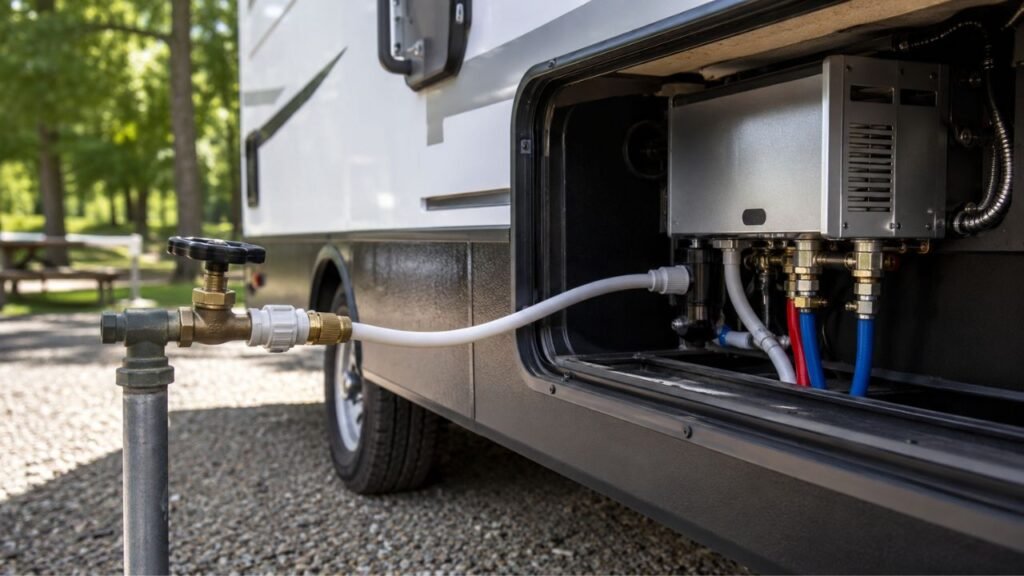
Check the campground spigot, regulator, freshwater hose, external filter, and city-water connection.
If the heater performs poorly on both city water and the pump, look more closely at internal restrictions or the heater.
Test Water Restrictions One at a Time
Avoid changing five things simultaneously.
Start at the water source and move toward the heater.
You can investigate in this order:
- Campground supply.
- Pressure regulator.
- Freshwater hose.
- External water filter.
- RV city-water inlet.
- Water pump and strainer.
- Heater inlet screen.
- Faucet aerator or showerhead.
- Internal heater restriction.
Change or inspect one item at a time.
This method helps you identify the actual cause instead of accidentally fixing the problem without knowing why.
How Do You Fix Low Water Flow to an RV Tankless Water Heater?
Once you have confirmed insufficient flow, start with simple restrictions before considering expensive heater repairs.
Fully Open the Water Supply
Check the campground spigot first.
Make sure it is completely open and not damaged.
Then inspect any supply or bypass valves inside your RV.
A valve left halfway closed after winterization or maintenance can restrict flow throughout the hot-water system.
Clean the Heater Inlet Screen
Turn off the water source and relieve plumbing pressure.
Locate the water inlet screen according to your heater manual.
Remove debris carefully and reinstall the screen correctly.
If you regularly camp in areas with sediment-heavy water, this screen may need occasional inspection.
Clean or Replace Clogged Water Filters
A disposable filter cartridge usually needs replacement rather than cleaning.
Reusable screens can often be rinsed.
If your heater begins working after replacing a heavily clogged filter, you have probably found the restriction.
Choose replacement filters that provide enough flow for your RV’s normal water demand.
Check the Water Pressure Regulator
Inspect your regulator for visible debris or damage.
If you use an adjustable model, verify its setting with a pressure gauge.
A regulator should protect your plumbing without choking water flow.
Do not permanently remove it simply because doing so improves heater performance. Campground pressure can suddenly rise and potentially damage RV plumbing.
Straighten the Freshwater Hose
Remove sharp bends and kinks from the hose.
Avoid running it where tires, leveling equipment, storage boxes, or other objects can compress it.
If an old hose has become soft or internally damaged, replacement may restore better flow.
Clean the Showerhead and Faucet Aerators
Unscrew and inspect the affected fixture.
Mineral buildup and debris often collect around small screens and outlet holes.
If your heater works everywhere except one faucet or shower, this should be one of your first checks.
Purge Air From the Plumbing
Open faucets and allow water to run steadily.
Begin with cold water, then move to hot.
Continue until sputtering stops and the water stream becomes smooth.
This simple step is especially useful after winterization or plumbing maintenance.
Use the Onboard Pump When Campground Pressure Is Weak
A functioning onboard pump may provide steadier water flow than a weak campground connection.
You can fill your freshwater tank and use the pump temporarily when campsite pressure is inadequate.
This is also a useful diagnostic test.
However, it should not be used to hide a failing pump or severe plumbing restriction.
Service or Replace a Weak Water Pump
If your tankless heater struggles only while using the freshwater tank, inspect the pump system.
Clean the strainer first.
Check for air entering the suction side and confirm the pump receives proper voltage.
If the pump still cannot maintain its rated output, repair or replacement may eventually be necessary.
Descale the Tankless Heater
Consider descaling when external pressure is good but hot-water flow remains restricted.
This is especially likely after long-term use with hard water.
Follow the cleaning method specified by your heater manufacturer.
Different heaters use different procedures, so avoid assuming one flushing process works for every model.
Can a Water Pressure Regulator Make the Problem Worse?
Yes. A water pressure regulator can contribute to low-flow problems when it becomes clogged, damaged, undersized, or incorrectly adjusted.
Your regulator still serves an important purpose. Campground water systems sometimes deliver pressure higher than RV plumbing should handle. Removing your regulator permanently just to gain more flow is not a good solution.
Instead, confirm the campground pressure and evaluate the regulator itself.
A good regulator should maintain safe pressure while allowing enough water volume for your shower, faucets, and tankless heater.
Should You Increase Water Pressure to Make the Heater Ignite?
Increasing pressure may help when your incoming supply is genuinely too low, but you should not increase it blindly.
The safest approach is measuring pressure first.
Then compare your reading with both your RV plumbing specifications and your tankless heater manual.
You may see recommendations online telling every RV owner to use one specific PSI setting. I would avoid treating those numbers as universal rules.
Different RVs, regulators, fittings, pumps, and heaters have different limits.
The goal is not achieving the highest possible pressure.
You want enough pressure to maintain adequate flow while staying safely within your system’s rated limits.
Why Does My Tankless Heater Work With the Faucet Fully Open?
When you open the hot faucet completely, more water passes through the heater.
That additional flow may finally exceed the activation threshold required by the flow sensor.
When you partially close the faucet, flow drops again. If the burner then shuts off, your system is probably operating near the minimum threshold.
Check your filter, regulator, inlet screen, aerator, showerhead, and water source.
The heater itself may still be perfectly functional.
Why Does My RV Tankless Heater Work on the Water Pump but Not City Water?
This symptom is actually very helpful.
If the heater works normally while using your freshwater tank and pump, the heater has demonstrated that it can ignite when adequate flow is available.
That shifts attention toward the city-water side.
Check the campground supply, pressure regulator, freshwater hose, external filter, and city-water connection.
The problem could still be inside the RV, but an upstream restriction becomes much more likely.
Why Does Low Water Flow Make the Shower Turn Hot Then Cold?
Intermittent shower temperature often happens when water flow repeatedly moves above and below the heater’s minimum operating threshold.
The burner starts when flow is high enough.
Then the flow drops slightly and the burner shuts down.
Cold water begins moving through the line. Flow rises again, the heater restarts, and another burst of hot water follows.
This cycle can create frustrating hot-cold-hot temperature swings.
A restrictive showerhead can cause it. So can weak campground pressure or another fixture using water simultaneously.
Even flushing the toilet can briefly reduce available flow in some RV systems.
When Low Water Pressure Is Not the Real Problem
Low water flow is common, but it is not responsible for every tankless heater that refuses to produce hot water. If your flow tests look normal, start considering other operating problems.
- The propane tank may be empty or closed.
- Propane pressure may be inadequate.
- The heater may not receive proper 12-volt power.
- A fuse may have blown.
- The igniter may not be producing a proper spark.
- The burner intake or exhaust may be blocked.
- A temperature sensor may be malfunctioning.
- The heater may be entering overheat protection.
- A bypass valve may be positioned incorrectly.
- The flow sensor may be defective.
- The control board may have developed a fault.
An error code can also help narrow the problem.
If your heater has a digital controller, check the owner’s manual before replacing anything.
When Should You Call an RV Technician?
Most external water-flow checks are reasonable DIY tasks. Internal gas, combustion, and electrical troubleshooting deserve more caution.
- Measured GPM exceeds requirements, but the burner still will not start.
- Flow-related errors return after every restriction has been cleared.
- The flow sensor appears damaged or defective.
- Water leaks from inside the heater housing.
- Wiring or electronic components require testing.
- Gas valves or combustion components need repair.
- The heater repeatedly overheats or enters safety shutdown.
- You smell propane near the water heater.
- Soot or unusual combustion signs appear around the exhaust.
Do not bypass heater safety devices to keep the burner operating.
Those systems are designed to shut the appliance down when unsafe conditions appear.
Final Words
Low water pressure can absolutely stop an RV tankless water heater, but PSI alone does not tell the entire story. The heater needs enough actual water flow through its internal sensor to recognize demand and keep heating.
I would start at the campground connection and work inward. Check the source, regulator, hose, filter, pump, inlet screen, and fixture before assuming the heater has failed. A few simple flow tests can often locate the problem without an expensive replacement.
Related FAQs
What Water Pressure Is Too Low for an RV Tankless Water Heater?
There is no universal minimum PSI for every RV tankless heater. Your model has its own requirements, and usable GPM matters as much as pressure. Check the heater manual and measure actual flow before adjusting the regulator.
How Many GPM Does an RV Tankless Water Heater Need?
Many RV tankless heaters activate somewhere around 0.3 to 0.5 GPM, but specifications vary by model. Always use the minimum flow requirement listed for your exact heater rather than relying on a general number.
Can a Clogged Water Filter Stop a Tankless Water Heater From Igniting?
Yes. A heavily clogged water filter can reduce flow below the heater’s activation threshold. You may still see water from the faucet, but the flow sensor may not detect enough movement to start the burner.
Can an RV Water Pressure Regulator Cause Low Water Flow?
Yes. A clogged, damaged, undersized, or incorrectly adjusted regulator can restrict water volume. Test the system carefully before replacing it, and never remove pressure protection permanently just to increase flow.
Why Does My RV Tankless Water Heater Only Work With the Faucet Fully Open?
Opening the faucet fully increases water flow through the heater. If that is the only time it ignites, your system may be operating close to its minimum activation flow because of low pressure or another restriction.
Why Does My RV Tankless Water Heater Shut Off During a Shower?
The heater may shut off when shower flow falls below its minimum operating rate. Weak campground pressure, restrictive showerheads, clogged screens, or another fixture using water can all cause the flow to drop temporarily.
Why Does My Tankless Water Heater Work on the RV Pump but Not City Water?
If it works on the RV pump, the campground side becomes the stronger suspect. Check campsite pressure, the regulator, freshwater hose, external filter, and city-water inlet for restrictions before blaming the heater.
Can a Showerhead Cause an RV Tankless Water Heater to Shut Off?
Yes. A very restrictive or clogged showerhead can reduce GPM enough for some tankless heaters to stop heating. This is especially likely when other faucets produce hot water normally.

Ethan Walker writes about travel routes, outdoor exploration, and road-based adventures. His guides focus on simple planning, dependable gear, and realistic travel advice. He values comfort, safety, and practical experience over hype.