RV tankless water heater error codes are diagnostic messages that point to problems with ignition, propane supply, temperature sensors, overheating, airflow, water flow, or internal controls. However, codes are not universal. An E5, E8, or E9 code can mean different things depending on your heater’s brand and model.
In this guide, I’ll help you understand the most common codes, what you can safely check yourself, how to reset the heater, and when it is better to stop troubleshooting and call a technician.
Key Takeaways
- RV tankless water heater error codes identify detected operating problems.
- Error-code meanings can differ between brands and heater models.
- E1 commonly relates to ignition or flame failure.
- E3 and E6 often involve overheating or temperature protection.
- Fan, airflow, and venting problems can trigger E5 or E8.
- Low water flow can cause shutdowns and temperature-related faults.
- Write down the code before resetting your water heater.
- Check propane, water flow, 12V power, and venting first.
- Repeated gas, overheating, wiring, or sensor faults need professional attention.
- Never assume an online error-code chart matches your exact heater.
Quick RV Tankless Water Heater Error Code Reference
The table below gives you a useful starting point. Think of these as common fault categories rather than universal definitions. Always compare the code with your exact heater manual before replacing parts.
| Error Code | Common Meaning on Many RV Heaters | What to Check First |
| E0 | Outlet temperature sensor fault | Sensor connection and heater manual |
| E1 | Ignition or flame failure | Propane supply, gas valves, ignition |
| E2 | Flame-sensing or false-flame fault | Flame detection and ignition system |
| E3 | High-limit or temperature protection | Overheating and water flow |
| E4 | Temperature sensor fault | Inlet or outlet temperature sensor |
| E5 | Fan, blower, or airflow problem | Exterior vent, blower, strong wind |
| E6 | Overtemperature or temperature surge | Water flow, filters, scale buildup |
| E7 | Gas or proportional valve fault | Model-specific valve system |
| E8 | Fan speed or pressure-switch fault | Airflow, fan, intake, exhaust |
| E9 | Flame or valve-related fault | Exact model manual required |
| En/EN | Timer or continuous-run indication | Stop hot-water demand and reset |
| Fd | Freeze-protection operation | Temperature and freeze-protection mode |
| EC/Ec | Model-specific fault | Exact brand and model documentation |
The most important thing here is not memorizing every code. Your first job is identifying the exact heater that produced it.
Are RV Tankless Water Heater Error Codes Universal?
No. RV tankless water heater error codes are not standardized across the entire industry.
Several manufacturers use similar codes like E0 through E9. That can make the systems appear almost identical. Unfortunately, the same letters and numbers do not guarantee the same diagnosis.
For example, one heater may use E5 for a blower problem. Another model may associate a similar code with air-pressure sensing. E8 may involve an airflow switch on one heater and fan-speed feedback on another.
Even products from the same manufacturer can change between generations.
That is why I recommend using online error charts only as a starting point. Before you disconnect wires, replace sensors, or order parts, find your heater’s exact model number.
You should ideally match three things:
Brand + model number + displayed error code.
That combination gives you a much more reliable diagnosis.
How to Identify Your Water Heater Before Looking Up a Code
Before troubleshooting anything, gather a few details about your heater. This takes only a few minutes and can prevent a lot of unnecessary work.
- Find the water heater manufacturer.
- Write down the complete model number.
- Record the serial number if available.
- Photograph or write down the displayed error.
- Pay attention to capitalization, such as EN, En, or EC.
- Notice whether the burner tried to ignite.
- Listen for the blower or fan starting.
- Check whether the problem begins immediately.
- Note whether hot water works briefly before stopping.
- Remember whether propane tanks were recently changed.
- Consider whether the RV was recently winterized.
- Note whether the problem started after storage.
- Check whether rain or strong wind occurred recently.
- Record whether you are using city water or the RV pump.
These details help separate a real component failure from a temporary operating problem.
What the Most Common RV Tankless Water Heater Error Codes Usually Mean
Several codes appear frequently across popular RV tankless heaters. I’ll walk through their common meanings, but keep your model number nearby while troubleshooting.
E0: Temperature Probe or Sensor Fault
E0 commonly points toward an outlet-water temperature sensor or probe problem.
The heater constantly monitors water temperature while operating. If the control board cannot receive a normal signal, it may shut down and display E0.
Possible causes include:
- A disconnected temperature sensor
- Damaged sensor wiring
- A shorted sensor circuit
- A failed temperature probe
- An internal control problem
A power reset may temporarily clear the display. However, a recurring E0 usually deserves closer inspection.
If accessing the sensor requires opening gas or electrical components, leave that work to a qualified technician.
E1: Ignition Failure or Flame Loss
E1 is one of the most common RV tankless water heater errors.
On many heaters, it means the burner failed to ignite. It can also mean the flame started but disappeared unexpectedly.
Start with the simple things first.
Check whether your propane tank has fuel. Make sure the tank valve is open. Confirm other propane appliances can operate normally.
Air inside the propane line can also cause E1. This commonly happens after replacing a propane cylinder or storing the RV.
Low gas pressure, ignition problems, burner contamination, or flame-sensing problems can also trigger the code.
If E1 returns repeatedly despite a healthy propane supply, professional diagnosis may be needed.
E2: Flame-Sensing or False-Flame Fault
E2 is a good example of why you should avoid universal code charts.
On some heaters, E2 indicates that the controller detected a flame signal when it should not have. Other systems may associate E2 with flame loss or abnormal flame detection.
Possible causes can include:
- Flame sensor problems
- Ignition circuit problems
- Control-board issues
- Unexpected flame signals
- Wiring faults
Because the exact definition varies, check your heater manual before attempting repairs.
E3: High-Limit or Overtemperature Protection
E3 commonly involves an overheating protection system or high-temperature safety circuit.
Your water heater is designed to stop combustion when temperatures become unsafe. This protects the heater and plumbing from excessive heat.
Possible causes can include:
- Restricted water flow
- An overheating heat exchanger
- A temperature sensor problem
- A faulty high-limit device
- Mineral buildup
- Abnormal water temperature
Let the heater cool before attempting another restart.
If E3 repeatedly returns, do not keep resetting it. A repeating high-temperature safety fault deserves proper diagnosis.
E4: Inlet or Outlet Temperature Sensor Fault
E4 commonly relates to a water-temperature sensor on several RV tankless heater families.
On many systems, it specifically refers to the inlet-water temperature probe. However, you should verify that definition for your model.
Possible causes include:
- Disconnected temperature probe
- Shorted sensor
- Loose wiring
- Failed inlet sensor
- Damaged sensor circuit
You may see online guides describing E4 as a low-flow code. That definition should not be applied automatically.
Always match E4 with your specific heater manual.
E5: Blower, Fan, or Airflow Fault
An E5 code often points toward the combustion-air system.
Your tankless heater needs proper airflow before combustion can operate safely. The blower also helps move exhaust gases outside the RV.
Potential causes include:
- Blocked exterior exhaust
- Blocked combustion-air intake
- Insect nests
- Leaves or road debris
- Blower motor problems
- Damaged blower wiring
- Strong wind blowing against the vent
- Faulty airflow sensing
Start by inspecting the exterior vent from outside.
Do not insert tools deeply into the heater or dismantle combustion components. Remove only obvious external debris that can be safely reached.
E6: Overtemperature or Temperature Surge
E6 commonly indicates that water temperature became too high.
Restricted water movement is one possible cause. Less water passing through the heat exchanger can allow outlet temperatures to rise quickly.
Check for:
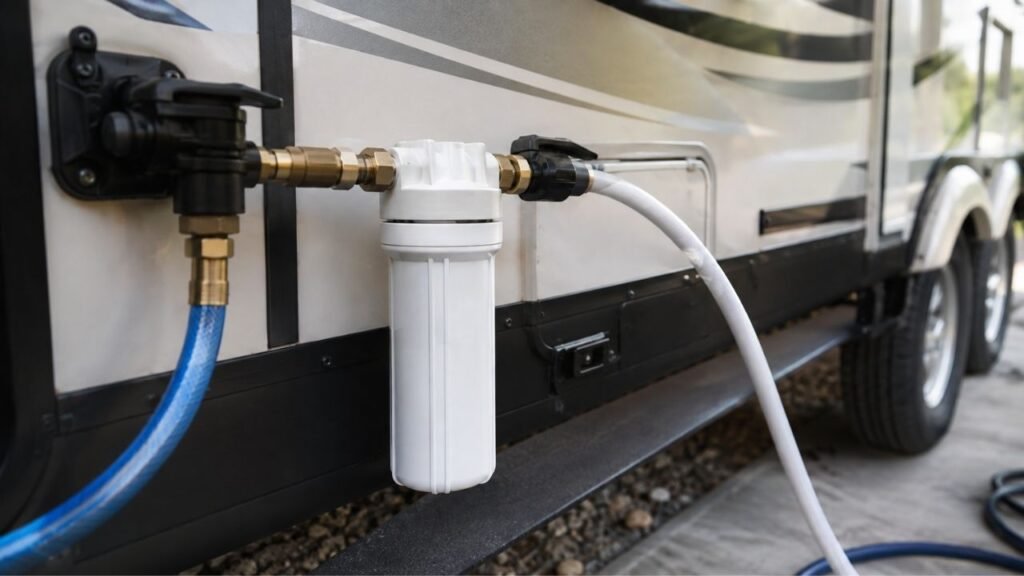
- Dirty inlet screens
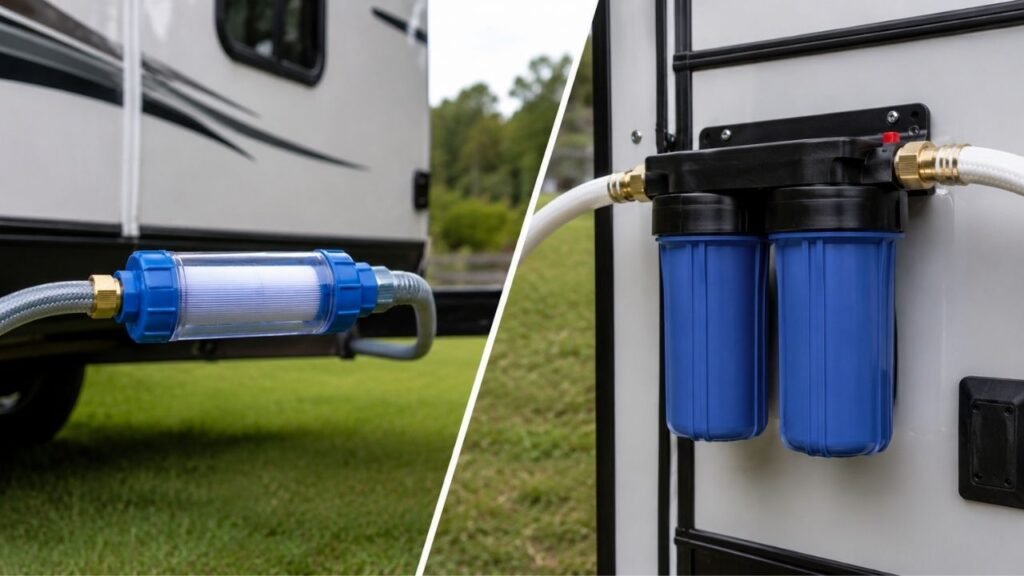
- Clogged water filters
- Restricted showerheads
- Low campground water pressure
- Weak RV pump output
- Air inside plumbing lines
- Excessive mineral scale
- Sudden changes in fixture demand
Some models may also react poorly when large cold-water demands suddenly change flow through the system.
If E6 keeps returning, do not assume the temperature sensor is automatically defective. The underlying issue may simply be poor water movement.
E7: Gas Valve or Proportional Valve Fault
E7 commonly involves a gas-control valve circuit on several tankless systems.
Depending on the model, the heater may call this a solenoid valve, proportional valve, or linear valve fault.
This is different from simply running out of propane.
The control board may not be receiving the expected response from the valve system.
Possible causes include:
- Valve circuit problems
- Electrical connection faults
- Failed internal valve
- Control-board problems
Gas-control components should not be bypassed or modified.
If your manual identifies E7 as a gas-valve fault, professional service is usually the safest next step.
E8: Airflow, Fan Speed, or Pressure-Switch Fault
E8 is particularly model-dependent.
On some heaters, it relates to an air-pressure switch. On others, it may indicate abnormal fan-speed feedback.
Start with external airflow checks.
Make sure nothing blocks the intake or exhaust. Look for insects, leaves, dirt, snow, or other debris.
If the exterior openings are clear and E8 returns, the blower, pressure switch, wiring, or internal controls may need testing.
E9: Flame Sensor or Model-Specific Control Fault
E9 is another code you should never diagnose from memory alone.
Depending on the manufacturer and model, it may involve:
- False-flame detection
- Flame sensor short circuit
- Unexpected flame signal
- Proportional valve operation
- Another internal control fault
Check your model’s own code table before replacing anything.
An incorrect E9 diagnosis can easily lead you toward the wrong component.
What Do En, EN, Fd, and EC Codes Mean?
Not every message on the controller begins with E followed by a number. Some heaters also display timer, freeze-protection, or model-specific codes.
En or EN: System Timer
Some RV tankless heaters limit continuous burner operation.
If hot water runs for an extended period, the controller may eventually stop heating and display En or EN.
This does not necessarily mean a part has failed.
Try closing the hot-water faucet. Allow the system to stop, then restart demand according to your heater instructions.
If EN keeps appearing during short periods of use, investigate further.
Fd: Freeze-Protection Operation
Some tankless heaters display Fd when their automatic freeze-protection function is active.
This can be an operating status rather than a failure.
The heater may use internal protection when temperatures become dangerously low.
However, built-in heater protection does not automatically protect every water line inside your RV. Proper winterization is still required when freezing conditions are expected.
EC or Ec: Check the Exact Model
EC or Ec is especially difficult to define without knowing your water heater model.
Some heater families use EC for a specific operating fault. Others do not use it at all.
If EC appears, write down your full model number before troubleshooting.
Check:
- 12V power
- Propane supply
- Water supply
- Water pressure
- Flow through the heater
- Exterior venting
Then compare the displayed code with the exact manufacturer’s troubleshooting information.
How Error Codes Differ Between Popular RV Tankless Water Heater Brands
Popular RV heater brands often use similar-looking controllers. However, their fault definitions can still differ, especially with later codes.
Furrion Tankless Water Heater Error Codes
Many Furrion tankless heaters use codes ranging from E0 through E7.
Common fault categories include:
- Temperature probes
- Ignition
- False-flame detection
- Overtemperature protection
- Airflow
- Temperature surges
- Gas-valve operation
Do not assume an older Furrion heater shares every definition with a newer model.
Girard Tankless Water Heater Error Codes
Girard heaters commonly use an E0 through E9 fault structure on certain models.
They may also display additional messages such as En and Fd.
Common Girard categories include:
- Temperature sensors
- Ignition failure
- ECO protection
- Blower operation
- Overheating
- Gas valves
- Air-pressure sensing
- Flame-sensor faults
Model identification still matters because Girard has produced different heater generations.
Fogatti Tankless Water Heater Error Codes
Fogatti heaters commonly use E-series codes as well.
Earlier codes often relate to temperature sensing, ignition, fan operation, and overheating.
Later codes can vary considerably between InstaShower versions.
For example, an E8 or E9 on one Fogatti model may not describe the same component on another.
This is why I would avoid using a Fogatti code chart unless the chart specifically names your model.
RecPro Tankless Water Heater Error Codes
RecPro tankless heaters can use E0 through E9 and additional controller messages.
Depending on the unit, these codes can identify:
- Sensor faults
- Ignition problems
- Fan problems
- Overtemperature protection
- Gas-valve faults
- False-flame conditions
Again, use the complete model number rather than diagnosing only from the displayed code.
Suburban Tankless Water Heater Faults
Suburban tankless systems may communicate operating problems differently from the E0 through E9 structure found on some other brands.
Depending on the model, the controller can monitor:
- Water flow
- Burner ignition
- Blower operation
- Flame status
- Supply voltage
- Overtemperature protection
- Ignition lockout
Do not automatically apply a Girard, Furrion, Fogatti, or RecPro E-code chart to a Suburban heater.
What Should You Check Before Resetting the Error Code?
Before reaching for the power switch, spend a minute checking the basics. A reset may erase the code without solving what caused it.
- Photograph the error code first.
- Check for any propane odor.
- Confirm the propane tank contains fuel.
- Make sure the propane valve is fully open.
- Check whether another propane appliance operates.
- Verify the heater has stable 12V power.
- Confirm your fresh-water supply is available.
- Open one hot-water faucet steadily.
- Check the water-heater inlet screen.
- Inspect faucet aerators for restrictions.
- Check the showerhead for poor flow.
- Inspect the exterior intake and exhaust.
- Look for obvious insect nests or debris.
- Consider whether strong wind is hitting the vent.
- Confirm winterization bypass valves are correctly positioned.
If you smell propane, stop troubleshooting. Shut off the supply and have the system inspected.
Can Low Water Flow Cause an RV Tankless Water Heater Error Code?
Yes. Low water flow can cause an RV tankless water heater to stop heating or trigger certain temperature-related faults.
Tankless heaters need water moving through the heat exchanger before combustion begins. They also need enough continued flow to control outlet temperature safely.
The required minimum flow varies by heater.
Some RV units can activate with relatively low water demand. Others need around 0.7 gallons per minute before normal heating begins.
That is why the exact manufacturer’s specification matters.
Common causes of low flow include dirty inlet screens, clogged filters, restrictive showerheads, weak campground pressure, and poor RV pump performance.
Mineral scale can also reduce flow inside the heater.
You may also create unstable operation by mixing too much cold water at the shower. Reducing hot-side flow too far can sometimes push the heater below its operating threshold.
If your heater works with the hot faucet fully open but shuts down when you reduce flow, water delivery deserves closer inspection.
Why Does the Error Code Return After You Reset the Heater?
When the same code keeps returning, the reset is probably clearing the shutdown without removing the original problem. Here are the most common reasons that happens.
The Original Fault Is Still Present
A reset does not repair a failed sensor, blocked vent, weak propane supply, or damaged component.
It simply gives the heater another chance to operate.
If the fault remains, the controller detects it again.
Water Flow Keeps Dropping
A clogged filter or weak pump can create inconsistent flow.
The heater may start normally, then shut down when water demand changes.
Check whether the problem happens only at one fixture or throughout the RV.
Propane Pressure Is Unstable
The burner needs a steady propane supply.
An empty cylinder is obvious, but regulator problems and trapped air are less noticeable.
If other propane appliances also behave strangely, the problem may be upstream from the water heater.
The Vent or Blower Problem Is Intermittent
Wind and debris can create occasional airflow problems.
The heater may run normally one minute and fault the next.
This is especially worth checking when the error happens only during windy weather.
A Sensor or Wiring Connection Is Failing
A loose connection can behave normally until vibration, heat, or movement interrupts the signal.
That can create an error that disappears temporarily after resetting.
Recurring sensor codes should not be ignored.
Mineral Scale Is Causing Overheating
Scale can restrict water movement through the heat exchanger.
That makes temperature control more difficult and can eventually cause high-temperature protection to activate.
If you camp frequently in hard-water areas, descaling may become an important maintenance task.
How to Reset an RV Tankless Water Heater Error Code Safely
Reset procedures vary between manufacturers, so your exact heater instructions always come first. Still, the general process below is a safe way to approach most situations.
- Write down or photograph the displayed error.
- Turn off hot-water demand.
- Check propane, water, power, and exterior venting.
- Correct any obvious external problem you find.
- Turn the heater off using its normal control.
- Wait for the period recommended by the manufacturer.
- Turn the heater back on.
- Open one hot-water faucet at a steady flow.
- Watch whether the heater ignites normally.
- Stop resetting it if the same safety fault returns.
Some heaters use an OFF, short wait, then ON reset sequence.
Other heaters clear certain lockouts when hot-water demand stops and restarts.
Never assume your heater follows the procedure used by another brand.
Why Did the Error Code Appear After Changing the Propane Tank?
An error after replacing a propane cylinder often points toward air in the LP line or interrupted gas supply.
When the cylinder is changed, the water heater may not immediately receive a steady propane flow.
The burner then attempts ignition but fails. After several unsuccessful attempts, the controller can enter a safety lockout.
Make sure the cylinder valve is open and propane is reaching the RV system.
If appropriate for your RV, checking another propane appliance can help confirm whether fuel is available.
Do not repeatedly cycle the heater if you smell propane or suspect a leak.
A regulator problem can also appear after cylinder changes, so persistent ignition problems may require service.
Why Does the Heater Show an Error After Rain or Strong Wind?
Rain itself does not automatically mean your tankless heater has failed.
However, strong wind can interfere with combustion airflow on some systems. Wind blowing directly toward the exterior vent may affect pressure sensing or exhaust movement.
Moisture and debris around the exterior compartment can also contribute to problems.
Check the vent area for:
- Leaves
- Mud
- Insects
- Nests
- Snow
- Ice
- Road debris
Do not spray high-pressure water directly into the heater.
If an airflow code appears repeatedly during normal weather, the blower or sensing system may need inspection.
Why Does the Error Code Appear After Winterizing the RV?
Seeing an error during the first trip after winterization does not automatically mean the heater is damaged.
Several setup issues can appear after long storage.
- Air may remain trapped inside water lines.
- Water supply may not be fully restored.
- Bypass valves may remain in winterization positions.
- The inlet screen may contain debris.
- The propane supply may still be off.
- Air may remain inside the propane line.
- The 12V battery may be weak after storage.
- The heater may not receive steady water flow.
- Freeze damage may exist if winterization was incomplete.
Start by restoring normal plumbing and propane operation.
Then run the water long enough to remove trapped air before judging heater performance.
If you find signs of cracks, leaks, or freeze damage, stop operating the heater until it is inspected.
Is an Error Code Always a Sign Something Is Broken?
No. Not every display message means a component has failed.
Some codes indicate that the heater entered a protective operating mode.
Others simply tell you that a timer has expired or freeze protection is operating.
For example, an En-style timer message may appear after extended continuous operation. An Fd-style message may indicate active freeze protection on certain systems.
These are very different from a failed temperature sensor or gas valve.
That is another reason the exact code definition matters.
Treat the display as information from the heater rather than automatic proof that a part needs replacing.
When Should You Stop Troubleshooting and Call an RV Technician?
Many external checks are simple, but gas appliances have clear limits for DIY troubleshooting. Stop and seek professional service when the problem moves beyond basic maintenance.
- You smell propane anywhere around the heater.
- Black soot appears around the exterior exhaust.
- The burner repeatedly fails despite adequate propane.
- An overheating error keeps returning.
- A gas-valve or solenoid fault appears.
- Wiring looks burned, melted, or damaged.
- Internal electrical testing is required.
- Gas pressure must be measured or adjusted.
- A sensor fault continues after a normal reset.
- Water is leaking into electrical components.
- The heater has suffered freeze damage.
- The control board repeatedly reports an internal fault.
- The manufacturer’s manual requires technician service.
Never bypass a safety switch simply to make the heater operate.
Those protections are there because combustion, propane, heat, and exhaust gases can become dangerous when something goes wrong.
How to Prevent RV Tankless Water Heater Error Codes From Coming Back
You cannot prevent every electronic fault, but regular maintenance can reduce many common shutdowns. A few simple habits make a noticeable difference.
- Keep the inlet water screen clean.
- Replace clogged RV water filters promptly.
- Clean restrictive faucet aerators.
- Keep the showerhead flowing properly.
- Maintain stable water-pump performance.
- Use a suitable pressure regulator on city water.
- Descale the heater when required.
- Keep the exterior intake clear.
- Keep the exhaust opening unobstructed.
- Maintain healthy 12V battery voltage.
- Inspect propane supply and regulator condition.
- Remove plumbing air after storage.
- Restore bypass valves correctly after winterization.
- Winterize the heater using model-specific instructions.
- Record recurring error codes and repair history.
A simple maintenance record can be surprisingly helpful.
If the same code appears several months apart, your notes may reveal a pattern involving weather, propane changes, water pressure, or hard-water buildup.
Final Words
RV tankless water heater error codes are meant to point you toward the problem, not provide a complete diagnosis by themselves.
Start by identifying your heater’s exact brand and model. Then check the matching code definition before replacing anything. For many problems, the cause turns out to be something simple like low water flow, interrupted propane, weak 12V power, or blocked airflow.
When the same safety-related code keeps returning, take it seriously. A professional inspection is much better than repeatedly resetting a heater that is trying to tell you something is wrong.
Related FAQs
What Does E1 Mean on an RV Tankless Water Heater?
E1 commonly means the burner failed to ignite or the flame was lost. Check your propane supply, gas valves, and whether other propane appliances work. Because definitions can vary, confirm E1 in your exact heater manual.
What Does E5 Mean on an RV Tankless Water Heater?
E5 commonly relates to the blower, airflow, exhaust, or air-pressure system on many RV tankless heaters. Inspect the exterior vent for obvious blockage and verify the exact meaning for your model before replacing parts.
What Does E6 Mean on an RV Tankless Water Heater?
E6 often indicates excessive water temperature or a temperature surge. Low water flow, clogged filters, scale buildup, or sudden flow changes can contribute, although the exact definition varies between heater models.
What Does an EC Code Mean on an RV Tankless Water Heater?
EC is a model-specific code and should not be diagnosed using a generic E0 through E9 chart. Find your heater’s brand and model number, then check its documentation for the correct definition and reset procedure.
How Do I Clear an RV Tankless Water Heater Error Code?
Record the code first, correct obvious propane, water, power, or venting problems, then follow the manufacturer’s reset procedure. If the same safety code immediately returns, stop resetting the heater and investigate the underlying fault.
Can Low Water Pressure Cause a Tankless Water Heater Error?
Yes. Low pressure can reduce water flow below the heater’s operating requirement. This may prevent ignition, cause cycling, or contribute to overheating faults. Check filters, pump performance, showerheads, and the heater’s minimum flow requirement.
Can a Low RV Battery Cause Water Heater Error Codes?
Yes. RV tankless heaters often depend on stable 12V DC power for the control board, ignition system, gas valve, and blower. Low voltage can cause unreliable operation, startup failures, or unexpected shutdowns.
Why Does My RV Tankless Water Heater Show an Error After Changing Propane Tanks?
Air inside the propane line can temporarily prevent successful ignition after a cylinder change. Make sure propane is available and the valve is open. Persistent ignition faults may point toward a regulator or gas-supply problem.
Are Furrion and Girard Tankless Water Heater Error Codes the Same?
Not necessarily. Some Furrion and Girard models use similar code structures, but you should not assume every code has the same meaning. Always match the error with the exact brand and model.
Should I Keep Resetting My RV Water Heater if the Error Code Returns?
No. One reset after correcting an obvious problem can be reasonable. If the same code repeatedly returns, the underlying fault still exists. Repeated overheating, gas, airflow, or sensor faults should be properly diagnosed.

Ethan Walker writes about travel routes, outdoor exploration, and road-based adventures. His guides focus on simple planning, dependable gear, and realistic travel advice. He values comfort, safety, and practical experience over hype.