Most standard RV water filters cannot reliably remove both bacteria and viruses. Basic inline filters mainly reduce sediment, chlorine, bad taste, and odor. Some specialized filters can remove bacteria, while viruses usually require a tested purifier, reverse osmosis system, ultrafiltration membrane, UV treatment, or another technology specifically designed for microbiological protection.
The important part is knowing what your particular filter can actually do. Below, I’ll explain how different RV filters handle bacteria and viruses, what micron ratings really mean, and which treatment setup makes sense for different water sources.
Key Takeaways
- Basic inline RV filters usually do not remove bacteria or viruses reliably.
- Fine absolute-rated filters can remove many bacteria but may still miss viruses.
- Viruses are much smaller than bacteria and require stronger treatment.
- Reverse osmosis and certain ultrafiltration systems can address microorganisms.
- UV systems inactivate bacteria and viruses instead of physically filtering them.
- Never assume a filter makes questionable water safe without verified treatment claims.
- Starting with a known potable water source remains the safest approach.
Can an RV Water Filter Actually Remove Bacteria and Viruses?
Some RV water filters can handle microorganisms, but you cannot assume every filter does. The answer depends on the filtration technology, pore size, testing standards, and whether the system is designed as a simple filter or a true water purifier.
What Happens to Bacteria in an RV Water Filter?
Bacteria are microscopic, but they are still considerably larger than many viruses.
That means sufficiently fine filtration can physically trap many types of bacteria before they reach your faucet.
A filter with an appropriately small absolute micron rating may provide bacterial protection. However, the common carbon or sediment filter you connect to a campground hose usually is not designed for this purpose.
This is an important distinction.
A filter might make cloudy campground water look crystal clear while bacteria remain in the water. Clear water does not automatically mean microbiologically safe water.
If bacteria protection matters to you, look for a product specifically tested and rated for bacterial reduction rather than choosing one based only on appearance, price, or marketing claims.
Why Are Viruses Much Harder to Filter?
Viruses create a bigger challenge because many are extremely small.
Some viruses are only a tiny fraction of the size of common bacteria. Because of this, they can pass through filtration media that successfully traps larger microorganisms.
This is why a fine sediment filter should not automatically be considered a virus filter.
Even a cartridge advertised as 1 micron, 0.5 micron, or 0.2 micron does not necessarily provide reliable virus protection.
Systems designed to address viruses may use:
- Reverse osmosis membranes
- Extremely fine ultrafiltration
- Electro-adsorptive media
- UV disinfection
- Chemical disinfection
- Multiple treatment stages working together
The safest approach is to look at the manufacturer’s actual virus-reduction claim rather than trying to guess performance from the micron number.
Filtering a Germ Is Different From Killing It
You will often see the words filter, purify, and disinfect used interchangeably. They are not exactly the same thing.
Mechanical filtration physically captures contaminants.
Reverse osmosis separates contaminants through an extremely fine membrane.
UV treatment exposes microorganisms to ultraviolet light that prevents them from reproducing.
Chemical disinfection uses an approved disinfecting agent to inactivate microorganisms.
Carbon filtration mainly works through adsorption and is commonly used for chlorine, taste, odor, and certain chemicals.
Understanding this difference prevents one of the biggest RV water mistakes: assuming that anything called a “water filter” automatically protects you from microorganisms.
What Do Standard Inline RV Water Filters Actually Remove?
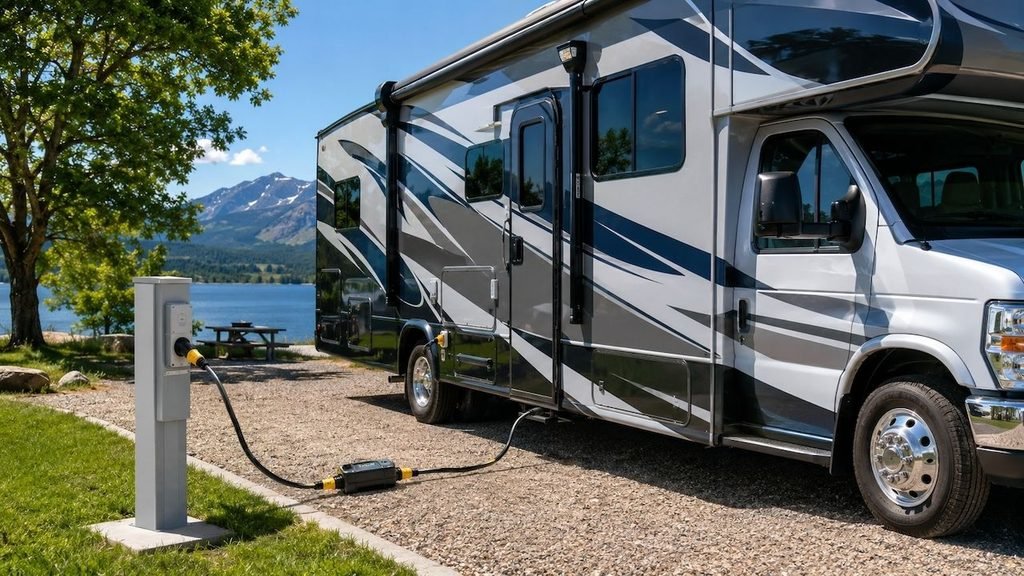
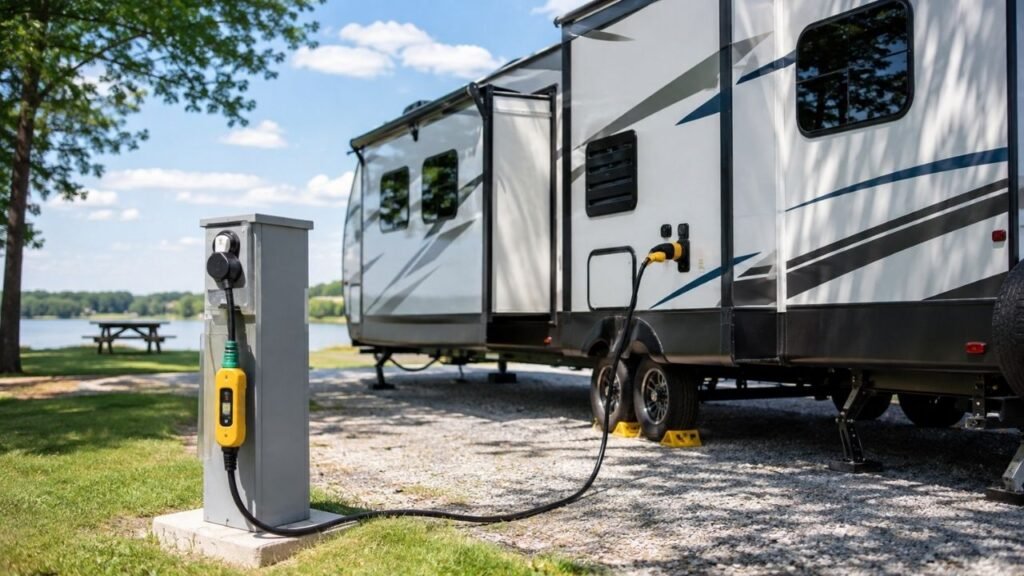
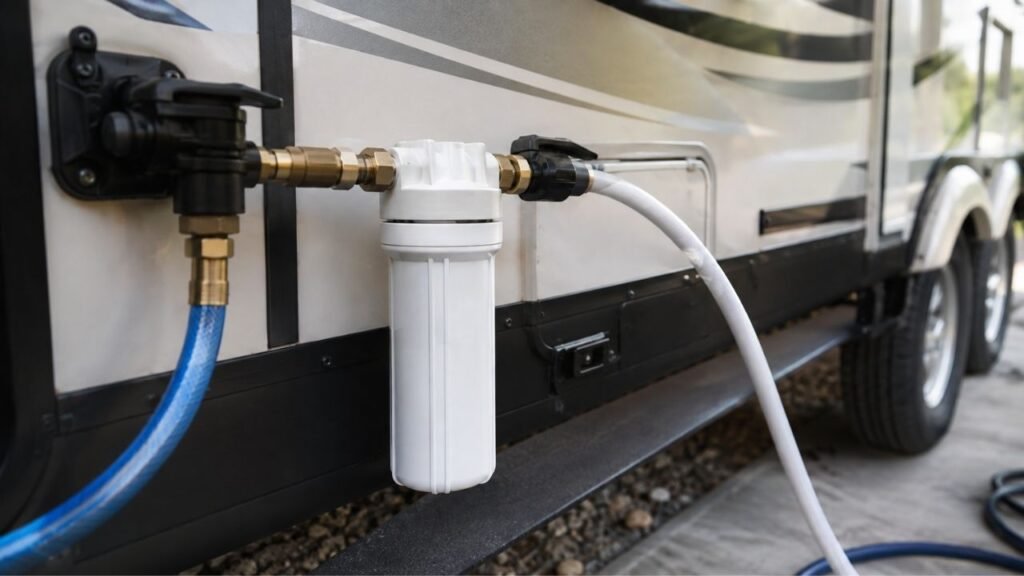
The inexpensive filters commonly attached between a campground spigot and drinking-water hose are mainly intended to improve ordinary potable water. They can be very useful, but their capabilities have limits.
Depending on the filter media, a typical inline RV filter may help reduce:
- Dirt and sediment
- Rust particles
- Chlorine
- Unpleasant tastes
- Unpleasant odors
- Some organic compounds
- Certain chemicals
- Debris that could enter RV plumbing
That makes inline filtration worthwhile at many RV parks.
You may immediately notice better-tasting coffee, cleaner-looking water, and less chlorine smell while showering.
The filter also gives your plumbing another layer of protection against sediment entering faucets, pumps, valves, and your water heater.
However, none of these benefits automatically mean the filter protects against disease-causing microorganisms.
Unless the manufacturer specifically states and verifies bacterial or virus reduction, I would treat a basic inline filter as a water-quality filter rather than a microbiological purifier.
Which RV Water Treatment Methods Can Handle Bacteria and Viruses?
Different treatment technologies solve different water problems. This table gives you a practical overview before we examine the important options more closely.
| RV Water Treatment | Bacteria | Viruses | Parasites/Cysts | Main RV Consideration |
| Basic sediment filter | Not dependable | No | Not dependable | Mainly removes dirt and particles |
| Carbon filter | Not normally designed for them | No | No | Improves taste, odor, and chlorine |
| Fine microfilter | Often, when properly rated | Usually not | Often | Check absolute micron rating |
| Ultrafiltration | Yes | Some systems can | Yes | Can reduce flow |
| Electro-adsorptive filtration | Some tested systems can | Some tested systems can | Often | Verify specific performance claims |
| Reverse osmosis | Yes | Yes | Yes | Lower flow and wastewater |
| UV purification | Inactivates | Inactivates | Can inactivate | Requires power and clear water |
| Filter plus disinfection | Yes | Yes | Depends on system | Useful for questionable sources |
| Boiling | Kills | Kills | Kills | Practical mainly for drinking water |
There is no single treatment technology that is automatically best for every RV owner.
If you stay almost entirely at developed RV parks using verified potable water, your needs are very different from someone pulling water from remote wells or uncertain sources while boondocking.
What Micron Rating Removes Bacteria From RV Water?
Micron ratings are useful, but they are also one of the most misunderstood specifications on RV water filters. The smaller the number, the smaller the particles a filter may be able to capture, but the number alone does not tell the entire story.
What Does a 20-Micron RV Filter Remove?
A 20-micron filter is relatively coarse.
It works well as a first-stage sediment filter for larger particles such as:
- Sand
- Dirt
- Rust
- Pipe debris
- Visible sediment
This type of filter can protect finer filters downstream and help keep debris out of your RV plumbing.
I would not depend on a 20-micron cartridge for microorganism protection.
What About a 5-Micron Filter?
A 5-micron filter captures considerably smaller particles.
It can improve water clarity and provide useful sediment protection, especially where campground plumbing produces fine rust or debris.
However, 5 microns is still far too large to assume reliable bacteria or virus removal.
Think of it as improved filtration, not purification.
Does a 1-Micron Filter Remove Bacteria?
A 1-micron filter is much finer and may capture some larger microorganisms and cysts.
Still, you should not automatically conclude that every 1-micron RV filter makes contaminated water safe.
Performance depends on whether the rating is nominal or absolute and how the filter was actually tested.
For drinking-water safety, verified reduction claims matter more than the marketing number printed on the cartridge.
What About 0.3- and 0.2-Micron Filters?
Once you reach this range, properly designed absolute-rated filters can physically retain many bacteria.
That makes these filters much more useful when bacterial reduction is important.
But there is still an important limitation.
A small micron rating does not automatically mean the cartridge can remove viruses.
Why Doesn’t a 0.2-Micron Filter Automatically Stop Viruses?
Many viruses are significantly smaller than 0.2 micron.
Some specialized filters can still reduce viruses by using mechanisms other than simple physical pore size. For example, charged filter media can attract and hold extremely small contaminants.
That is why comparing products solely by micron rating can be misleading.
A 0.2-micron filter with specialized media and validated virus testing may perform very differently from another 0.2-micron mechanical cartridge.
Read the actual microorganism-reduction claims.
Absolute vs Nominal Micron Ratings Matter
You may see two filters with the same micron number while their actual performance is very different.
A nominal micron rating generally means the filter captures a certain percentage of particles around the stated size.
An absolute micron rating provides a stricter indication of the largest particle size expected to pass through the filter under specified conditions.
For general campground sediment, this distinction might not seem important.
For microorganism protection, it matters considerably more.
If you are selecting filtration specifically for bacteria, parasites, or other microorganisms, I recommend paying attention to the absolute rating and verified reduction performance rather than simply choosing the smallest-looking number.
Can Reverse Osmosis Remove Bacteria and Viruses From RV Water?
Yes. A properly functioning reverse osmosis system can provide strong protection against bacteria, viruses, and many other contaminants.
RO works by forcing water through an extremely fine semi-permeable membrane.
Because the membrane is so restrictive, many contaminants that pass through ordinary RV filters are separated from your drinking water.
RO can also reduce many dissolved substances that sediment and carbon filters cannot effectively handle.
For RV owners, however, there are practical compromises.
Reverse osmosis systems typically:
- Produce water relatively slowly
- Generate wastewater
- Require adequate water pressure
- Need regular membrane maintenance
- Take up cabinet or counter space
- May require a storage tank
- Work better as drinking-water systems than whole-RV systems
For this reason, many RV owners use RO only at the kitchen sink.
You probably do not need to produce expensive purified water for flushing your toilet or washing the outside of the RV.
A point-of-use system lets you purify the water you actually drink and cook with while leaving higher-flow water available elsewhere.
Can a UV Water Purifier Kill Bacteria and Viruses in an RV?
A properly designed UV purifier can inactivate bacteria and viruses, making it a useful additional treatment stage for RV drinking water. However, UV works best when the incoming water is already clear enough for ultraviolet light to reach microorganisms effectively.
Why Does Pre-Filtration Matter Before UV?
Imagine trying to shine a flashlight through muddy water.
The dirt blocks and scatters the light.
Something similar can happen inside a UV purification system.
Sediment and suspended particles can interfere with UV exposure and potentially shield microorganisms from the light.
That is why a good RV UV setup normally includes sediment filtration before the UV stage.
Carbon filtration may also be included to improve taste and reduce chlorine.
A typical treatment sequence could look like this:
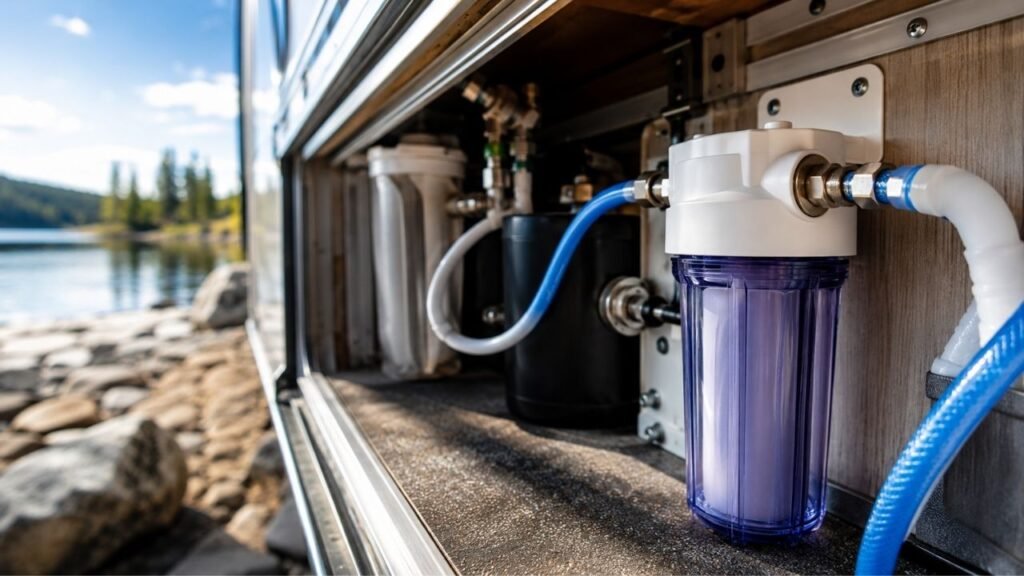
Sediment filter → carbon filter → UV purifier → drinking faucet
Each stage performs a different job.
What Happens if UV Intensity Is Too Low?
A UV purifier must expose water to enough ultraviolet energy.
Performance can be affected by:
- Water moving too quickly
- Dirty UV components
- Aging lamps
- Insufficient electrical power
- Cloudy incoming water
- Incorrect installation
Follow the manufacturer’s rated flow and maintenance schedule rather than assuming that simply having a UV light installed provides permanent protection.
UV Does Not Remove Sediment or Improve Taste
UV has one very specific job.
It treats microorganisms.
It does not remove dirt, rust, hardness minerals, chlorine, or bad taste.
That is why UV generally works best as part of a multi-stage RV water system rather than as the only treatment method.
What About Electro-Adhesive or Electro-Adsorptive RV Filters?
Some premium RV filtration systems use electrically charged filtration media to capture contaminants that would otherwise be small enough to pass through ordinary pores.
This technology can be useful because filtration is no longer based solely on physical particle size.
Think of it as giving the filter media an additional way to catch extremely small contaminants.
Some systems using this approach are specifically tested for bacteria and virus reduction.
However, not every cartridge using charged media provides the same protection.
Before relying on one, check whether the exact model has verified claims for:
- Bacteria
- Viruses
- Cysts
- Flow rate
- Treatment capacity
Avoid assuming that one brand’s test results automatically apply to every filter using a similar technology.
Filter vs Purifier: The Label Makes a Big Difference
The wording on the packaging can tell you something about what the product is intended to do, but you still need to examine the actual performance claims.
- Water filter: May only reduce sediment, chlorine, taste, odor, or specific contaminants.
- Microbiological purifier: Designed and tested to achieve significant reduction of microorganisms.
- Disinfection system: Inactivates microorganisms rather than simply trapping particles.
- Water softener: Treats hardness minerals but should not be considered a pathogen treatment system.
This distinction matters when you are filling your RV from an unfamiliar source.
A campground filter improving chlorine taste is performing a completely different job from a purifier designed for questionable water.
Neither product is necessarily bad.
They simply solve different problems.
Which Certifications Should You Look for on an RV Water Filter?
Certification can help you compare water-treatment products, but you still need to know what the specific certification covers. Seeing “NSF” somewhere on the packaging does not mean a product removes every contaminant.
What Is NSF P231?
NSF P231 deals with microbiological water purifiers.
If microbiological purification is your goal, certification or validated testing against a relevant microbiological standard gives you much more meaningful information than vague phrases such as “advanced protection.”
Pay attention to the exact contaminant claims associated with the particular model.
What Is NSF/ANSI 55?
NSF/ANSI 55 applies to ultraviolet microbiological water-treatment systems.
You are most likely to encounter it while researching UV systems.
Again, look at the actual product classification and performance rather than simply assuming all UV units perform identically.
What Is NSF/ANSI 244?
NSF/ANSI 244 applies to certain filtration systems intended for water that is normally microbiologically safe but could experience intermittent contamination.
That is different from treating untreated surface water.
If you regularly collect water from lakes, streams, or other questionable sources, you need a system appropriate for that higher level of risk.
Why Isn’t “NSF Certified” Enough?
Because different standards test different things.
One filter might be certified for chlorine reduction.
Another might be certified for lead.
Another may be tested for cysts.
Those certifications do not automatically mean all three filters remove bacteria and viruses.
Before buying, check:
- The exact certification
- The exact filter model
- The specific contaminant claim
- Rated filter capacity
- Maximum flow rate
- Required replacement interval
This takes a few extra minutes but tells you far more than marketing phrases on the front of the package.
Do You Need Bacteria and Virus Protection at a Campground?
Your water source should determine how much treatment you need. Someone staying at full-service RV parks with municipal water normally faces a different situation than an RVer filling from isolated wells while traveling through remote areas.
When the Campground Provides Potable Water
If the campground specifically provides potable drinking water, a sediment-and-carbon RV filter may be enough for many travelers.
The purpose here is usually improving:
- Taste
- Odor
- Chlorine levels
- Sediment
- Water clarity
I still recommend asking the campground if you have doubts about the source.
Never assume every outdoor faucet around a campground provides potable water.
Some may be intended only for cleaning, irrigation, or waste-handling areas.
When You Are Filling From a Private Well
Private wells require more caution.
Unlike treated municipal supplies, well-water quality can vary dramatically depending on location, maintenance, flooding, nearby septic systems, and groundwater conditions.
The water might look and taste completely normal while containing microorganisms.
If you regularly rely on private well water, source testing is much more useful than trying to solve every possible problem with one generic filter.
Once you know what is actually in the water, you can choose appropriate treatment.
When You Are Boondocking or Using an Unknown Source
This is where stronger treatment becomes much more important.
If the source is not confirmed potable, I would not depend on a standard hose-mounted campground filter.
Unknown sources could contain:
- Bacteria
- Viruses
- Parasites
- Sediment
- Agricultural contamination
- Industrial chemicals
- Naturally occurring minerals
Microbiological purification solves only part of that list.
If chemical contamination is possible, killing microorganisms does not suddenly make the water safe.
Whenever possible, begin with the safest known source available.
Can You Drink Lake or Stream Water Through an RV Filter?
Not through a standard RV inline filter.
Lake and stream water can contain microorganisms, animal waste, runoff, parasites, and other contaminants that basic carbon-and-sediment filtration was never intended to handle.
If untreated surface water is your only available source, you need a treatment method designed for that situation.
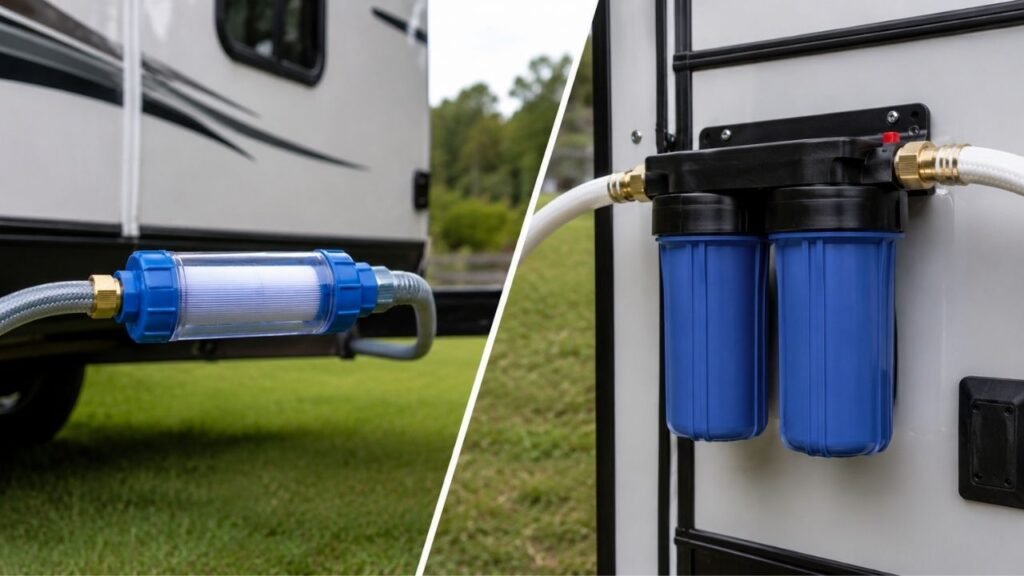
A multi-barrier setup may include:
- Coarse sediment pre-filtration
- Fine microbiological filtration
- Purification or disinfection
- Additional drinking-water treatment when needed
Even then, consider possible chemical contamination.
For example, water downstream from agricultural or industrial activity may contain contaminants that boiling, UV, or ordinary microbiological treatment cannot solve.
This is why selecting the water source is just as important as selecting the filter.
Does a Water Filter Make a Boil-Water Advisory Safe?
Do not assume your normal RV filter replaces the instructions issued during a boil-water advisory.
A basic carbon or sediment filter usually does not provide enough protection against the microorganisms responsible for an advisory.
If local authorities tell residents and visitors to boil water, follow the advisory.
This applies even if the filtered water:
- Looks clear
- Smells normal
- Tastes fine
- Passes through an expensive carbon filter
Appearance does not tell you whether disease-causing microorganisms remain.
Once the advisory ends, you may also need to consider flushing or sanitizing parts of your RV water system if contaminated water entered the tank or plumbing.
Can Bacteria Grow Inside an RV Water Filter?
Yes, bacteria can potentially grow in damp filtration systems, especially when water remains stagnant for long periods. Filters improve incoming water quality, but they are not automatically self-sanitizing.
Risk can increase with:
- Warm temperatures
- Stagnant water
- Long gaps between RV trips
- Old filter cartridges
- Improper filter storage
- Contaminated freshwater hoses
- Dirty freshwater tanks
- Overdue cartridge replacement
This is especially important for seasonal RV owners.
If your filter has been sitting wet and unused for months, I would not simply reconnect everything and begin drinking from it.
Follow the manufacturer’s storage and replacement instructions.
When in doubt, replacing an old cartridge before the season begins is usually better than trying to stretch every last gallon from it.
An RV Water Filter Cannot Replace Freshwater Tank Sanitizing
Even the best incoming filter cannot sanitize contamination that is already living inside your freshwater tank, pipes, hose, or fixtures.
Think of filtration and sanitation as two separate jobs.
Your incoming water filter handles water before or while it enters the RV.
Freshwater-system sanitation deals with the tank and plumbing that store and deliver that water.
You need both when appropriate.
A neglected freshwater tank can develop contamination even if every gallon originally passed through a high-quality filter.
Likewise, a dirty drinking-water hose can contaminate water after it leaves the campground spigot.
Regularly inspect, drain, flush, and sanitize the system according to your RV manufacturer’s instructions.
How to Decide What Level of RV Water Treatment You Need
You do not need the most complicated purification system simply because one exists. Start by looking at where your water normally comes from and what you are trying to remove.
| Your Water Source | Main Concern | Sensible Treatment Approach |
| Municipal campground potable water | Sediment, chlorine, taste | Sediment and carbon filtration |
| Potable campground water with added protection desired | Taste plus microbiological concern | Validated fine filtration or purifier |
| Private well | Variable water quality | Test source and treat identified issues |
| Boil-water advisory | Microorganisms | Follow advisory instructions |
| Untreated lake or river | Bacteria, viruses, parasites | Validated multi-stage purification |
| Frequent remote boondocking | Uncertain sources | Multi-barrier treatment |
| Drinking water only | Lower water volume | Point-of-use purifier or RO |
| Whole-RV treatment | Higher flow demand | Properly sized whole-RV filtration |
For most RV owners traveling through established campgrounds, I would start simple.
Use a known potable source and good sediment/carbon filtration.
Then add stronger treatment only when your water sources or personal requirements justify it.
That generally gives you better water without unnecessarily reducing flow or making your plumbing complicated.
Before Trusting an RV Filter for Drinking Water, Check These Things
A few minutes of checking specifications can tell you much more than the size or price of the filter.
Before relying on one, ask:
- Is the source confirmed potable?
- Does the filter specifically claim bacteria reduction?
- Does it specifically claim virus reduction?
- What organisms was it tested against?
- Is the micron rating nominal or absolute?
- What independent testing or certification does it have?
- What is its rated flow rate?
- How many gallons can the cartridge treat?
- When should the cartridge be replaced?
- Does the system require electrical power?
- Does UV treatment require pre-filtration?
- Has the filter been stored properly?
- Is your freshwater tank currently sanitized?
- Is your drinking-water hose clean?
If you cannot find clear answers from the manufacturer, I would not assume the missing protection exists.
Water-treatment claims should be specific.
What I Would Use for Different RV Water Situations
There is no reason to make your RV water system more complicated than necessary. I prefer matching the treatment to the actual source rather than automatically installing every technology available.
Mostly Full-Hookup Campgrounds
If you mainly stay at established U.S. campgrounds with confirmed potable water, a good sediment-and-carbon setup makes sense.
It improves everyday water quality while helping keep dirt and debris out of your plumbing.
For many RV owners, this is all they realistically need.
Campgrounds and Private Wells
If your travels frequently include smaller campgrounds using private wells, I would pay more attention to source quality.
A multi-stage system can provide better sediment and chemical filtration, while an additional validated microbiological treatment stage can add protection where appropriate.
If you repeatedly use the same well source, testing the water provides valuable information.
Frequent Boondocking With Questionable Sources
I would use a multi-barrier approach rather than trusting a single inexpensive inline cartridge.
That could include:
- Sediment pre-filter
- Fine microbiological filtration
- UV or another validated purifier
- Point-of-use drinking-water treatment
The exact setup depends on the contaminants you expect.
Remember that microbiological purification does not automatically remove every chemical contaminant.
Drinking Water Only
Sometimes the simplest solution is treating only the water you actually consume.
An under-sink purifier, RO system, or other point-of-use setup can provide higher-quality drinking water without restricting water used for:
- Toilets
- Showers
- Hand washing
- Cleaning
- General RV use
This approach often makes sense when space, flow rate, or treatment cost matters.
Final Verdict
So, can an RV water filter remove bacteria and viruses?
Some can, but an ordinary RV filter usually cannot remove both reliably.
Your typical campground inline filter is best viewed as a water-quality filter. It reduces things such as sediment, chlorine, unpleasant taste, and odor when you are already starting with potable water.
Bacteria require appropriately fine and validated filtration, while viruses generally need more advanced treatment such as reverse osmosis, certain ultrafiltration or electro-adsorptive systems, UV purification, or another proven disinfection method.
The most important thing I want you to remember is this: never judge water safety by how clear it looks or how expensive your filter is.
Check your source first, then choose a treatment system with specific, verified claims for the contaminants you actually need to address.
Related FAQs
Does a 0.5-Micron RV Water Filter Remove Bacteria?
A 0.5-micron filter may capture many bacteria when it has an appropriate absolute rating, but the micron number alone does not prove reliable bacterial protection. Check whether the specific filter is tested and rated for bacteria reduction.
Does a 0.2-Micron RV Filter Remove Viruses?
Not necessarily. Many viruses are smaller than 0.2 micron, so ordinary mechanical filtration may not capture them. Some specialized 0.2-micron systems use additional charged media or purification technology that can reduce viruses.
Does an RV Carbon Filter Kill Bacteria?
No. Carbon filtration primarily reduces chlorine, bad taste, odors, and certain chemicals. Unless combined with another validated treatment technology, a carbon cartridge should not be considered a bacterial disinfectant.
Does Reverse Osmosis Remove Viruses From RV Water?
Yes, a properly designed and maintained reverse osmosis membrane can remove bacteria and viruses along with many dissolved contaminants. For RVs, RO is usually most practical as a point-of-use drinking-water system.
Does UV Remove Bacteria and Viruses?
UV treatment can inactivate bacteria and viruses when the system provides the proper UV dose. It does not physically remove them from the water, and sediment filtration is normally recommended before the UV stage.
Is Campground Water Safe to Drink After Filtering?
If the campground provides confirmed potable water and your RV freshwater system is clean, filtering can improve taste and water quality. However, a normal RV filter should not be used to turn an unknown or unsafe source into drinking water.
Can an RV Filter Remove E. Coli?
Certain properly rated and tested microbiological filters can reduce E. coli, but a standard sediment or carbon inline RV filter should not automatically be trusted for this purpose.
Can I Put Well Water in My RV Freshwater Tank?
You can use well water when you have reasonable confidence that it is safe. Because private well quality can vary, testing is especially useful when you regularly fill from the same well or have concerns about contamination.
Do I Need UV Water Purification in My RV?
Not necessarily. RVers who consistently use confirmed potable campground water may be comfortable with normal filtration. UV becomes more useful when you want an additional microbiological barrier or encounter less predictable water sources.
Can an RV Water Filter Make Any Water Safe to Drink?
No. No single ordinary RV filter can make every water source safe because water may contain microorganisms, chemicals, heavy metals, or other contaminants requiring different treatment methods.

Ethan Walker writes about travel routes, outdoor exploration, and road-based adventures. His guides focus on simple planning, dependable gear, and realistic travel advice. He values comfort, safety, and practical experience over hype.