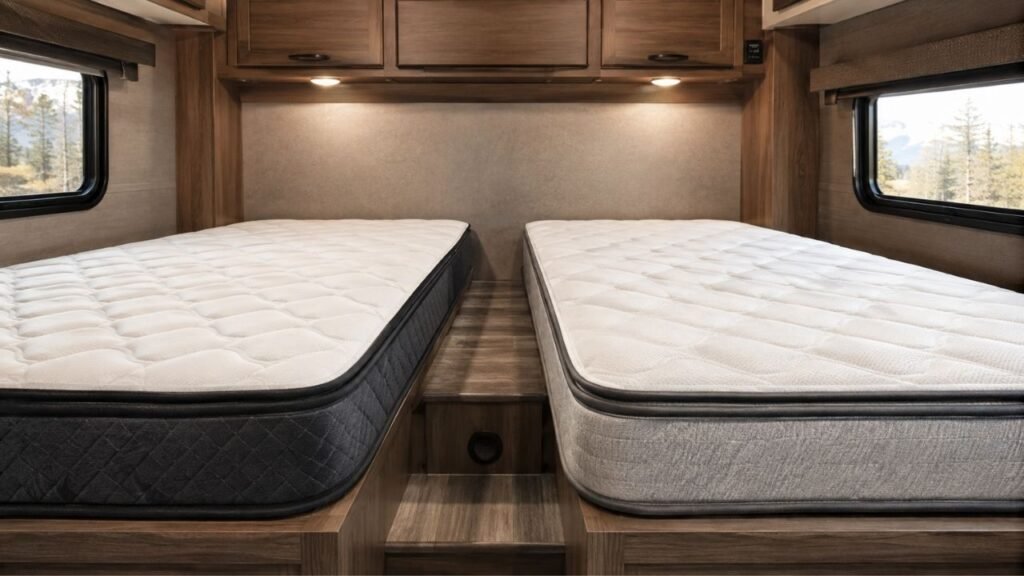
An RV mattress differs from a regular mattress mainly in size, thickness, weight, and shape. RV mattresses are often shorter, thinner, or specially shaped to fit limited sleeping spaces. However, both types can use similar materials, including memory foam, latex, coils, and hybrid construction.
In this guide, I’ll show you exactly how RV and regular mattresses compare. We’ll also cover sizes, comfort, weight, thickness, materials, and whether you can safely use a regular mattress in your RV.
Key Takeaways
- RV mattresses are often shorter or narrower than regular home mattresses.
- A short queen is commonly about 60 inches wide and 75 inches long.
- A standard residential queen measures 60 inches wide and 80 inches long.
- RV mattress names are not always standardized between manufacturers.
- RV mattresses may use lower profiles to preserve headroom and clearance.
- Both RV and regular mattresses can use foam, latex, coils, or hybrids.
- A regular mattress can work in an RV if size and weight allow.
- Always measure your actual RV bed platform before buying a mattress.
RV Mattress vs Regular Mattress: Key Differences at a Glance
The biggest differences become easier to understand when you compare them side by side. Keep in mind that these are general differences, not strict rules for every mattress.
| Feature | RV Mattress | Regular Mattress | Why It Matters in an RV |
| Size | Often shorter or narrower | Mostly standardized sizes | RV bedrooms have limited space |
| Thickness | Often lower profile | Many thicker options available | Thickness affects headroom and clearance |
| Weight | Many lightweight options | Can be heavier | Mattress weight uses cargo capacity |
| Shape | May have cut or rounded corners | Usually rectangular | Special shapes fit RV layouts |
| Folding options | Hinged models are available | Less common | Useful for Murphy beds |
| Materials | Foam, coils, latex, hybrid | Foam, coils, latex, hybrid | Materials can be very similar |
| Comfort | Basic to premium | Basic to premium | Quality depends on construction |
| Bedding | Some sizes need special sheets | Standard bedding widely available | Short RV sizes need proper fitted sheets |
| Installation | Made for compact interiors | Can be bulky | RV doors and hallways may be tight |
Are RV Mattresses Actually Different From Regular Mattresses?
Yes, but the difference is not as dramatic as it sometimes sounds.
An RV mattress is not made using some completely different mattress technology. In many cases, it uses the same types of foam, springs, latex, and fabric you might find in a residential mattress.
The main difference is that an RV mattress is designed around the limitations of an RV.
Your RV may have a short sleeping platform, limited ceiling height, nearby cabinets, a slide-out, or a bed that needs to fold. Manufacturers may therefore make the mattress shorter, thinner, lighter, or differently shaped.
A regular mattress is usually designed around standardized residential bed frames. Space and weight are rarely major concerns inside a normal bedroom.
That’s why I recommend focusing on the actual mattress dimensions and construction instead of the word “RV” on the label.
If a regular mattress fits your RV properly, there is no rule saying you cannot use it.
How Are RV Mattress Sizes Different?
Size is probably the most important difference you’ll notice while shopping. RV mattress dimensions can vary considerably, so never assume a familiar size name guarantees familiar dimensions.
Standard Mattress Sizes Used at Home
Most regular mattresses sold in the USA follow familiar residential dimensions.
Common sizes include:
- Twin: about 38″ × 75″
- Twin XL: about 38″ × 80″
- Full: about 54″ × 75″
- Queen: 60″ × 80″
- King: 76″ × 80″
- California king: 72″ × 84″
These standard measurements make replacing a residential mattress relatively straightforward.
RV mattresses are less predictable.
Common RV Mattress Sizes
RV manufacturers often adjust mattress dimensions to gain a few extra inches of walking space or fit a specific floor plan.
You may come across sizes such as:
- RV bunk: approximately 28″–35″ wide
- Three-quarter mattress: around 48″ × 75″
- RV full: approximately 53″–54″ × 75″
- Short queen: approximately 60″ × 74″–75″
- Queen: approximately 60″ × 80″
- Short king: approximately 72″ × 74″–75″
- RV king: approximately 72″ × 80″
These numbers are useful starting points, but don’t use them as your only reference.
Measure your RV.
Why RV Queen Sizes Can Be Confusing
This is where many RV owners make mistakes.
You might see one company advertise a 60″ × 75″ mattress as an RV queen. Another company may call the same dimensions a short queen.
Some RVs actually use a full 60″ × 80″ standard queen.
That means you shouldn’t order a replacement simply because your old paperwork says “queen mattress.”
Grab a tape measure and check the bed yourself.
Those extra five inches between a short queen and standard queen can determine whether your cabinet opens or your bedroom walkway disappears.
RV Mattresses Can Have Custom Shapes
Not every RV sleeping platform is a perfect rectangle.
Depending on your floor plan, you may find:
- Rounded corners
- Angled corners
- Cut corners
- Notched edges
- Curved ends
- Hinged sections
- Folding mattress sections
These designs help the mattress fit around cabinetry, walls, slides, and other RV components.
A normal household mattress usually won’t offer these shapes.
Are RV Mattresses Thinner Than Regular Mattresses?
RV mattresses are often thinner, but there is no universal thickness that every RV mattress follows. You can find everything from slim bunk mattresses to thick premium RV hybrids.
Why RV Mattresses Often Use a Lower Profile
Space inside an RV is valuable.
A mattress that is only a few inches thicker can create unexpected problems.
A lower-profile mattress may help preserve:
- Sitting headroom
- Bunk clearance
- Window access
- Cabinet access
- Slide-out clearance
- Murphy-bed operation
- Walking space around raised platforms
This is particularly important in overhead Class C beds and bunk areas.
Why Mattress Thickness Matters Beyond Comfort
It’s tempting to assume that a thicker mattress automatically means better sleep.
That’s not always true.
A well-designed 8-inch mattress can feel better than a poorly constructed 12-inch mattress.
You also need to think about what happens around the mattress.
Adding four inches of height could place your head uncomfortably close to the ceiling. It might cover part of a window or make an upper bunk difficult to enter.
Before upgrading to a thicker mattress, measure upward as carefully as you measure length and width.
Are RV Mattresses Lighter Than Regular Mattresses?
Many RV mattresses are designed to keep weight reasonable, but you should not assume every RV mattress is lightweight. Construction matters just as much as the label.
Why Mattress Weight Matters in an RV
Everything you carry contributes to your RV’s loaded weight.
That includes:
- Food
- Water
- Camping gear
- Batteries
- Clothing
- Tools
- Furniture
- Mattresses
Replacing a lightweight factory mattress with a much heavier model reduces the cargo capacity available for everything else.
For most owners, a modest mattress upgrade won’t create a problem by itself. However, you should still know how heavily your RV is loaded.
Check the weight and cargo information provided for your specific RV.
If you’re already traveling close to your allowable limits, adding a very heavy mattress deserves more attention.
Does a Regular Mattress Automatically Weigh Too Much?
No.
This is another area where broad comparisons can be misleading.
A simple residential foam mattress could weigh less than a thick premium RV hybrid.
Mattress weight depends on things such as:
- Overall dimensions
- Foam density
- Mattress thickness
- Latex content
- Number of coils
- Number of comfort layers
Instead of assuming regular mattresses are too heavy, check the actual listed weight.
Remember the Bed-Lift Mechanism
Does your RV mattress sit on a platform that lifts for storage?
If so, mattress weight affects more than cargo capacity.
A much heavier mattress can make the storage platform difficult to lift. The existing gas struts or lift hardware may have been selected for the lightweight factory mattress.
Compare mattress weights before making a major upgrade.
Do RV Mattresses Use Different Materials?
Not necessarily. RV and residential mattresses can use many of the same materials. The real difference is how manufacturers combine those materials within the available size, height, and weight limits.
Memory Foam
Memory foam is common in RV mattresses because it offers good pressure relief without requiring a complicated spring system.
It can also be compressed for easier shipping.
The downside is that some dense memory foam mattresses retain heat, which can be noticeable inside a warm RV.
Latex
Latex offers a responsive surface and can provide excellent durability.
However, natural latex can be relatively heavy.
If weight is important for your setup, compare the mattress specifications before choosing a thick latex model.
Innerspring
Traditional innerspring mattresses provide a familiar feel and good airflow.
They can work perfectly well in RVs when the dimensions match.
However, spring construction may make some mattresses harder to bend or maneuver through tight RV interiors.
Hybrid
Hybrid mattresses combine foam or latex comfort layers with a coil support system.
They can provide excellent support and pressure relief.
The tradeoff is that premium hybrids are often thicker and heavier, so clearance and weight deserve extra attention.
Is an RV Mattress Less Comfortable Than a Regular Mattress?
An RV mattress is not automatically less comfortable than a regular mattress.
The reputation probably comes from the thin factory mattresses installed in many RVs. Manufacturers have to control costs and vehicle weight, so the original mattress may be fairly basic.
That doesn’t mean every RV-size mattress feels that way.
You can buy RV mattresses with memory foam, pocketed coils, latex, cooling layers, and substantial support systems.
Comfort ultimately depends on the mattress quality and whether it suits you.
Your sleeping position, body weight, firmness preference, and support needs matter more than whether the mattress is categorized as RV or residential.
If you’re replacing an uncomfortable factory mattress, don’t focus only on finding something thicker.
Look for proper support first.
Do RV Mattresses Last as Long as Regular Mattresses?
They can, although lifespan depends much more on mattress quality and use than the category.
A full-time RVer sleeping on a mattress every night puts far more wear on it than someone taking six weekend trips each year.
Durability can also depend on:
- Foam quality
- Coil construction
- Mattress support
- Moisture exposure
- Humidity
- Temperature changes
- Frequency of use
- Proper storage
RV mattresses also face conditions that residential mattresses rarely experience.
An RV can sit closed for weeks with major temperature and humidity changes. Moisture can sometimes collect beneath the mattress when warm air meets a cold bed platform.
Good airflow and periodic inspections can therefore be just as important as choosing durable materials.
Can You Put a Regular Mattress in an RV?
Yes, you can use a regular mattress in an RV when it fits correctly and doesn’t interfere with the RV’s operation. Some RVs already have sleeping platforms designed around standard residential mattress dimensions.
Before using a regular mattress, check that:
- The width fits the bed platform.
- The length leaves enough walking space.
- The mattress does not hang excessively over the platform.
- The thickness leaves enough headroom.
- Bedroom cabinets can still open.
- Drawers remain accessible.
- Slide-outs can fully retract.
- Murphy-bed mechanisms can operate.
- The mattress weight works for your RV.
- Bed-lift hardware can support the added weight.
- You can physically get the mattress through the RV doorway.
If all those boxes are checked, there’s no reason you must buy a mattress simply because it carries an RV label.
Can You Put a Regular Queen Mattress in an RV?
Yes, a regular queen mattress can work in an RV with enough room for its 60″ × 80″ dimensions.
The important part is confirming what your RV was actually designed to hold.
Many RV bedrooms use a short queen around 60″ × 75″. Replacing that with a residential queen adds roughly five inches at the foot of the bed.
Five inches may not sound significant in a house.
Inside an RV, it can be a big deal.
The longer mattress could narrow the walkway, touch a wall, block drawers, interfere with the bedroom door, or create problems when the slide retracts.
Measure before buying rather than planning to deal with the overhang afterward.
How to Measure an RV for a Replacement Mattress
Don’t rely entirely on your current mattress or owner’s manual. Measuring the actual sleeping area gives you the best chance of getting the replacement right the first time.
Measure the Bed Platform
Start with the surface supporting the mattress.
Measure:
- Width from side to side
- Length from head to foot
- Available height above the platform
Write the measurements down instead of relying on memory.
If the existing mattress has compressed or changed shape, platform measurements are usually more useful.
Measure Unusual Corners
Look carefully at every corner.
If the platform isn’t rectangular, record any:
- Angles
- Curves
- Notches
- Cut corners
- Rounded edges
A difference of only a few inches can matter near cabinets and narrow walkways.
Check Vertical Clearance
Next, measure upward from the bed platform.
Look for anything that could interfere with a thicker mattress, including:
- Overhead cabinets
- Windows
- Ceiling slopes
- Upper bunks
- Shelving
Then think about how much sitting headroom you want.
Check the RV With the Slide Retracted
This step is easy to forget.
A mattress might fit beautifully while your RV is parked with every slide extended.
Then you press the slide switch on travel day and discover the bed is in the way.
If your bedroom has a slide, check mattress clearance in both positions.
Check Doors, Drawers, and Walking Space
Walk around the bed as though the new mattress were already installed.
Make sure you can:
- Open bedroom doors
- Open cabinet doors
- Pull out drawers
- Access closets
- Walk around the bed
A mattress technically fitting on the platform doesn’t guarantee the bedroom remains functional.
Check How You Will Get the Mattress Inside
Finally, think about installation.
Measure the RV entrance and consider the route from the door to the bedroom.
Rigid mattresses can be surprisingly difficult to maneuver around narrow hallways and corners.
A compressed mattress-in-a-box can make installation easier, particularly in smaller trailers and motorhomes.
RV Mattress vs Regular Mattress Bedding and Sheet Sizes
Your mattress isn’t the only thing affected by unusual RV dimensions.
Fitted sheets need to match the actual mattress size reasonably well.
A normal queen fitted sheet is intended for a mattress around 60″ × 80″. Put it on a 60″ × 75″ short queen, and you may have extra material bunching near the foot.
Unusual bunk mattresses can be even trickier.
Before buying bedding, check:
- Mattress width
- Mattress length
- Mattress depth
Depth matters because thick mattresses may require deep-pocket fitted sheets.
Again, actual measurements are more useful than the mattress name.
Does an RV Mattress Cost More Than a Regular Mattress?
Neither type is automatically more expensive.
Residential mattresses benefit from a huge market, so you often have more brands and price levels to choose from.
Common RV sizes such as short queens are also widely available and can be affordable.
Custom RV mattresses usually cost more when you request features such as:
- Special dimensions
- Cut corners
- Rounded corners
- Hinges
- Custom thickness
- Unusual shapes
Price should therefore be considered alongside fit.
Saving money on a regular mattress isn’t much of a bargain if it blocks your closet every morning.
RV Mattress or Regular Mattress: Which Should You Choose?
The right choice depends less on the label and more on your RV’s sleeping area. Start with fit and clearance, then compare comfort, materials, weight, and price.
Choose an RV-Specific Mattress If
An RV mattress usually makes more sense when:
- Your platform uses a short queen or uncommon size.
- Your mattress needs cut or rounded corners.
- Your bed requires a hinged mattress.
- Available mattress height is limited.
- Your RV has tight slide clearance.
- You need to minimize mattress weight.
- Your floor plan needs a custom shape.
In those situations, paying for an RV-specific design can save you plenty of frustration.
Choose a Regular Mattress If
A regular mattress can be a great option when:
- Your RV has a true standard-size bed platform.
- There is enough space around the mattress.
- Mattress thickness doesn’t cause interference.
- Slides and cabinets still operate normally.
- The mattress weight is reasonable for your RV.
- You prefer the wider selection of residential mattresses.
There’s no practical benefit to avoiding a regular mattress simply because you’re putting it inside an RV.
What Should You Prioritize?
If I were replacing an RV mattress, I would consider things in this order:
- Exact dimensions
- Support and comfort
- Mattress thickness
- Mattress weight
- Construction and materials
- Price
Getting those first four points right will prevent most replacement problems.
Common Mistakes When Replacing an RV Mattress
Most expensive mattress mistakes happen before the new mattress even reaches the RV. A few extra measurements now can prevent a return or an awkward installation later.
Avoid these common mistakes:
- Buying based only on the words “RV queen”
- Assuming every RV queen measures 60″ × 75″
- Measuring only the old mattress
- Forgetting mattress thickness
- Measuring only with the slide extended
- Ignoring rounded or angled corners
- Assuming all RV mattresses are lightweight
- Assuming every residential mattress is too heavy
- Forgetting under-bed lift hardware
- Ignoring RV doorway dimensions
- Buying regular queen sheets for a short queen
- Assuming a thicker mattress must be more comfortable
- Choosing price before checking dimensions
The simple rule is to measure first and shop second.
Final Words
An RV mattress vs regular mattress comparison really comes down to fit, dimensions, thickness, weight, and layout rather than completely different mattress technology. Both can offer excellent comfort when properly selected.
If a regular mattress fits your platform, leaves enough clearance, and works with your RV’s weight and bed mechanisms, you can use it. If your RV needs shorter dimensions, unusual corners, reduced height, or a folding design, an RV-specific mattress will usually make the job easier.
Related FAQs
Is an RV Mattress the Same as a Regular Mattress?
Not exactly. RV mattresses often use different dimensions, thicknesses, or shapes to fit compact RV bedrooms, although they can use the same foam, latex, spring, and hybrid materials found in regular mattresses.
Are RV Mattress Sizes Different From Regular Mattress Sizes?
Yes, many are. RV mattresses may be shorter, narrower, or differently shaped, although some RVs use standard residential mattress dimensions.
Is an RV Queen the Same Size as a Regular Queen?
Not always. A regular queen measures 60″ × 80″, while many RVs use a short queen around 60″ × 75″. However, some manufacturers also sell full 60″ × 80″ RV queens.
What Size Is an RV Short Queen Mattress?
An RV short queen is commonly about 60 inches wide and 74 to 75 inches long. Always check the manufacturer’s exact dimensions before ordering.
Can I Use a Regular Queen Mattress in My RV?
Yes, if your RV provides enough room for a 60″ × 80″ mattress and the added length, thickness, and weight don’t interfere with slides, cabinets, doors, or walkways.
Is an RV King Smaller Than a Regular King?
Usually. A residential king normally measures 76″ × 80″, while many RV king mattresses are around 72″ × 80″. Dimensions can vary between manufacturers.
Why Are RV Mattresses So Thin?
Many RV mattresses use a lower profile to preserve headroom, reduce weight, provide bunk clearance, and avoid interfering with cabinets, windows, slides, or folding bed mechanisms.
Are RV Mattresses Lighter Than Regular Mattresses?
Many are designed to be lighter, but not every RV mattress weighs less. Size, thickness, foam density, latex content, and coil construction all affect mattress weight.
Can an RV Mattress Be Too Thick?
Yes. An overly thick mattress can reduce headroom, cover windows, interfere with cabinets, create bunk clearance problems, or prevent certain slides and folding beds from operating correctly.
Do RV Mattresses Need Special Sheets?
Some do. Standard-size RV mattresses can use regular sheets, but short queens, narrow bunks, and custom mattresses may need bedding designed for their specific dimensions.
Can You Use a Memory Foam Mattress in an RV?
Yes. Memory foam is commonly used in RVs because it offers pressure relief and comes in many sizes and thicknesses. Just check weight, heat retention, and available clearance.
Do You Need a Special Mattress for an RV?
Not necessarily. You need an RV-specific mattress when your sleeping area requires unusual dimensions, limited thickness, special corners, or folding sections. A regular mattress works when everything fits properly.
How Thick Should an RV Mattress Be?
There is no universal ideal thickness. Choose a mattress that provides enough comfort and support while still leaving sufficient headroom and clearance around cabinets, bunks, windows, and slides.
How Do I Know What Size Mattress My RV Takes?
Measure the actual bed platform’s width, length, and available height. Also check corners, cabinets, slides, walkways, and folding mechanisms before choosing a replacement.

Ethan Walker writes about travel routes, outdoor exploration, and road-based adventures. His guides focus on simple planning, dependable gear, and realistic travel advice. He values comfort, safety, and practical experience over hype.