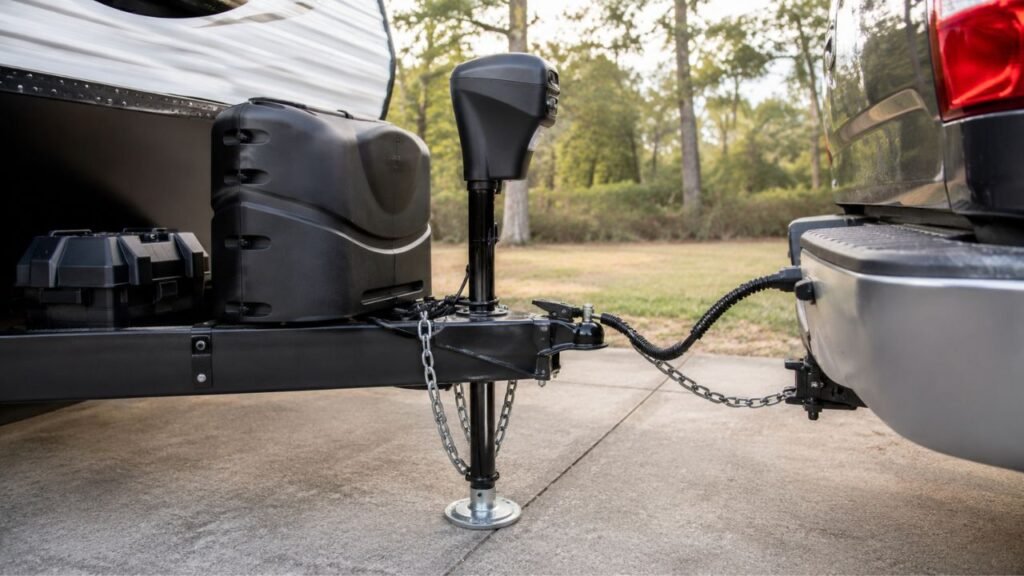
Your electric tongue jack usually works only when connected to the tow vehicle because the trailer’s 12-volt power path has a problem. A weak battery, bad ground, faulty disconnect, damaged breaker, or high-resistance connection may prevent enough current from reaching the jack.
The exact cause depends on what changes when you connect your truck. Below, I’ll help you test the battery, wiring, ground, fuse, breaker, and jack itself without replacing random parts.
Key Takeaways
- The tongue jack should normally work without the tow vehicle connected.
- A working jack motor usually means the problem is upstream.
- First determine whether the 7-way plug makes the jack work.
- Physical hitch connection helping the jack often suggests poor grounding.
- Test battery voltage while the jack is actually under load.
- Check the battery disconnect, breaker, fuse, terminals, and wiring.
- A working jack light does not guarantee enough motor current.
- Proper voltage and ground may indicate an internal jack problem.
What Does It Mean When the Tongue Jack Works Only With the Truck Connected?
When connecting your truck suddenly restores jack operation, something about the trailer’s electrical circuit is changing.
Your tongue jack normally receives power from the trailer’s 12-volt battery system. Current travels from the battery, through protective devices and wiring, into the jack motor. It then returns through the jack’s ground path.
Connecting the tow vehicle can add charging voltage through the 7-way connector. That extra power may temporarily compensate for a weak battery or poor connection.
There is another possibility, however.
If the jack only starts working after the trailer physically rests on the hitch ball, the hitch connection may be improving a weak ground path.
That distinction can save you considerable troubleshooting time.
Also, do not automatically assume the truck bypasses every blown jack fuse. A dedicated fuse installed directly in the jack’s positive wire usually remains part of that circuit.
The actual behavior depends on how your trailer was wired.
First, Determine How the Tow Vehicle Makes the Jack Work
Before touching the battery or removing wires, perform one simple comparison. It can quickly tell you which part of the system deserves attention first.
It Works After Plugging In the 7-Way Connector
If plugging in the 7-way makes the jack operate, start with the trailer battery and its power path.
Possible causes include:
- Weak or discharged trailer battery
- Battery disconnected from the trailer
- Loose positive or negative terminal
- Faulty battery disconnect switch
- Corroded battery connection
- Failing circuit breaker
- Excessive voltage drop
- Battery that is no longer accepting a proper charge
The truck may be adding enough charging voltage to overcome the problem temporarily.
However, this does not necessarily mean the trailer battery itself is bad.
A loose connection between the battery and jack can produce similar symptoms.
It Works Only After the Trailer Sits on the Hitch Ball
This situation makes me suspicious of the ground circuit.
Many electric tongue jacks ground through their metal mounting hardware. The mounting flange and bolts connect the jack housing to the trailer frame.
Rust, paint, powder coating, loose bolts, and corrosion can interrupt that connection.
When the trailer couples to the tow vehicle, the metal hitch connection may temporarily create another electrical path.
Your jack should not need the hitch ball for grounding.
If it does, inspect the jack mounting ground carefully.
It Works With Shore Power and the Tow Vehicle but Not the Battery
This is another useful clue.
If the jack operates while connected to shore power or the truck, the jack motor can probably operate when sufficient electrical power is available.
Focus your testing on:
- Trailer battery
- Battery terminals
- Battery disconnect
- Main breaker
- Battery cables
- Jack’s positive power circuit
- Trailer ground connection
Avoid replacing the jack until these components have been tested.
Quick Diagnosis: Match the Symptom to the Likely Problem
Several tongue-jack problems produce very similar symptoms. This table can help you decide where to begin testing.
| What You Notice | Likely Area to Check | First Test |
| Jack works after connecting the 7-way | Battery or battery power circuit | Test battery voltage under jack load |
| Jack works only when physically hitched | Frame or jack ground | Add a temporary battery-negative ground |
| Jack works on shore power but not battery | Battery, disconnect, or breaker | Check battery-side voltage |
| Jack light works but motor does not | Voltage drop or weak battery | Measure voltage while operating jack |
| Other 12V equipment also fails | Main battery circuit | Check battery and disconnect |
| Other 12V equipment works normally | Jack-specific circuit | Trace jack wiring and ground |
| Jack clicks but does not move | Low voltage, resistance, or binding | Perform a loaded voltage test |
| Jack runs slowly from the trailer battery | Weak battery or voltage drop | Compare battery and jack voltage |
1. Check the Trailer Battery Before Anything Else
The battery is the easiest place to start. More importantly, you need to test how it performs under load instead of checking voltage only while everything is turned off.
Make Sure the Battery Is Actually Connected
This sounds obvious, but battery connections frequently cause this problem.
Look closely at both battery terminals.
Check for:
- Loose terminal nuts
- Corroded cable ends
- Missing positive connection
- Disconnected negative cable
- Damaged ring terminals
- Broken wire strands
- Recently changed battery wiring
A terminal can look connected while still having poor electrical contact.
Try gently moving each cable by hand. Nothing should rotate around the battery post.
If corrosion is present, disconnect power and clean the connections properly.
Check the Battery’s Resting Voltage
Disconnect shore power and unplug the tow vehicle before testing.
Set your multimeter to DC voltage.
Place the red probe on battery positive. Place the black probe directly on battery negative.
A fully charged conventional 12-volt lead-acid battery usually sits around 12.6 to 12.8 volts after resting.
However, resting voltage alone cannot tell you everything.
A failing battery can sometimes show reasonable voltage without supporting heavy current.
That is why the next test matters more.
Test the Battery While Operating the Tongue Jack
Leave your multimeter connected directly to the battery terminals.
Now press the tongue-jack switch briefly.
Watch what happens to the voltage.
If the battery voltage drops dramatically when the motor tries starting, the battery may be weak, discharged, or damaged.
Different tongue jacks have different minimum operating-voltage requirements. Do not rely on one universal cutoff number.
What matters most is whether the battery remains reasonably stable under load.
If voltage falls sharply only when the jack operates, investigate the battery first.
Have the Battery Load-Tested When Necessary
If you remain unsure, have the battery professionally load-tested.
This can reveal internal battery problems that a basic voltage reading misses.
Battery age also matters.
A deeply discharged or aging battery may recharge enough to show voltage but still lack useful capacity.
2. Check the Battery Disconnect Switch
A battery disconnect can create exactly this type of confusing problem.
Make sure your trailer’s battery disconnect switch is fully in the ON position.
Do not simply look at the handle.
Cycle the switch OFF and ON several times. Internal contacts can fail even when the external handle appears correctly positioned.
Also inspect the electrical connections behind the switch when accessible.
Look for:
- Loose cable lugs
- Corrosion
- Heat damage
- Burned connections
- Broken terminals
Keep one important detail in mind.
Not every RV manufacturer wires its tongue jack through the battery disconnect. Some jacks remain connected directly to battery power regardless of disconnect position.
That means you should trace your actual wiring instead of assuming the switch controls your jack.
If the jack works from external power but not the battery, however, the disconnect still deserves inspection.
3. Inspect the Tongue Jack’s Positive Power Connection
After checking the battery, follow the jack’s positive power path. You are looking for anything preventing full current from reaching the motor.
Check the Positive Battery Terminal
Start where the jack receives its power.
Inspect the positive battery connection carefully.
Look for:
- Loose mounting nut
- Corrosion around the terminal
- Damaged ring connector
- Partially broken cable
- Melted insulation
- Burn marks
- Green or white corrosion inside the wire
A small amount of resistance can matter significantly when the jack motor starts.
The motor requires much more current than small lights or electronics.
Follow the Tongue Jack Power Wire
Physically follow the jack wire instead of guessing where it connects.
Depending on your trailer, it may run toward:
- Battery positive
- An inline fuse
- An auto-reset circuit breaker
- A junction block
- A distribution stud
- Another manufacturer-specific connection
Inspect the entire accessible length.
Watch for crushed insulation, damaged sections, loose connectors, and repaired splices.
Road spray and battery-area corrosion can also attack exposed electrical connections.
Check for Corrosion Inside Connectors and Fuse Holders
This is easy to overlook.
A fuse itself may be perfectly good while its holder has damaged contacts.
Corroded contacts increase resistance.
The circuit may still provide enough power for the jack’s small LED light. However, it cannot supply enough current for the motor.
That explains why some owners see a working light but no jack movement.
Look inside accessible connectors for:
- Green corrosion
- Darkened metal
- Loose blades
- Melted plastic
- Burned terminals
Replace damaged components instead of simply cleaning severe heat damage.
4. Check the Inline Fuse or Circuit Breaker
Most electric tongue jacks include overcurrent protection somewhere in their positive power circuit. Depending on your setup, this may be an inline fuse, circuit breaker, or both.
Inspect the Tongue Jack Fuse
Follow the jack’s positive power wire until you locate its fuse holder.
Remove the fuse and inspect it.
A visibly broken fuse element means the fuse needs replacement.
However, do not rely entirely on appearance.
Use a multimeter’s continuity setting when possible.
Replace a failed fuse only with the manufacturer-specified type and amperage.
Many tongue jacks use 30-amp protection, but that does not mean every tongue jack uses a 30-amp fuse.
Never install a larger fuse because the correct one keeps blowing.
Repeated fuse failures usually mean another problem requires investigation.
Do Not Assume a Fuse Is Good Because It Looks Normal
Fuse elements can fail where damage is difficult to see.
Corrosion can also affect the fuse blades.
Check continuity through the fuse itself.
Then inspect the holder.
A good fuse installed inside a damaged holder can still produce severe voltage drop.
Check an Auto-Reset or Manual-Reset Circuit Breaker
Some trailers have small 12-volt breakers mounted near the battery or A-frame.
Look for small metal or plastic devices with threaded studs and heavy wires.
To test one properly, measure voltage on both sides.
Check the battery-side terminal first.
Then check the load-side terminal.
Perform another test while somebody briefly operates the tongue jack.
If voltage remains strong entering the breaker but falls significantly leaving it, the breaker or its connections may have excessive resistance.
Check all mounting nuts before replacing anything.
Can a Blown Jack Fuse Still Let the Jack Work From the Truck?
Not necessarily.
If the jack has a dedicated inline fuse directly between its positive wire and power source, that fuse remains part of the jack circuit.
A completely open fuse would normally stop current from reaching the jack.
Connecting the tow vehicle does not automatically bypass that fuse.
However, the trailer may also contain main battery breakers, disconnect switches, and separate charging circuits.
A failure in one of those circuits can sometimes be temporarily masked when external power is connected.
For that reason, trace the actual electrical path before assuming which fuse is responsible.
5. Check the Tongue Jack Ground
A poor ground is one of the most important causes to investigate, especially when physical hitch connection changes how the jack behaves.
How Many Electric Tongue Jacks Are Grounded
Many A-frame tongue jacks use their mounting hardware as the electrical ground.
The path may look like this:
Jack housing → mounting flange → bolts → trailer frame → battery negative.
That means the mounting area must provide good metal-to-metal contact.
Some installations use star washers around the mounting bolts specifically to improve this connection.
If that ground becomes weak, the jack may receive positive voltage without completing the circuit properly.
Look for Rust, Paint, Powder Coating, and Corrosion
Inspect the area where the jack mounts to the A-frame.
Pay attention to:
- Rust beneath the mounting plate
- Heavy paint between mating surfaces
- Powder coating
- Corroded bolts
- Loose mounting hardware
- Dirt around contact surfaces
- Corroded trailer ground straps
- Damaged battery-negative connections
A jack can remain mechanically secure while having a poor electrical ground.
That is why visual inspection alone may not be enough.
Test the Ground With a Temporary Jumper
You can perform a simple test before disassembling the jack.
First, make sure the trailer is securely chocked.
Use a suitable jumper cable or heavy test lead.
Connect one end to battery negative.
Connect the other end to a clean, bare-metal portion of the jack or its approved grounding point.
Now operate the jack briefly.
If the jack suddenly works normally, you have strong evidence of a grounding problem.
Do not leave the temporary jumper as your permanent repair.
Find and correct the actual grounding fault.
Repair a Poor Tongue Jack Ground
Disconnect battery power before removing mounting hardware.
Clean the designated grounding surfaces according to the jack manufacturer’s instructions.
You may need to remove corrosion from the required contact points.
Inspect mounting bolts and star washers.
Replace heavily corroded hardware when necessary.
Tighten the jack securely after reassembly.
Be careful when removing paint or protective coatings. Only expose metal where electrical contact is intentionally required.
6. Check for Voltage Drop Between the Battery and Jack
A multimeter showing 12 volts does not automatically prove your wiring is healthy. Voltage-drop testing is one of the best ways to find hidden resistance.
Why Battery Voltage Alone Can Be Misleading
Imagine your battery measures 12.6 volts.
That looks good.
However, current still has to travel through cables, terminals, breakers, fuse holders, and ground connections.
A damaged connection may work normally with almost no load.
Once the jack motor starts pulling significant current, resistance creates a voltage drop.
The motor then receives much less voltage than the battery reading suggests.
Measure Voltage at the Jack Under Load
Measure voltage directly at the battery while attempting jack operation.
Write down that reading.
Then measure the voltage arriving at the jack while operating it again.
Compare both measurements.
If battery voltage remains strong but voltage at the jack drops significantly, resistance exists somewhere between those points.
Check:
- Positive cable
- Battery terminal
- Fuse holder
- Breaker
- Wire connection
- Junction block
- Ground path
Do not replace the motor until you know what voltage actually reaches it.
Check Both Positive and Negative Sides
Voltage-drop problems can exist on either side of the circuit.
Many owners focus only on the positive wire.
The ground side can create exactly the same symptom.
A corroded mounting point may prevent current flow even when positive voltage looks normal.
Testing both sides prevents unnecessary parts replacement.
7. Check Whether the Trailer Battery Is Being Charged
If the jack repeatedly works from external power but fails later, the battery may not be receiving a proper charge. Understanding where charging comes from can reveal the real problem.
Check Charging From Shore Power
Connect the RV to shore power.
Measure voltage directly across the trailer battery.
A working converter or charger normally raises battery voltage above its resting level.
The exact voltage depends on:
- Battery chemistry
- Converter design
- Charging stage
- Battery state of charge
- Temperature
- Charging-system configuration
If voltage never rises when shore power is connected, investigate the charging system.
A healthy battery cannot stay charged if the converter never replenishes it.
Check Charging From the Tow Vehicle
Your tow vehicle’s 7-way connector may provide an auxiliary charging circuit.
However, charging performance varies considerably between vehicles.
Some trucks require:
- Specific fuses
- Relays
- Trailer settings
- Engine operation
- Certain electrical conditions
The 7-way charging circuit also has limited current capacity.
It should not be treated like a dedicated high-output battery charger.
A deeply discharged trailer battery may need proper charging before the jack operates normally.
Why the Battery Can Still Be Dead After Driving
Driving does not guarantee the trailer battery was properly charged.
Possible reasons include:
- Disabled tow-vehicle charge circuit
- Blown vehicle charging fuse
- Poor 7-way connection
- Corroded connector pins
- Long undersized wiring
- High trailer electrical loads
- Failed battery
- Battery disconnect configuration
- Poor ground path
If this keeps happening after every trip, inspect the charging system instead of repeatedly charging the battery manually.
8. Does the 7-Way Connector Power the Tongue Jack Directly?
Usually, you should think of the tongue jack as part of the trailer’s 12-volt system rather than a device powered directly by the truck.
The tow vehicle’s 7-way auxiliary circuit can add charging voltage to the trailer electrical system.
Depending on trailer wiring, that additional power can help the tongue jack operate.
However, different manufacturers wire trailers differently.
Some designs route circuits through breakers and junction boxes. Others connect the jack more directly to the battery.
Therefore, do not assume your truck has a dedicated wire running directly to the jack motor.
Trace the wiring when symptoms do not match expectations.
9. Why Does the Tongue Jack Light Work but the Motor Does Not?
A working jack light can be misleading.
The small LED requires very little electrical current.
The motor requires considerably more.
Therefore, a weak electrical connection can power the light while failing completely when the motor starts.
Possible causes include:
- Weak battery
- Loose battery terminal
- Corroded fuse holder
- High-resistance breaker
- Bad jack ground
- Damaged power cable
- Loose connector
This is why you should test voltage while operating the jack.
A no-load voltage reading cannot reveal every electrical problem.
10. What If Other 12-Volt RV Equipment Still Works Normally?
Your other 12-volt equipment provides another useful troubleshooting clue. Compare what works from battery power before assuming the entire trailer battery system has failed.
If interior lights, the water pump, and awning work normally, inspect:
- Tongue-jack positive wire
- Jack fuse
- Jack breaker
- Jack mounting ground
- Extend/retract switch
- Internal jack connections
- Jack motor
If most 12-volt equipment stops working when external power is disconnected, inspect:
- Battery state of charge
- Battery terminals
- Main positive cable
- Main negative cable
- Battery disconnect
- Main fuse or breaker
- Trailer ground
This simple comparison helps you decide whether the fault affects one circuit or the entire RV.
11. Step-by-Step Troubleshooting Order
The easiest way to solve this problem is to follow one consistent testing sequence. Start at the trailer battery and work toward the jack.
- Chock the trailer wheels securely.
- Disconnect shore power.
- Unplug the tow vehicle’s 7-way connector.
- Confirm the trailer battery is connected.
- Check the battery disconnect position.
- Measure resting battery voltage.
- Measure battery voltage while operating the jack.
- Check whether other 12-volt equipment works.
- Inspect both battery terminals.
- Trace the jack’s positive power wire.
- Test the inline fuse for continuity.
- Inspect the fuse holder for corrosion.
- Test both sides of any circuit breaker.
- Inspect the jack mounting ground.
- Test the ground with a temporary jumper.
- Measure voltage directly at the jack under load.
- Reconnect the tow vehicle and compare the results.
- Check whether the battery is charging properly afterward.
Do not skip directly to replacing the tongue jack.
In many cases, the motor is simply exposing a problem elsewhere.
12. What Your Test Results Mean
Once you have several voltage and operating tests, the pattern usually becomes much clearer.
| Test Result | What It Usually Suggests |
| Battery voltage collapses under jack load | Weak or discharged battery |
| Battery stays strong but jack voltage falls | Wiring, fuse, or breaker resistance |
| Jack works with temporary negative jumper | Poor frame or jack ground |
| All battery-powered RV equipment fails | Main battery circuit problem |
| Only tongue jack fails | Jack-specific circuit problem |
| Jack works on shore power and truck | Battery-side power problem |
| Correct voltage and ground reach the jack | Internal switch, motor, or mechanical problem |
| Fuse repeatedly blows | Electrical short, overload, or internal jack fault |
13. When the Problem May Be Inside the Tongue Jack
If proper voltage reaches the jack and the ground tests correctly, you can begin investigating the jack itself. External electrical faults should be eliminated before reaching this stage.
Faulty Extend/Retract Switch
The directional switch carries current to the jack motor.
Its internal contacts can wear, corrode, or fail.
You may notice intermittent operation when moving the switch.
Do not assume this automatically means the motor has failed.
Loose Internal Wire or Connector
Vibration, weather exposure, and repeated use can loosen internal connections.
Some tongue jacks contain push-on or spade terminals beneath their protective housing.
A loose connection may cause:
- Intermittent movement
- Clicking
- Slow operation
- Complete failure
- Operation only after vibration or movement
Disconnect electrical power before opening any jack housing.
Failed Motor
A failed motor becomes more likely when:
- Proper voltage reaches the motor circuit.
- The ground is confirmed good.
- The switch operates correctly.
- Wiring connections remain secure.
- The jack still refuses to move.
At this stage, repair or replacement may be necessary.
Mechanical Binding or Overload
Electrical problems are not your only possibility.
The jack may also struggle because of:
- Bent inner tube
- Damaged gears
- Binding screw mechanism
- Excessive tongue weight
- Reaching its travel limit
- Internal bearing failure
Try the manual override if your jack supports one.
If it feels unusually difficult to crank, investigate mechanical binding.
14. Can I Keep Using the Tongue Jack by Connecting the Truck?
Connecting the tow vehicle can help temporarily when you need to hitch or diagnose the trailer.
However, I would not treat it as the permanent solution.
The truck is masking an electrical problem somewhere in the trailer.
That fault may become worse and eventually stop the jack from working completely.
You could also find yourself unable to operate the jack when your tow vehicle is unavailable.
Repair the underlying battery, wiring, breaker, fuse, or ground problem instead.
15. What Should I Do If I Need to Move the Trailer Before Repairing It?
Most electric tongue jacks include some form of manual override. This can help you hitch the trailer when electrical operation fails.
- Securely chock the trailer wheels.
- Make sure the trailer is properly supported.
- Disconnect electrical power when your jack manual requires it.
- Locate the jack’s manual override access.
- Remove the protective cap if applicable.
- Insert the correct crank handle or socket.
- Turn the mechanism in the required direction.
- Stop if the jack becomes unusually difficult to turn.
- Fully retract and secure the jack before towing.
Do not assume every tongue jack uses the same crank direction.
Some extend clockwise while others operate differently.
Check your jack’s manual before forcing the mechanism.
Significant resistance can indicate internal mechanical damage.
16. When Should You Call an RV Technician?
Most battery, fuse, and grounding checks are fairly straightforward. However, some symptoms deserve professional diagnosis rather than repeated trial-and-error repairs.
Consider calling an RV technician when:
- Correct voltage reaches the jack but it remains dead.
- The correct fuse repeatedly blows.
- A circuit breaker repeatedly trips.
- Wiring becomes unusually hot.
- Electrical insulation appears melted.
- You find burned connectors.
- Ground repairs do not restore operation.
- The jack binds during manual operation.
- The motor or gearbox appears damaged.
- You cannot safely support the trailer during testing.
Electrical heat, burning smells, or melted wiring should never be ignored.
Disconnect power until the problem has been inspected.
How to Prevent This Tongue Jack Problem From Coming Back
Most tongue-jack electrical failures develop slowly from corrosion, loose connections, or battery neglect. A few simple checks can reduce the chance of getting stranded later.
- Keep both battery terminals clean and tight.
- Maintain battery charge during long storage periods.
- Inspect the jack fuse holder for corrosion.
- Check breaker terminals near the battery.
- Keep exposed wiring protected from road damage.
- Inspect the jack mounting bolts periodically.
- Maintain clean manufacturer-approved grounding points.
- Check the trailer’s main frame ground.
- Test the tongue jack before each long trip.
- Repair charging problems instead of relying on the truck.
- Replace damaged connectors before resistance creates excessive heat.
Final Verdict
If your tongue jack works only when connected to the tow vehicle, start by asking exactly what connection makes it work.
If plugging in the 7-way restores operation, focus first on battery power, charging, terminals, disconnects, breakers, and voltage drop.
If the jack only works after the trailer physically sits on the hitch ball, inspect the jack and trailer ground carefully.
The best test is not simply checking whether you have 12 volts. Measure what happens while the jack motor is trying to operate.
If strong voltage and a reliable ground both reach the jack under load, then move your attention toward the switch, internal wiring, motor, or mechanical components.
Following that order keeps you from replacing a good tongue jack when a loose connection was the real problem.
Related FAQs
Should an Electric Tongue Jack Work Without the Tow Vehicle Connected?
Yes. A properly wired electric tongue jack should normally operate from the trailer’s 12-volt battery system without requiring the tow vehicle to be connected.
Does a Tongue Jack Run Directly From the Trailer Battery?
Many electric tongue jacks receive power from the trailer battery through an inline fuse or circuit breaker. However, the exact wiring arrangement varies between trailer and jack manufacturers.
Can a Bad Trailer Battery Still Show 12 Volts?
Yes. A failing battery can show reasonable resting voltage but drop significantly when the tongue-jack motor demands current. Testing voltage while operating the jack gives you a better indication of battery condition.
Why Does My Tongue Jack Light Work but the Jack Does Not Move?
The light requires much less electrical current than the jack motor. A weak battery, corroded connection, faulty breaker, or poor ground may power the light without supplying enough current for movement.
Does the Hitch Ball Ground the Trailer?
Metal-to-metal hitch contact can sometimes provide an additional electrical path, but your trailer should have its own dependable ground system. The tongue jack should never depend on the hitch ball for normal grounding.
What Size Fuse Does an Electric Tongue Jack Use?
Many common tongue jacks use a 30-amp fuse, but requirements vary between models. Always use the exact fuse type and amperage specified by the jack manufacturer.
Can a Bad Ground Make a Tongue Jack Work Only When Hitched?
Yes. If hitching the trailer creates a better frame ground, a jack with a poor mounting or frame connection may suddenly work. Inspect the mounting bolts and trailer ground system.
Can a Battery Disconnect Stop the Tongue Jack From Working?
Yes, depending on how your trailer is wired. Some tongue jacks run through the battery disconnect circuit, while others connect directly to battery power ahead of the disconnect.
Will Shore Power Make a Tongue Jack Work With a Weak Battery?
It can. A working converter may raise system voltage enough for the tongue jack to operate. If this happens, test the battery and its connections before replacing the jack.
Why Does My Tongue Jack Click but Not Move?
Clicking without movement can come from low battery voltage, excessive voltage drop, a poor ground, mechanical binding, an overloaded jack, or an internal motor or switch problem.
Why Does My Tongue Jack Work With the Truck Running but Not When It Is Off?
The truck’s charging system may be supplying additional voltage through the trailer connector. This often points toward a weak trailer battery, poor battery connection, or charging problem.
Can a Bad Circuit Breaker Cause Intermittent Tongue Jack Operation?
Yes. A damaged or corroded 12-volt circuit breaker can develop excessive resistance. It may pass some current while preventing enough power from reaching the jack motor.

Ethan Walker writes about travel routes, outdoor exploration, and road-based adventures. His guides focus on simple planning, dependable gear, and realistic travel advice. He values comfort, safety, and practical experience over hype.