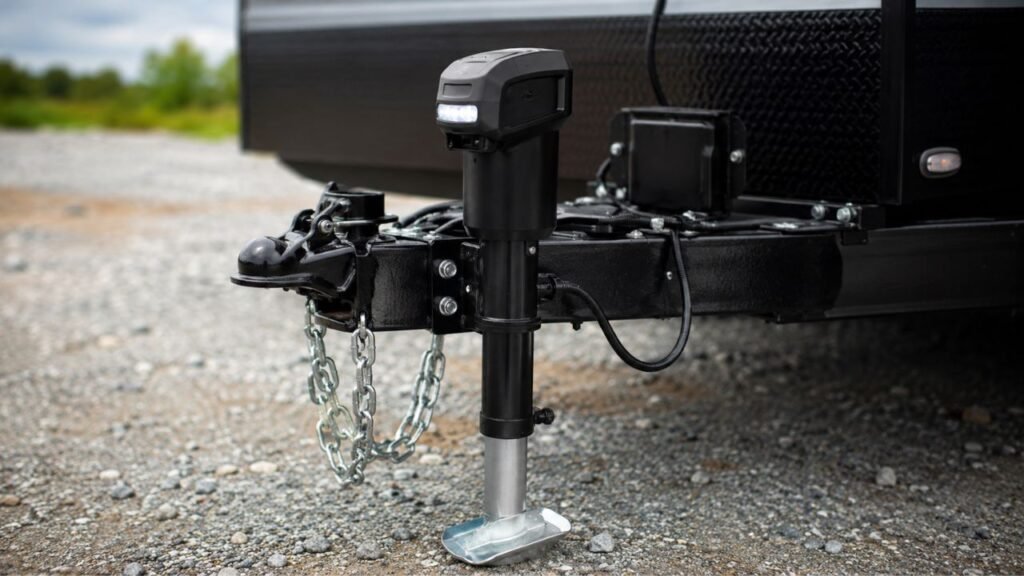
A slow electric tongue jack is usually caused by a weak trailer battery, poor ground connection, corroded wiring, excessive voltage drop, or mechanical resistance inside the jack. If it slows mainly while lifting the trailer, tongue weight or a weakening motor may also be contributing.
The good news is that you can usually narrow down the problem without replacing the jack. Below, I’ll walk you through the most likely causes, simple tests, and the order I recommend checking everything.
Key Takeaways
- A weak or undercharged battery can make a tongue jack noticeably slower.
- Poor grounding is one of the most common electric jack problems.
- Corroded terminals and fuse holders can restrict current without completely stopping the jack.
- A jack that moves slowly only upward may be struggling with load.
- Normal battery voltage does not rule out voltage drop while operating.
- Hard manual cranking usually points toward mechanical resistance.
- Easy manual cranking with slow powered operation suggests an electrical problem.
- Grinding, overheating, or repeated stopping should not be ignored.
- Check simple electrical problems before assuming the motor has failed.
Is It Normal for an Electric Tongue Jack to Move Slowly?
Electric tongue jacks are not designed for high-speed operation. Their gearing sacrifices speed to produce enough force to raise and lower a heavy trailer tongue.
If your jack has always moved at roughly the same slow but steady pace, there may be nothing wrong with it. The more important warning sign is a noticeable change in speed.
For example, pay attention if your jack used to raise the trailer comfortably but now sounds strained or takes much longer. You should also investigate if it jerks, stalls, slows dramatically under load, or becomes unusually hot.
Some tongue jacks may also slow slightly near their travel limits. Check the owner’s manual for your particular model before assuming this behavior indicates a failure.
Quick Electric Tongue Jack Slowdown Diagnosis
The way your jack behaves can tell you a lot about the problem. Use this table to narrow down where you should start looking.
| What Your Tongue Jack Does | Most Likely Causes | What to Check First |
| Slow in both directions | Weak battery, bad ground, voltage drop | Battery and electrical connections |
| Slow mainly going up | Low voltage, heavy tongue load, mechanical drag | Battery under load and tongue weight |
| Goes down normally but raises slowly | Weak battery, excessive resistance, high load | Battery, ground, and manual operation |
| Starts fast and gradually slows | Voltage sag, heating connection, motor overheating | Battery voltage while operating |
| Moves slowly and jerks | Bent tube, dirt, rust, internal binding | Jack tube and manual crank |
| Easy to crank manually but slow electrically | Wiring, battery, switch, or motor | Voltage reaching the jack |
| Difficult to crank manually | Mechanical binding, gears, screw, corrosion | Mechanical components |
| Runs faster when truck is connected | Weak trailer battery or charging issue | Trailer battery |
| Runs faster while connected to shore power | Battery or charging-system problem | Battery and converter charging |
| Makes grinding or slipping noises | Overload, travel limit, gearbox problem | Stop and inspect jack |
Why Is My Electric Tongue Jack Moving Slowly?
Several different problems can produce almost the same slow-jack symptom. I recommend starting with the battery and electrical connections before moving into internal mechanical repairs.
Weak or Undercharged Trailer Battery
A weak trailer battery is one of the first things I would check.
Your tongue jack motor requires much more current than small 12-volt lights. That means your trailer lights might work perfectly while the jack still struggles.
A battery can also show reasonable voltage when nothing is running but drop significantly once the jack motor starts drawing current.
Possible battery-related problems include:
- Low battery charge
- Aging battery
- Damaged battery
- Poor battery charging
- Loose terminals
- Corroded battery connections
Charge the trailer battery fully and test the jack again. If its speed noticeably improves, you have a strong clue that the power supply was contributing to the problem.
Poor Ground Connection
A poor electrical ground can make a perfectly good tongue jack move painfully slowly.
Many tongue jacks ground through their mounting hardware directly to the trailer’s A-frame. Other models use a dedicated negative wire.
For frame-grounded jacks, rust, paint, powder coating, dirt, or corrosion between the mounting surfaces can create unwanted electrical resistance.
Check for:
- Rust around jack mounting bolts
- Loose mounting hardware
- Corrosion between metal surfaces
- Paint preventing metal-to-metal contact
- Damaged ground wires
- Loose negative battery connections
Do not automatically sand paint from your trailer without checking how your particular jack is grounded. If your jack uses the mounting flange as its ground, follow the manufacturer’s instructions for creating proper metal-to-metal contact.
Corroded or Loose Positive Connections
The positive side of the circuit matters just as much as the ground.
A loose or corroded connection can still pass enough electricity for the motor to run, but not enough for it to perform normally under load.
Trace the positive cable from the battery toward the jack.
Pay attention to:
- Battery terminals
- Ring connectors
- Inline fuse holders
- Circuit breakers
- Splices
- Crimp connectors
- Wire damage
Look for green corrosion, darkened terminals, loose hardware, melted plastic, or damaged insulation.
If a connection becomes unusually warm while the jack operates, excessive resistance may be present.
Excessive Voltage Drop
Voltage drop deserves special attention because checking battery voltage alone can sometimes be misleading.
Imagine your battery is adequately charged. You measure it while the jack is sitting idle, and everything looks normal. However, corrosion or a weak connection between the battery and jack may cause the voltage reaching the motor to fall once you press the switch.
The problem may come from:
- Corroded battery terminals
- Bad ground connections
- Damaged wiring
- Loose connectors
- Poor splices
- Corroded fuse holders
- Failing circuit breakers
The better test is measuring voltage while the jack is actually operating.
If the battery maintains healthy voltage but the voltage reaching the jack drops significantly, concentrate on the wiring and connections between them.
Too Much Tongue Weight or Jack Load
A jack that works reasonably well without much load but slows dramatically once it begins raising the trailer may simply be working too hard.
Tongue weight can increase when you add:
- Extra batteries
- Larger propane tanks
- Heavy cargo in front storage compartments
- Gear near the front of the trailer
- Accessories mounted on the A-frame
Remember that tongue-jack capacity refers to how much weight the jack itself must lift. It does not mean the jack needs to lift the trailer’s entire GVWR.
Certain hitching procedures can also temporarily place more load on the jack.
If the motor sounds heavily strained only after the jack contacts the ground and begins lifting, check your actual tongue load and the jack’s rated capacity.
Mechanical Binding in the Jack Tube
Electrical problems are common, but mechanical resistance can make the motor work equally hard.
Inspect the jack tube closely.
Watch for:
- Bent tubing
- Rust
- Deep scratches
- Dirt buildup
- Impact damage
- Side loading
- Misalignment
- A damaged footplate
A jack tube should extend and retract smoothly.
If the jack slows or catches at approximately the same position every time, that is a useful clue. A bent tube or damaged internal component becomes more likely than a battery problem.
Dry or Dirty Jack Components
Moving components create more resistance when dirt, corrosion, or inadequate lubrication interferes with normal movement.
Depending on the design, maintenance may involve cleaning or lubricating:
- The inner jack tube
- Screw mechanism
- Gear assembly
- Other manufacturer-specified moving parts
However, I would not spray lubricant randomly into the motor housing or gearbox.
Find the maintenance instructions for your specific jack model first. Different manufacturers specify different lubricants and service procedures.
Corroded Fuse Holder or Weak Circuit Breaker
Most people check whether the tongue jack fuse has blown and stop there.
The fuse holder itself can also cause trouble.
Moisture and road exposure can corrode contacts inside an inline fuse holder. The fuse may remain intact while resistance across those connections reduces the amount of usable power reaching the jack.
Inspect for:
- Green corrosion
- Loose fuse contacts
- Burned terminals
- Melted plastic
- Damaged wiring near the holder
Some installations use an automatically resetting circuit breaker instead of, or along with, an inline fuse.
A weak or overheating breaker may repeatedly interrupt operation under heavy load.
Never replace a fuse or breaker with a higher rating simply to stop it from opening. Always use the rating specified for your jack and wiring.
Worn Extend/Retract Switch
The rocker switch carries current whenever you extend or retract the jack.
Over time, internal contacts can wear or corrode.
A switch problem becomes more suspicious when one direction behaves differently from the other.
For example, the jack may:
- Raise slowly but lower normally
- Lower slowly but raise normally
- Change speed when the switch is moved
- Work intermittently
- Stop unless you hold the switch in a certain position
Before replacing the switch, still verify battery voltage and wiring connections.
Water or Moisture Inside the Jack Head
The jack head lives outside in rain, humidity, road spray, and temperature changes.
A damaged cover, cracked housing, deteriorated switch boot, or failed seal can allow moisture inside.
Over time, moisture may corrode:
- Switch terminals
- Wire connectors
- Motor connections
- Circuit components
Inspect the top housing for cracks or damaged seals.
If you find obvious water intrusion, deal with the source before replacing electrical parts. Otherwise, the same problem may return.
Failing Motor or Gearbox
A worn motor can eventually lose torque and run slowly.
Internal gearbox wear can create similar symptoms.
However, I would put the motor near the bottom of your troubleshooting list rather than the top.
Consider an internal motor or gearbox problem after confirming:
- The battery is properly charged.
- Battery voltage remains stable under load.
- The jack receives adequate voltage.
- Ground connections are good.
- Wiring is undamaged.
- The jack is not overloaded.
- The tube is not binding.
Replacing the whole jack before checking those inexpensive problems can waste a lot of money.
How to Diagnose a Slow Electric Tongue Jack Step by Step
You can make troubleshooting much easier by following the electrical path first, then checking mechanical resistance. Here is the order I recommend.
Step 1: Notice Exactly How the Jack Is Slowing
Do not immediately start replacing components.
Run the jack briefly and observe what actually happens.
Ask yourself:
- Is it slow in both directions?
- Is it slower going up?
- Does it start normally before slowing?
- Does it slow only after taking trailer weight?
- Does it jerk?
- Does it stop at one particular position?
- Does the motor sound strained?
- Do you hear grinding or clicking?
These details can quickly separate a general power problem from a load or mechanical problem.
Step 2: Check the Trailer Battery
Start with the simplest possible cause.
Check the battery terminals for looseness or corrosion. Make sure the battery disconnect switch is in the correct position if your trailer has one.
Charge the battery completely and test again.
For a better diagnosis, measure battery voltage while someone operates the jack. A substantial voltage drop under load can indicate a weak battery or power-supply problem.
Follow the specifications for your battery type when interpreting voltage readings.
Step 3: Clean and Check the Ground
Determine how your jack receives its negative connection.
If it uses a dedicated ground wire, inspect that wire from the jack to its connection point.
If the jack grounds through its mounting flange, inspect the mounting bolts and contact surfaces.
Look for:
- Corrosion
- Loose bolts
- Damaged wiring
- Rust
- Dirt
- Poor metal contact
Restore the ground according to the jack manufacturer’s installation instructions.
Step 4: Inspect the Positive Cable and Fuse Holder
Follow the jack’s positive wire toward the battery.
Inspect every accessible connection along the path.
Pay particular attention to the inline fuse holder because it often sits in an exposed area near the trailer tongue.
Replace damaged terminals, connectors, or fuse holders with properly rated components.
Step 5: Test Voltage While the Jack Is Running
This is one of the most useful troubleshooting tests.
Compare voltage at the battery with voltage reaching the jack while the motor is running.
You can interpret the results generally like this:
Both voltages fall significantly:
The battery or overall supply system deserves closer inspection.
Battery voltage stays healthy but jack voltage falls:
Look for resistance in wiring, connectors, fuse holders, breakers, or grounds.
Good voltage reaches the jack but it remains slow:
Focus more heavily on jack load, mechanical drag, the switch, motor, or gearbox.
If you are uncomfortable taking live electrical measurements, have an RV technician perform this test.
Step 6: Try the Manual Override
Most electric tongue jacks include a manual crank or emergency override.
Use the manufacturer’s manual-cranking procedure with the trailer properly secured.
Pay attention to resistance.
If the jack cranks relatively smoothly manually:
An electrical problem becomes more likely.
If the jack is extremely difficult to crank manually:
Mechanical binding deserves closer attention.
You may be dealing with a bent tube, damaged screw mechanism, corrosion, or internal gearbox resistance.
Step 7: Compare Its Behavior Under Load
If it can be done safely, notice how the jack behaves before and after it begins carrying substantial tongue weight.
A jack that moves normally unloaded but slows dramatically under load may have:
- A weak battery
- Excessive voltage drop
- Too much tongue weight
- Mechanical drag
- A weakening motor
Never place yourself beneath the trailer while performing this test.
Step 8: Inspect for Mechanical Resistance
Extend only as needed and inspect accessible jack components.
Look closely for:
- Bent tubing
- Rust
- Scratches
- Dirt buildup
- Misalignment
- Side loading
- Damaged footplate
If the same section of the jack binds during every cycle, mechanical damage becomes particularly suspicious.
Step 9: Check the Switch and Motor Last
Once the power supply, wiring, ground, load, and mechanical movement have been verified, move on to internal electrical components.
At this stage, the extend/retract switch, motor, or gearbox may require testing or replacement.
If the jack must be opened for diagnosis, check whether doing so affects its warranty before proceeding.
Why Is My Tongue Jack Slow Going Up but Faster Going Down?
A jack that lowers normally but raises slowly often has a problem that becomes noticeable under heavier load.
Raising the trailer requires considerably more motor effort than lowering it. A slightly weak battery, poor connection, excessive tongue weight, or mechanical resistance may therefore appear mainly when the jack is extending under load. A weakening motor can behave similarly.
If manual operation is also difficult while raising, look closely for mechanical binding. If manual operation feels smooth, concentrate more on battery voltage and electrical resistance.
Why Does My Tongue Jack Start Fast and Then Slow Down?
A tongue jack that begins at normal speed but gradually slows may be experiencing a problem that becomes worse as current flows.
Common possibilities include:
- Battery voltage dropping under sustained load
- A resistive electrical connection heating up
- Motor temperature increasing
- An overloaded jack
- An automatic breaker beginning to trip
- Increasing mechanical resistance during travel
Do not repeatedly run the jack until it overheats and then treat cooling down as the repair. Something is making the motor work harder or reducing the electricity available to it.
Why Does My Electric Tongue Jack Work Better With the Truck Connected?
If connecting your tow vehicle makes the tongue jack noticeably faster, I would investigate the trailer battery and its charging system first.
Depending on how your tow vehicle and trailer are wired, the 7-way connection may provide additional charging support to the trailer’s 12-volt system.
That extra support may temporarily compensate for:
- A weak trailer battery
- Low battery charge
- Poor charging
- Battery deterioration
However, do not assume every vehicle supplies enough current through its trailer connector to operate every jack normally.
Use the improvement as a diagnostic clue rather than a permanent solution.
Will Shore Power Make a Slow Electric Tongue Jack Faster?
Connecting your RV to shore power can sometimes make a slow tongue jack perform better, but the jack itself still operates on 12-volt DC power.
When shore power is connected, your RV’s converter or charger may support the 12-volt system while charging the battery.
Therefore, if your jack becomes noticeably stronger while the RV is connected to shore power but slows again when disconnected, inspect the trailer battery.
The battery may be undercharged, deteriorated, or not receiving a proper charge.
Can Too Much Tongue Weight Make an Electric Jack Slow?
Yes. An overloaded or heavily loaded tongue jack may move noticeably slower, especially while raising the trailer.
Possible signs include:
- Jack moves normally before touching the ground.
- Speed drops after it takes the trailer’s weight.
- Motor sounds strained.
- Jack is much slower going upward.
- Protective clutch slips.
- Breaker repeatedly interrupts operation.
- Problem appeared after adding front-mounted cargo.
Compare the actual load on the jack with its rated lifting capacity.
Also consider recent changes such as adding batteries, propane tanks, storage equipment, or heavy cargo near the trailer’s front.
Should I Lubricate a Slow Electric Tongue Jack?
Lubrication can help when friction is contributing to slow operation, but you should follow the maintenance instructions for your specific jack.
Some models require periodic cleaning and lubrication of the inner tube or other moving components. Others have internal parts that are not intended for routine owner servicing.
Start by identifying the manufacturer and model.
Clean exposed moving surfaces as directed, then use only the recommended lubricant.
Avoid coating everything with heavy grease. Excess lubricant can collect dirt and create additional problems.
Can Cold Weather Make an Electric Tongue Jack Move Slower?
Cold weather can make an electric tongue jack seem slower because low temperatures affect both batteries and mechanical components.
A cold battery may provide less usable power, particularly if it is already weak or partly discharged. Lubricants can also become thicker, increasing mechanical resistance.
A small seasonal difference may therefore be normal.
However, severe slowdown, jerking, grinding, or stalling should still be investigated rather than blamed entirely on cold weather.
When Should You Stop Using a Slow Electric Tongue Jack?
A slight speed change does not always mean immediate failure. Certain symptoms, however, suggest you should stop powered operation and inspect the jack before continuing.
Stop using the jack if you notice:
- Loud grinding
- Repeated popping
- Continuous clutch slipping
- Burning smell
- Smoke
- Extremely hot wiring
- Melted fuse holder
- Severely bent jack tube
- Heavy jerking
- Jack slipping under load
- Repeated fuse or breaker problems
Always chock the trailer wheels before working around the tongue area.
Never place yourself underneath a trailer supported only by the tongue jack. Also, never install a larger fuse or breaker than the manufacturer specifies in an attempt to keep the jack running.
Should You Repair or Replace a Slow Electric Tongue Jack?
Many slow tongue jacks can be repaired without replacing the complete assembly. The right choice depends on whether the problem is external and inexpensive or involves serious internal damage.
Repair or Service It When
Repair usually makes sense when the problem involves:
- Weak battery
- Dirty battery terminals
- Poor frame ground
- Loose ground wire
- Corroded fuse holder
- Damaged connector
- Repairable wiring
- Replaceable switch
- Routine manufacturer-approved lubrication
These problems are generally worth addressing before considering replacement.
Consider Replacing It When
Replacement may make more sense when you find:
- Severely bent jack tube
- Extensive internal corrosion
- Damaged gearbox
- Motor that has lost torque despite proper voltage
- Repeated internal binding
- Jack slipping under normal load
- Structural damage
- Unavailable replacement parts
Compare repair cost with the price of a properly rated replacement jack before investing heavily in an older unit.
How to Keep Your Electric Tongue Jack From Getting Slow Again
Regular inspection can prevent many of the electrical and mechanical problems that gradually make a tongue jack sluggish.
- Keep your trailer battery properly charged.
- Clean battery terminals when corrosion appears.
- Inspect jack wiring periodically.
- Check the inline fuse holder for moisture and corrosion.
- Keep ground connections clean and tight.
- Inspect the jack housing for water intrusion.
- Keep protective caps and switch boots in good condition.
- Clean the inner tube as recommended.
- Lubricate only according to manufacturer instructions.
- Avoid side-loading the jack.
- Stay within the jack’s rated capacity.
- Do not continue holding the switch at the travel limit.
- Keep the manual crank where you can easily access it.
A few minutes of inspection during normal trailer maintenance can save you from dealing with a jack that barely moves when you are trying to hitch up.
Final Words
If your electric tongue jack has suddenly become slower, start with the simple things before blaming the motor. I recommend checking the battery, terminals, ground connection, fuse holder, wiring, and voltage under load first.
If those areas check out, use the manual override to see how easily the jack moves mechanically. Smooth manual operation points more toward an electrical problem, while heavy resistance suggests binding or internal wear. Following that order can help you find the actual problem without replacing expensive parts unnecessarily.
Related FAQs
Why Is My Electric Tongue Jack So Slow Under Load?
A tongue jack that slows mainly under load may have a weak battery, excessive voltage drop, too much tongue weight, mechanical resistance, or a weakening motor. Check battery performance under load before assuming the jack itself has failed.
Can a Weak Battery Make an Electric Tongue Jack Run Slowly?
Yes. A weak or partially discharged trailer battery may still operate lights while failing to provide enough current for the tongue jack motor. Charging and load-testing the battery can help confirm the problem.
Can a Bad Ground Make a Tongue Jack Move Slowly?
Yes. A poor ground adds resistance to the electrical circuit and reduces available power at the motor. Check mounting surfaces or dedicated ground wires according to your jack’s design.
Why Does My Tongue Jack Go Down Normally but Raise Slowly?
Raising the trailer places considerably more load on the motor than lowering it. Low battery power, voltage drop, excessive tongue weight, mechanical binding, or motor wear can therefore become more noticeable while going up.
Why Does My Electric Tongue Jack Slow Down After a Few Seconds?
The battery may be sagging under load, an electrical connection may be heating up, or the motor may be overheating. Increasing mechanical resistance or an overloaded jack can also produce the same behavior.
Why Does My Tongue Jack Work Only When the Truck Is Connected?
The tow vehicle may be providing additional support to the trailer’s 12-volt electrical system. If the jack improves when connected, check the trailer battery, battery connections, and charging system.
Does Shore Power Run an Electric Tongue Jack?
The tongue jack normally operates from the trailer’s 12-volt DC system rather than directly from 120-volt shore power. However, the RV converter may support the 12-volt system and charge the battery while shore power is connected.
How Do I Know if My Electric Tongue Jack Motor Is Bad?
A bad motor becomes more likely when proper voltage reaches the jack, electrical connections are clean, grounding is good, the load is within capacity, and the jack moves smoothly manually but remains weak during powered operation.
How Fast Should an Electric Tongue Jack Move?
There is no universal speed because gearing, jack capacity, motor design, and load vary between models. Compare your jack with its normal previous operation and manufacturer specifications rather than expecting it to match another trailer’s jack.
Can a Corroded Fuse Holder Slow Down a Tongue Jack?
Yes. Corrosion inside a fuse holder can create electrical resistance even when the fuse itself remains intact. This can reduce voltage at the motor and make the jack run slowly under load.
Can I Manually Crank an Electric Tongue Jack?
Most electric tongue jacks include a manual override for emergencies or troubleshooting. Follow your manufacturer’s procedure and make sure the trailer is properly secured before manually operating the jack.
Can an Overloaded Tongue Jack Run Slowly?
Yes. Excessive load forces the motor to work harder and may cause slower movement, overheating, breaker interruptions, or clutch slipping. Never exceed the lifting capacity specified for your jack.
Should I Grease My Electric Tongue Jack?
Only lubricate the jack according to its manufacturer’s maintenance instructions. Some models require periodic lubrication of specific components, while others should not be opened or filled with general-purpose grease.
Why Is My Tongue Jack Slow in Only One Direction?
If the jack moves normally one way but slowly the other, the difference may come from load, mechanical resistance, or worn switch contacts. Slow upward travel is especially likely to expose weak batteries and voltage-drop problems.

Ethan Walker writes about travel routes, outdoor exploration, and road-based adventures. His guides focus on simple planning, dependable gear, and realistic travel advice. He values comfort, safety, and practical experience over hype.