Your RV tankless water heater usually turns hot then cold because water flow through the heater is changing. Low flow, fluctuating pressure, cold-water mixing, clogged filters, pump cycling, overheating, or ignition problems can cause the burner to reduce heat or shut off completely.
The good news is that you can usually narrow down the cause quickly. I’ll walk you through the symptoms, simple tests, common fixes, and signs that your heater needs professional service.
Key Takeaways
- Unstable water flow is one of the most common causes.
- A brief cold burst after restarting water can be normal.
- Repeated hot-cold cycling usually means something needs troubleshooting.
- Mixing cold water can affect some heaters more than others.
- Your RV pump and campground water supply can behave differently.
- Dirty filters, aerators, and inlet screens can restrict water flow.
- High water flow can also overwhelm the heater in cold weather.
- Recurring error codes or ignition problems need model-specific diagnosis.
First, Identify How Your Water Is Turning Hot and Cold
Before changing settings or replacing parts, pay attention to the pattern. Different temperature patterns often point toward completely different problems.
| What You Notice | Most Likely Cause | First Thing to Check |
| Hot, briefly cold, then hot again | Cold-water sandwich | Did you pause or restart the shower? |
| Repeated hot-cold-hot cycling | Flow dropping too low | Run one hot faucet steadily |
| Hot until another faucet opens | Water-flow redistribution | Turn every other fixture off |
| Stable on city water, unstable on pump | Pump or fresh-water issue | Check pump cycling and strainer |
| Stable on pump, unstable on city water | Campground supply issue | Check hose, regulator, and filter |
| Hot water slowly becomes lukewarm | Heater capacity being exceeded | Reduce water flow slightly |
| Very hot water suddenly becomes cold | Overheating protection | Check display and error codes |
| Only the shower fluctuates | Showerhead or mixing problem | Test a sink faucet |
| Every faucet fluctuates | System-wide heater or supply issue | Check flow, propane, and power |
This simple comparison can save you from replacing good parts unnecessarily.
Why an RV Tankless Water Heater Can Suddenly Stop Heating
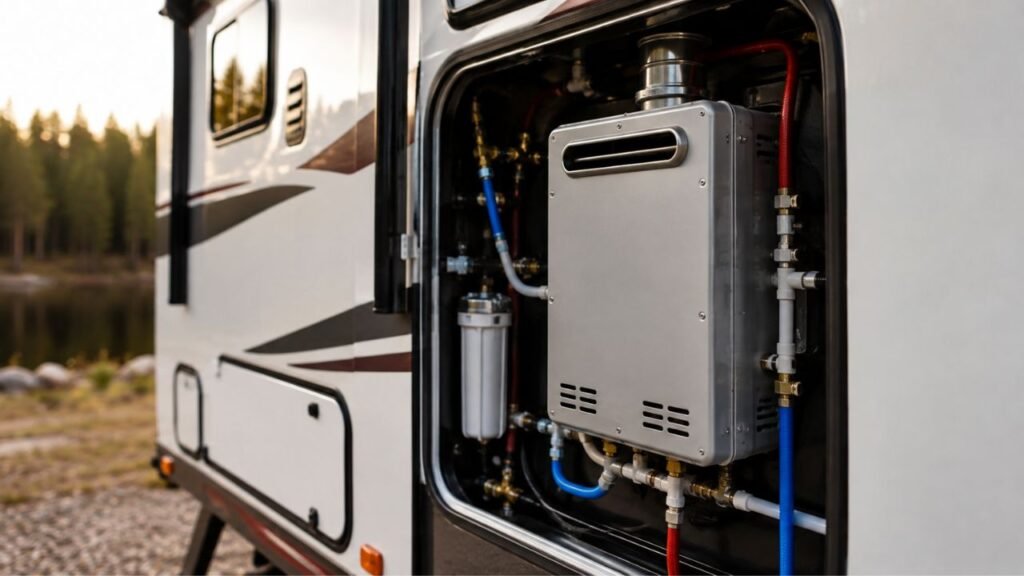
An RV tankless water heater only heats water when it detects enough flow. Unlike a traditional tank heater, it does not store gallons of hot water.
When you open a faucet, water begins moving through the heater. A flow sensor detects that movement and signals the control board. The heater then checks its operating conditions and starts the burner.
Once running, the heater constantly adjusts burner output. It responds to water flow and incoming water temperature.
Problems begin when those conditions keep changing.
If flow drops below the heater’s required level, the burner may stop. When enough flow returns, the burner starts again.
That restart creates a noticeable temperature swing at the faucet.
Every heater has its own activation requirements. There is no single minimum GPM number that applies to every RV tankless water heater.
Common Reasons Your RV Tankless Water Heater Goes Hot Then Cold
Several problems can create similar temperature swings. I recommend starting with water-flow problems because they are common and easier to check.
Water Flow Is Dropping Too Low
Tankless water heaters depend heavily on steady water flow. If the flow becomes too weak, the heater may stop heating.
Common restrictions include:
- A partially opened faucet
- A clogged showerhead
- A kinked shower hose
- A dirty faucet aerator
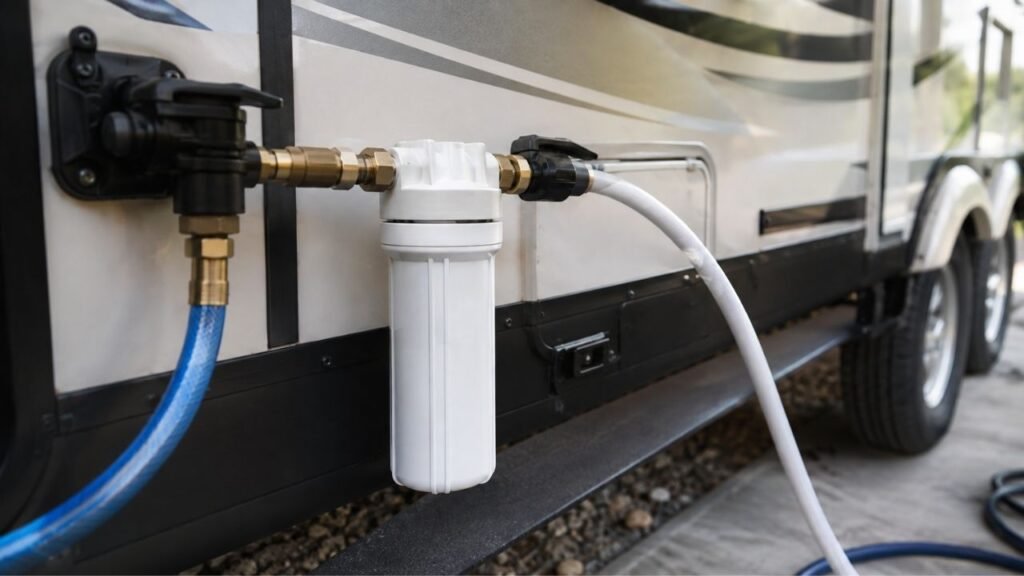
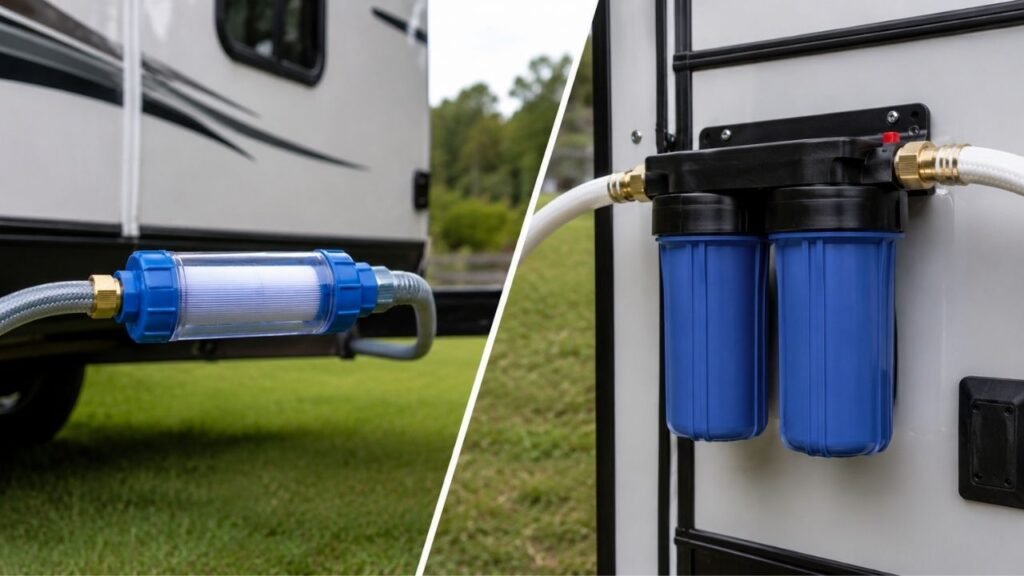
- A clogged water filter
- A dirty pump strainer
- A restricted heater inlet screen
- Weak campground water flow
You may notice the water warming again after opening the faucet farther.
That is a strong clue that the heater was losing activation flow.
Try opening one hot-water faucet fully. Leave every other fixture turned off.
If the temperature suddenly becomes stable, low flow is probably involved.
You Are Changing Hot-Water Flow While Mixing Cold Water
This is one of the most misunderstood RV tankless problems.
When you add cold water at the faucet, less water travels through the hot side. On some systems, that reduced hot-side flow can bring the heater close to its operating threshold.
The burner may reduce output or shut down.
You then feel cold water.
When flow rises again, the heater restarts and produces hot water.
However, using cold water is not automatically wrong.
Some RV tankless heaters are designed for normal hot-and-cold mixing. Other installations work more consistently when the heater is set near shower temperature and mostly hot water is used.
For example, you might set the heater around 100°F to 105°F. You could then shower using mainly the hot side.
The best method depends on your particular heater.
Check the operating instructions for your model before changing your normal faucet habits.
You Are Experiencing a Cold-Water Sandwich
A cold-water sandwich is different from repeated temperature cycling.
Imagine taking a shower and pressing the showerhead pause button. Water flow stops, so the heater stops firing.
Hot water remains inside some sections of your plumbing.
When you restart the shower, that remaining hot water reaches you first. It may be followed by cooler water that entered while the heater was restarting.
Then newly heated water arrives.
You experience:
Hot water → cold burst → hot water again.
This can also happen when taking a Navy shower.
A single short cold burst after restarting water is usually less concerning. Continuous hot-cold cycling while water stays running points toward another issue.
Your RV Water Pump Is Pulsing
Pay attention to your water pump while showering from the fresh tank.
Does the pump repeatedly start and stop?
Do you hear pressure rising and falling?
If the water temperature changes with the pump rhythm, the heater may be reacting to unstable flow.
Possible causes include:
- A dirty pump strainer
- A restricted water line
- Air inside the plumbing
- Improper pump adjustment
- Low fresh-water level
- A weak water pump
- Very low faucet demand
Some RV plumbing systems also use accumulator tanks to smooth pump operation.
The easiest test is comparing pump water with city water.
If the heater works perfectly on city water, investigate the pump system first.
Campground Water Pressure or Flow Keeps Changing
Campground water supplies are not always consistent.
Pressure can fall during busy mornings and evenings. Flow may also change when many campers use water simultaneously.
Your pressure regulator can only regulate available pressure. It cannot create additional water flow.
Other campground-side restrictions may include:
- A restrictive pressure regulator
- A kinked drinking-water hose
- A clogged inline filter
- A very long hose
- A partially closed campground spigot
You can perform a useful comparison test.
Fill your RV fresh-water tank and disconnect city water. Run the heater using your RV pump.
If the hot water becomes stable, investigate the campground connection.
Another Faucet or Toilet Is Changing Available Flow
RV plumbing systems are compact, so one fixture can affect another.
You might have steady hot water until someone:
- Flushes the toilet
- Opens the kitchen faucet
- Uses the bathroom sink
- Starts an appliance using water
The total system flow changes instantly.
Depending on your heater and plumbing setup, the water heater may react by changing burner output.
Try showering with every other fixture completely turned off.
If that solves the problem, simultaneous water use is contributing.
Water Is Flowing Faster Than the Heater Can Heat It
Low flow can stop a tankless heater.
Too much flow creates a different problem.
When water passes through too quickly, the burner may not have enough capacity to raise the temperature as much as requested.
This becomes especially noticeable during cold weather.
Winter campground water may enter your RV extremely cold. Raising that water to shower temperature requires more heating power.
You may notice:
- Water starts hot but becomes lukewarm
- The heater stays running
- Water does not become completely cold
- Lowering flow improves the temperature
Try reducing the hot-water flow slightly.
If the temperature rises and stays stable, you may be exceeding the heater’s heating capacity under those conditions.
A Filter, Screen, Showerhead, or Aerator Is Restricted
Tankless heaters can be sensitive to small flow restrictions.
A filter does not need to be completely clogged before causing trouble.
Check accessible components such as:
- Whole-RV water filters
- Inline campground filters
- Pump strainers
- Water-heater inlet screens
- Faucet aerators
- Showerheads
- Shower hoses
Remove and clean components only as your manuals allow.
I especially recommend checking the showerhead if only your shower has problems.
Mineral deposits can reduce flow without making the shower appear completely blocked.
Mineral Scale Is Restricting the Heat Exchanger
Hard water leaves mineral deposits inside plumbing appliances.
Over time, scale can narrow internal passages and reduce heat transfer. Water may still pass through, but performance becomes less stable.
You might notice:
- Gradually worsening temperature swings
- Reduced hot-water flow
- Longer heating delays
- More frequent shutdowns
- Reduced performance in hard-water areas
Descaling may help when mineral buildup is responsible.
However, do not automatically pour vinegar or another chemical through every heater.
Follow the flushing and descaling procedure approved for your exact model.
Different manufacturers can specify different cleaners and procedures.
Hot and Cold Water Are Crossing Inside the RV Plumbing
Sometimes the water heater is working correctly.
The actual problem is somewhere else in the plumbing.
Hot and cold water can unintentionally mix through certain fixtures.
Common places to check include:
- Exterior showers
- Interior shower valves
- Winterization valves
- Water-heater bypass valves
- Mixing valves
- Faucet cartridges
An exterior shower is especially easy to overlook.
Suppose both exterior shower faucet handles remain open. If you stop water using only the showerhead button, hot and cold lines may still connect through the faucet body.
That crossover can affect water temperatures elsewhere inside your RV.
Close both exterior shower valves completely when you are finished using them.
The Heater Is Overheating and Shutting Down
A different pattern happens when water becomes extremely hot first.
You may get:
Very hot water → completely cold water → hot water again later.
That can indicate an overtemperature shutdown.
Possible causes include:
- Water flow becoming too low
- Restricted water passages
- Mineral scale
- Very warm incoming water
- Temperature sensor problems
- Incorrect heater operation
The heater’s safety system may shut the burner down before temperatures become dangerous.
Do not bypass an overtemperature switch or another safety device.
If overheating keeps happening with good water flow, professional diagnosis is appropriate.
Propane, Ignition, 12-Volt Power, or a Sensor Is Interrupting the Burner
If water flow looks normal, move your attention toward the heater itself.
RV tankless heaters generally require several things to work together:
- Adequate propane
- Stable 12-volt DC power
- Reliable ignition
- Correct flame detection
- Working temperature sensors
- Working flow sensors
- Proper exhaust airflow
A brief interruption can shut down the burner.
You may hear the burner stop before the water becomes cold.
Check the heater display immediately.
An error code can provide an important clue.
Avoid repeatedly resetting a heater without understanding why the fault returns.
How to Fix an RV Tankless Water Heater That Keeps Going Hot and Cold
The easiest approach is eliminating one possible cause at a time. Start with simple water-flow checks before moving toward heater repairs.
- Turn off every other water fixture.
Run only the faucet or shower you are testing. - Open the hot side to a steady flow.
See whether the heater remains continuously active. - Watch the heater display.
Check whether the burner indicator disappears when water gets cold. - Try the operating method recommended by your manufacturer.
Some heaters work well with normal mixing. Others may remain steadier with a lower setpoint and mostly hot-side flow. - Test another faucet.
If sinks stay hot but the shower cycles, inspect the shower assembly. - Clean accessible aerators and showerheads.
Mineral deposits can restrict enough flow to cause cycling. - Inspect your water filters.
Replace filters that are dirty or unusually restrictive. - Check the pump strainer and heater inlet screen.
Follow the heater and pump instructions while doing this. - Compare city water with your RV pump.
This quickly separates campground problems from RV plumbing problems. - Check exterior shower and bypass valves.
Make sure hot and cold water cannot cross unintentionally. - Look for an error code.
Record the exact code before turning anything off. - Consider approved descaling.
Do this when maintenance is overdue or scale seems likely. - Stop if gas-system diagnosis becomes necessary.
Propane pressure, combustion components, and safety controls deserve professional service.
Should You Use Only Hot Water With an RV Tankless Heater?
There is no universal rule saying you must use only hot water.
Some RV owners get better temperature stability by lowering the heater setting close to shower temperature. They then use mostly or entirely the hot faucet.
For example, you might select around 100°F to 105°F. This keeps more water moving through the hot side.
That can help a flow-sensitive installation stay activated.
However, other heaters are designed for normal faucet mixing. You can set a higher heater temperature and blend cold water normally.
The important point is this:
Do not assume advice for one heater automatically applies to yours.
Check your owner’s manual for the intended temperature-control method.
If temperature swings happen mainly while mixing cold water, test your shower using a lower heater temperature and stronger hot-side flow.
If that solves the problem, flow through the hot side was likely involved.
Water Pressure vs Water Flow: Why the Difference Matters
RV owners often use pressure and flow as though they mean the same thing.
They do not.
PSI measures water pressure.
GPM measures how much water is actually flowing.
Your campground connection could show reasonable pressure while delivering poor flow under demand.
A clogged filter can create the same situation.
Your pressure regulator may be properly adjusted, but a dirty filter downstream can still limit water entering the heater.
Tankless water heaters care greatly about actual water movement.
That is why checking only the regulator pressure may not reveal the problem.
When diagnosing temperature cycling, also check hoses, filters, aerators, showerheads, and other restrictions.
Does Your Heater Act Differently on City Water and the RV Pump?
Comparing both water sources is one of my favorite diagnostic tests. It can quickly tell you which side of the system deserves attention.
Hot and Cold Only on City Water
If temperature swings happen only while connected to campground water, inspect:
- Campground water pressure
- Available campground flow
- Your pressure regulator
- Drinking-water hose
- External water filter
- Campground spigot
Try another campsite connection when practical.
Hot and Cold Only When Using the Fresh Tank
If the problem appears only while using your onboard pump, inspect:
- Fresh-water tank level
- Pump strainer
- Pump cycling
- Air in the plumbing
- Pump performance
- Plumbing restrictions
Listen carefully while the heater runs.
If the water turns cold whenever the pump stops, unstable pump flow deserves attention.
Hot and Cold on Both Water Sources
If city water and pump water produce the same problem, look closer at:
- Heater inlet screen
- Heater settings
- Shower or faucet restrictions
- Plumbing crossover
- Mineral scale
- Propane supply
- Sensors
- Ignition system
- Heater control system
This makes the heater or downstream plumbing more likely than either water source.
Why Does It Happen Only in the RV Shower?
If every sink stays consistently hot but the shower does not, start with the shower itself.
Common shower-specific causes include:
- A restrictive low-flow showerhead
- Mineral buildup inside the showerhead
- A kinked shower hose
- A partially blocked hose
- A showerhead pause valve
- A faulty mixing cartridge
- Excessive cold-water mixing
- Low hot-side flow
Try removing the showerhead temporarily if your plumbing setup allows it.
Run hot water through the open hose.
If the temperature becomes stable, the showerhead may be restricting flow.
You can also compare the shower with a nearby bathroom sink.
A stable sink strongly suggests the heater can operate correctly.
What If It Goes Cold Whenever Someone Flushes the Toilet?
A toilet flush can temporarily change water flow throughout your RV.
This is especially noticeable when using a smaller water pump or weak campground connection.
You may feel reduced shower pressure immediately.
If hot-side flow through the heater drops enough, the burner can reduce output or shut down.
Test the shower while nobody uses another fixture.
Then repeat the test while someone flushes the toilet.
If the temperature changes at exactly the same moment, shared water demand is contributing.
Check for excessive restrictions before assuming you need a larger heater.
Check the Error Code Before Resetting the Water Heater
An error code can tell you more than another random adjustment. Record the information before clearing or resetting anything.
Write down:
- The complete error code
- Water-heater brand
- Exact model number
- Selected water temperature
- Whether the burner icon disappeared
- Whether water pressure changed
- Whether propane appliances were running
- Whether you were using city water or the pump
Error codes are not universal.
An E1 code on one heater may mean something different elsewhere.
Always use the troubleshooting table for your exact brand and model.
If the same error keeps returning, repeated resets are not a real repair.
When Hot-Then-Cold Water Is Normal and When It Is Not
A small temperature change does not always mean your heater is failing.
Usually Normal
- A short delay when first opening hot water
- A brief cool section after restarting the shower
- Minor temperature movement after changing faucet flow
- A short transition after another fixture closes
Usually Needs Troubleshooting
- Repeated hot-cold cycling during uninterrupted flow
- Water becomes dangerously hot before turning cold
- Burner repeatedly shuts down
- An error code keeps returning
- Water pressure rises and falls constantly
- Strong flow exists but heating still stops
- The problem continues getting worse
- You smell propane around the appliance
Persistent cycling should not be ignored.
When Should You Call an RV Technician?
Most flow checks are simple, but some problems should not become DIY experiments.
Contact a qualified RV technician when:
- You smell propane.
- Ignition faults repeatedly return.
- The heater repeatedly overheats.
- Strong, steady water flow does not solve the problem.
- A temperature sensor appears faulty.
- A flow sensor appears faulty.
- Gas-pressure testing is required.
- Electrical diagnosis requires opening the heater.
- The control board may be failing.
- The heat exchanger leaks.
- Combustion components need disassembly.
Never bypass a flame sensor, temperature limiter, pressure-relief device, airflow protection, or another safety component.
How to Prevent RV Tankless Water Temperature Swings
A little maintenance can prevent many annoying shower problems.
- Keep water flow reasonably steady during showers.
- Replace RV water filters before they become clogged.
- Clean faucet aerators when flow begins weakening.
- Remove mineral buildup from showerheads.
- Keep the water-pump strainer clean.
- Inspect the heater inlet screen as recommended.
- Use a suitable RV water-pressure regulator.
- Avoid badly kinked drinking-water hoses.
- Descale the heater using approved procedures.
- Close exterior shower valves completely after use.
- Keep winterization valves in their correct positions.
- Check error codes instead of repeatedly resetting faults.
- Follow your heater’s recommended temperature-control method.
Regular attention helps you catch restrictions before they become frustrating.
Final Words
When an RV tankless water heater turns hot then cold, start with water flow. Many temperature problems come from changing flow rather than a failed heater.
Run one hot-water fixture with every other fixture closed. Watch whether the burner stays active and whether water pressure remains steady.
If the water becomes stable, slowly reintroduce your normal setup. That process often reveals whether the problem comes from mixing, the showerhead, another fixture, campground water, or your pump.
If the heater still cycles with strong, steady flow, move toward model-specific diagnostics. Repeated ignition faults, overheating, propane issues, and sensor problems deserve professional attention.
Related FAQs
Why Does My RV Tankless Water Heater Go Cold After a Few Minutes?
Your heater may be losing adequate water flow, overheating, losing ignition, or detecting another fault. Check whether the burner indicator disappears when the water turns cold, then inspect filters, flow, propane supply, and any displayed error code.
Why Does My RV Tankless Water Heater Only Work With the Faucet Fully Open?
The heater probably needs more flow than it receives at lower faucet settings. A clogged aerator, showerhead, filter, or inlet screen can make the problem worse by reducing water movement through the heater.
Should I Mix Cold Water With an RV Tankless Water Heater?
It depends on your heater. Some installations stay more stable when you lower the heater setpoint and use mostly hot water, while other tankless systems are designed for normal hot-and-cold mixing.
Why Does My RV Shower Go Cold When Someone Flushes the Toilet?
Flushing the toilet changes water demand inside your RV. That temporary flow change can reduce hot-side water enough for a tankless heater to reduce output or stop firing until normal flow returns.
Can Low Campground Water Pressure Make a Tankless Heater Shut Off?
Yes. If campground pressure or available flow becomes too low, water moving through the heater may fall below its operating requirement. A restrictive regulator, filter, hose, or campground supply can contribute.
Can a Clogged RV Water Filter Make the Water Heater Go Hot and Cold?
Yes. A dirty water filter can restrict flow through your plumbing. If flow repeatedly approaches the heater’s activation threshold, the burner may cycle on and off, causing noticeable temperature swings.
Why Does My Tankless Water Heater Get Very Hot and Then Go Cold?
The heater may be overheating and activating a safety shutdown. Low water flow, restrictions, scale, warm incoming water, or a temperature-sensor problem can contribute. Recurring overheating should be professionally diagnosed.
Does Descaling an RV Tankless Water Heater Fix Temperature Fluctuations?
Descaling can help when mineral buildup restricts water flow or reduces heat transfer. Follow the cleaning procedure recommended for your exact heater instead of assuming one descaling method works for every model.
What Water Pressure Does an RV Tankless Water Heater Need?
The correct pressure range depends on the specific heater and RV plumbing system. Check your heater manual rather than relying on one universal PSI recommendation, and remember that adequate water flow matters too.
Is a Cold-Water Sandwich Normal With an RV Tankless Water Heater?
A brief cold section after completely stopping and restarting water can happen with some tankless systems. Repeated cold bursts while water keeps flowing are more likely caused by unstable flow or another operating problem.

Ethan Walker writes about travel routes, outdoor exploration, and road-based adventures. His guides focus on simple planning, dependable gear, and realistic travel advice. He values comfort, safety, and practical experience over hype.