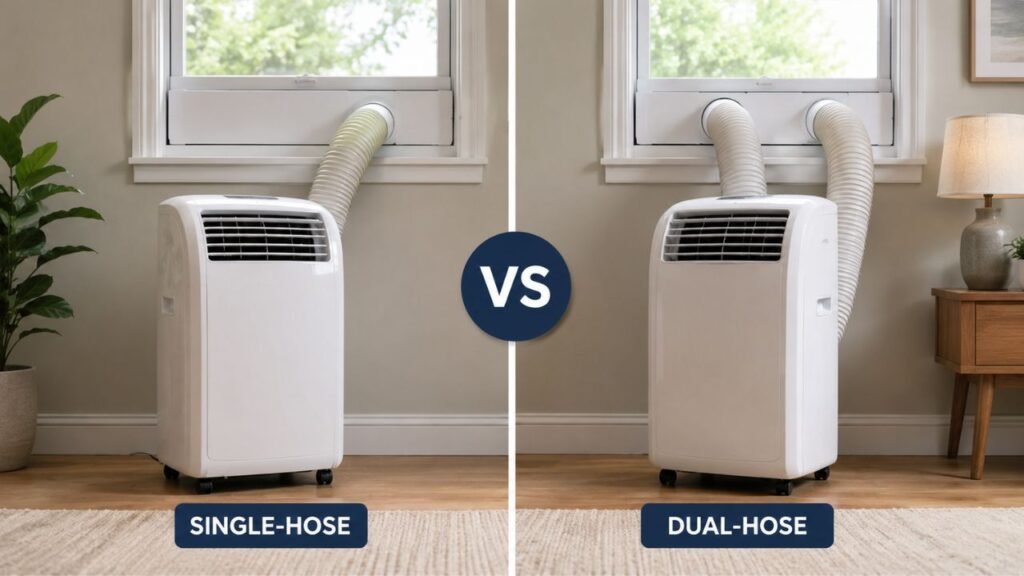
A single-hose portable AC uses one hose to push hot air outdoors. A dual-hose portable AC uses separate intake and exhaust air paths. This difference matters because single-hose units can create negative room pressure. Dual-hose systems reduce that pressure problem and usually cool more efficiently.
That does not mean dual hose is automatically best for everyone. Below, I’ll compare cooling performance, efficiency, power use, noise, installation, room size, cost, and other factors that actually matter when choosing between them.
Key Takeaways
- Single-hose portable ACs are usually cheaper and easier to install.
- Single-hose systems exhaust indoor air and create negative pressure.
- Negative pressure can pull warm outdoor air back inside.
- Dual-hose systems greatly reduce unwanted replacement-air infiltration.
- Dual-hose ACs generally handle heavier cooling loads more effectively.
- A dual-hose AC does not always use fewer watts.
- DOE/SACC cooling capacity matters more than hose count alone.
- Some dual-hose models use one combined hose-in-hose assembly.
- Room size, insulation, sunlight, climate, and compressor design also matter.
- A good single-hose AC can still work well in smaller rooms.
Single-Hose vs Dual-Hose Portable AC at a Glance
Both designs cool indoor air using the same basic refrigeration process. The biggest difference involves how they manage hot condenser air.
| Feature | Single-Hose Portable AC | Dual-Hose Portable AC |
| Airflow design | One exhaust air path | Separate intake and exhaust paths |
| Condenser air source | Usually indoor air | Usually outdoor air |
| Room pressure | Creates more negative pressure | Keeps pressure more balanced |
| Warm-air infiltration | Usually higher | Usually lower |
| Cooling performance | Good for lighter loads | Better for demanding loads |
| Cooling speed | Usually slower | Usually faster |
| Real-world efficiency | Generally lower | Generally higher |
| Upfront cost | Usually lower | Usually higher |
| Installation | Simpler | Slightly more involved |
| Window kit | Usually smaller | May require more venting space |
| Portability | Often easier | Can be bulkier |
| Best use | Small or moderate rooms | Larger or harder-to-cool rooms |
| Visible hoses | Usually one | One combined hose or two hoses |
What Is a Single-Hose Portable Air Conditioner?
A single-hose portable air conditioner has one duct running outdoors. That hose removes heat collected by the unit’s condenser.
The AC pulls warm room air into its cabinet. Part of that air passes across the cold evaporator coil. The cooled air then returns to your room.
Another portion helps remove heat from the condenser. That heated air gets pushed outdoors through the exhaust hose.
Here is where the design becomes important.
Every cubic foot of indoor air exhausted outside must be replaced. The room cannot simply keep losing air indefinitely.
Replacement air may enter around windows, doors, wall gaps, vents, or adjoining rooms. During hot weather, that replacement air can be warmer than the indoor air.
Your portable AC then has another heat load to handle.
That is why a single-hose system can sometimes feel like it is working against itself. It is cooling the room while indirectly encouraging warmer air to enter.
Still, single-hose units are not bad air conditioners. They can work perfectly well when properly sized for smaller spaces.
Their biggest advantages are simplicity, lower cost, and easier installation.
What Is a Dual-Hose Portable Air Conditioner?
A dual-hose portable AC separates condenser airflow from indoor cooling airflow.
One air path brings outside air into the unit. That air passes across the condenser and absorbs heat.
A second path sends the heated condenser air back outdoors.
Meanwhile, indoor room air passes across the evaporator coil. It gets cooled and returned to your living space.
Because the condenser does not depend as heavily on conditioned room air, less indoor air gets deliberately exhausted.
That greatly reduces the negative-pressure effect found with single-hose units.
The room therefore needs less replacement air from outdoors. Your AC spends more of its capacity cooling the room itself.
This is why dual-hose portable ACs often perform better during long runtimes, high outdoor temperatures, and heavier cooling loads.
Why Negative Air Pressure Makes Such a Big Difference
Negative pressure sounds technical, but the basic idea is simple. Air leaving your room has to be replaced by air from somewhere else.
How a Single-Hose AC Creates Negative Pressure
Imagine closing every window and door, then continuously pumping indoor air outside.
The room begins operating at slightly lower air pressure than surrounding areas. Air naturally moves toward that lower-pressure space.
It may come through cracks around your windows. It can also enter below doors or through building gaps.
If outdoor temperatures reach 95°F, that replacement air carries extra heat.
The AC must now remove that added heat too.
Why Replacement Air Reduces Effective Cooling
Suppose your portable AC is producing cold air successfully. At the same time, warm outside air keeps slipping indoors.
The unit may still lower the room temperature. However, it needs longer runtimes to maintain your thermostat setting.
Humidity can also enter with that replacement air.
That becomes especially noticeable during humid summers. Your AC must remove both sensible heat and additional moisture.
The problem usually grows as outdoor conditions become more extreme.
How a Dual-Hose System Reduces the Problem
A dual-hose system gives the condenser its own airflow loop.
Outdoor air comes in, carries condenser heat, and returns outdoors. Much less conditioned room air needs to leave.
That keeps indoor pressure closer to surrounding pressure.
It does not make every room perfectly pressure-balanced. Building leakage and ventilation still affect pressure.
However, the design removes a major source of pressure imbalance.
Single-Hose vs Dual-Hose Portable AC: Key Differences
Hose count affects more than installation convenience. It can influence cooling speed, efficiency, temperature stability, and overall comfort.
Cooling Performance
Dual-hose systems generally have the stronger airflow design.
They avoid wasting as much conditioned room air through the condenser. They also reduce the amount of warm replacement air entering.
That allows more cooling capacity to benefit your actual living space.
However, hose design is only one factor.
A powerful single-hose model can outperform an undersized dual-hose model. SACC capacity, compressor design, airflow, room conditions, and insulation still matter.
Cooling Speed
Dual-hose units often cool demanding rooms faster.
They are not constantly replacing as much exhausted indoor air. This lets room temperature fall with less opposing heat infiltration.
The advantage becomes more noticeable during very hot weather.
In a mild room with moderate heat gain, the difference may feel smaller.
Energy Efficiency
Efficiency is where this comparison often becomes confusing.
A dual-hose AC can be more efficient even if its wattage looks similar. It may convert those watts into more useful room cooling.
A single-hose system loses some effective cooling through infiltration.
The machine still consumes electricity while dealing with that added heat.
For long daily runtimes, those losses can become meaningful.
Room Temperature Stability
A dual-hose AC can make room temperatures easier to maintain.
Once your room reaches the thermostat setting, lower infiltration helps preserve that temperature.
Single-hose models may experience more frequent heat entering through building gaps.
That can make the compressor run longer or cycle more often.
Performance in Very Hot Weather
Hot outdoor temperatures increase the challenge for every portable AC.
The difference between indoor and outdoor temperature becomes larger. Heat also moves indoors faster through walls, windows, and ceilings.
A single-hose system adds another pathway through pressure-driven infiltration.
For that reason, dual hose becomes more appealing in very hot climates.
It can also help in upstairs rooms, sunny rooms, and spaces with large windows.
Performance in Humid Weather
Humidity deserves attention because replacement air can contain substantial moisture.
A single-hose AC may pull humid outdoor air through building leaks. The evaporator then needs to remove that moisture.
Dual-hose airflow reduces this particular source of moisture infiltration.
However, do not assume every dual-hose AC dehumidifies better.
Actual moisture-removal performance depends on the individual unit.
Noise
Hose design alone does not determine noise.
Some dual-hose units are quiet. Some single-hose units are louder.
Compressor speed, fan design, cabinet insulation, airflow, and operating mode matter more.
An inverter compressor can also reduce noise during lighter cooling loads.
Compare actual dBA ratings when bedroom noise matters.
Installation
Single-hose portable ACs usually win here.
You connect one hose to the unit and window panel. Fewer connections generally mean a quicker setup.
Dual-hose systems need two airflow paths.
Older designs may have two separate flexible hoses. Newer designs can combine both paths into one larger assembly.
Either way, window sealing remains extremely important.
Portability and Storage
Single-hose units are often simpler to move between rooms.
You have fewer vent components to disconnect and store.
Dual-hose units may use larger window adapters or additional hose hardware.
The actual weight still varies greatly between models.
Check dimensions and weight instead of assuming every dual-hose unit is heavier.
Purchase Price
Single-hose ACs usually cost less upfront.
Their simpler airflow design makes them attractive for budget-conscious buyers.
Dual-hose systems can cost more, especially with inverter technology.
Whether that extra cost is worthwhile depends on runtime and cooling demand.
For occasional bedroom use, single hose may be enough.
For daily summer cooling, better efficiency can become more valuable.
Does Dual Hose Always Mean Two Separate Hoses?
No. A dual-hose portable AC does not always have two separate visible tubes.
The important difference is the number of airflow paths.
A traditional dual-hose unit has one dedicated intake hose and one exhaust hose. Both run separately between the unit and window.
Some newer systems place both air channels inside one larger hose assembly.
This design is often called hose-in-hose or dual-duct construction.
From the outside, you may see what looks like one hose. Internally, it still keeps incoming and outgoing condenser air separated.
So, do not judge the design by counting visible tubes alone.
Instead, check whether the manufacturer describes separate condenser intake and exhaust paths.
DOE BTU vs ASHRAE BTU: Which Rating Matters?
Portable AC listings can show two different BTU numbers. Understanding them helps you compare cooling performance more accurately.
What ASHRAE BTU Tells You
ASHRAE ratings describe the unit’s gross refrigeration cooling capacity under standardized test conditions.
This number is often the larger BTU figure displayed in marketing.
For example, a portable AC may advertise 12,000 or 14,000 ASHRAE BTU.
That number does not fully account for portable-AC-specific losses.
What DOE SACC Tells You
DOE SACC means Seasonally Adjusted Cooling Capacity.
This rating tries to better represent usable cooling from a portable AC.
It accounts for losses connected with factors such as exhaust duct heat and air infiltration.
That is why SACC numbers are often noticeably lower than ASHRAE numbers.
For a U.S. shopper, SACC is particularly helpful when comparing portable models.
Why You Should Compare SACC to SACC
Always compare equivalent rating systems.
Do not compare one model’s 14,000 ASHRAE BTU with another model’s 10,000 SACC and assume the first unit is stronger.
You would be comparing different measurements.
Look for each model’s DOE/SACC capacity when possible.
That gives you a much more useful side-by-side comparison.
Is a Dual-Hose Portable AC Actually More Energy Efficient?
Generally, the dual-hose airflow design has an efficiency advantage.
It wastes less conditioned room air through the condenser. It also reduces the amount of hot replacement air entering.
However, that does not mean every dual-hose AC beats every single-hose model.
Compressor technology can make a large difference.
A modern inverter portable AC can adjust compressor output as cooling demand changes. Older fixed-speed compressors typically cycle fully on and off.
Fan efficiency also matters.
So do duct design, window sealing, thermostat settings, SACC, and room conditions.
This is why I would not rely on a broad claim such as “dual hose is 40% more efficient.”
The real difference depends on the two actual models you compare.
Does a Dual-Hose AC Use Less Electricity?
Not necessarily.
Efficiency and instantaneous power draw are two different things.
Imagine a dual-hose AC drawing 1,300 watts. Another single-hose unit might draw only 1,000 watts.
The single-hose model uses fewer watts while running.
However, it might need to operate much longer to achieve the same comfort level.
The dual-hose model could cool faster and reduce compressor runtime.
Your actual energy cost depends on several factors:
- Rated wattage
- Compressor runtime
- Thermostat setting
- Outdoor temperature
- Room heat load
- Compressor efficiency
- Window sealing
- Local electricity rates
So, check wattage when electrical load matters.
Check overall cooling efficiency when energy cost matters.
Which Portable AC Is Better for Your Room?
There is no single room-size cutoff that works for everyone. Heat load matters just as much as square footage.
Small Bedroom
A single-hose AC can be a practical choice for a small bedroom.
It may provide enough cooling without the extra cost of dual hose.
Look for proper SACC sizing and reasonable noise levels.
Good window sealing also helps significantly.
Home Office
Either design can work well in a home office.
Consider computers, monitors, and other electronics that constantly produce heat.
A heavily equipped office may need more cooling than its square footage suggests.
If you work there all day, dual hose can become more worthwhile.
Medium or Large Room
Larger rooms usually create a heavier cooling load.
A dual-hose system becomes more attractive as runtime increases.
However, check SACC capacity carefully.
Hose design cannot compensate for an undersized AC.
Sunny or Hard-to-Cool Room
Direct sunlight can add substantial heat through windows and walls.
Upper-floor rooms also tend to stay warmer.
If your space already struggles with heat, reducing infiltration becomes more valuable.
I would generally lean toward dual hose in this situation.
Older or Drafty Home
Drafty construction can make single-hose pressure problems more noticeable.
Negative pressure finds existing leakage paths.
Warm air can enter around doors, windows, outlets, and structural gaps.
A dual-hose design reduces this added pressure-driven airflow.
Apartment or Rental
Renters often value simple installation and easy seasonal removal.
That makes single-hose units attractive.
Still, a dual-hose model can work perfectly well if the window kit fits.
Before buying, measure your window carefully.
Also check whether building rules restrict portable AC venting.
When Does a Single-Hose Portable AC Make More Sense?
A single-hose model remains a sensible choice for many households. You do not need the more complex design for every cooling situation.
Choose single hose when:
- You are cooling a relatively small room.
- You only use the AC occasionally.
- Your upfront budget is limited.
- Simple installation is a priority.
- You move the AC between rooms frequently.
- Outdoor temperatures are usually moderate.
- Your room is reasonably well insulated.
- Maximum cooling efficiency is not your main concern.
A properly sized single-hose AC can still provide good comfort. The important part is matching the unit to your actual cooling load.
When Is a Dual-Hose Portable AC Worth It?
Dual hose becomes more valuable when cooling demand rises. The efficiency advantage matters most during demanding and extended operation.
Consider dual hose when:
- You cool the room for many hours daily.
- Your summers are consistently very hot.
- The room gets strong afternoon sunlight.
- You have a medium or larger space.
- The building has noticeable air leakage.
- Faster cooldown is important.
- Stable room temperature matters.
- You want to reduce pressure-related infiltration.
- Efficiency matters more than the lowest purchase price.
You will usually notice the benefit more during difficult conditions. In a mild, small room, the performance gap may be less important.
What Should You Check Besides the Number of Hoses?
Hose configuration matters, but it should never be your only buying factor. Several specifications can affect comfort just as much.
DOE/SACC Cooling Capacity
Start with SACC when comparing portable AC models.
Choose a capacity appropriate for your room and heat load.
Square footage is helpful, but it is not everything.
Sun exposure, ceiling height, insulation, windows, and electronics all add heat.
CEER or Efficiency Rating
Efficiency ratings help you compare how effectively models use electricity.
When comparing similar capacities, a stronger efficiency rating is generally preferable.
Just make sure both units use comparable rating methods.
Inverter vs Fixed-Speed Compressor
An inverter compressor can adjust speed as cooling demand changes.
That often improves temperature control and reduces unnecessary cycling.
It can also help lower noise at lighter loads.
Do not overlook compressor technology simply because one unit has dual hoses.
Rated Wattage and Amperage
Check electrical requirements before buying.
Portable ACs can place substantial demand on a household circuit.
Avoid running other high-watt appliances on the same circuit whenever possible.
Follow the manufacturer’s electrical requirements.
Noise Rating
Bedroom users should pay close attention to dBA specifications.
Compare noise ratings at similar operating speeds.
Remember that maximum fan mode will usually be louder.
Inverter units may become quieter after reaching the target temperature.
Window Kit Compatibility
Measure your window before ordering.
Check the minimum and maximum panel dimensions.
Also confirm whether your window opens vertically or horizontally.
A poorly fitted panel can leak enough hot air to hurt performance.
Hose Length and Placement
Keep the exhaust hose as short and straight as practical.
Avoid unnecessary bends that restrict airflow.
Do not extend the hose beyond manufacturer recommendations.
Longer hoses expose more hot surface inside your room.
Condensate Drainage
Portable ACs remove moisture while cooling.
Some units evaporate much of that water through the exhaust.
Others may require occasional or continuous draining.
This feature depends on the specific model, not hose count.
Does the Exhaust Hose Itself Reduce Portable AC Efficiency?
Yes, the exhaust hose can contribute to efficiency losses.
Hot condenser air passes through that hose before reaching outdoors.
The hose itself becomes warm.
Because most of the hose sits inside your conditioned room, some heat can transfer back into the space.
Long hoses expose more warm surface area.
Sharp bends can also increase airflow resistance.
I recommend keeping the hose properly installed and reasonably straight.
Seal the window panel carefully too.
Even a powerful portable AC will struggle if hot air leaks around its vent kit.
Common Single-Hose vs Dual-Hose Portable AC Myths
Several common claims make this comparison seem simpler than it really is. Knowing where they go wrong helps you choose more confidently.
Myth: Dual-Hose ACs Always Use Less Electricity
A dual-hose unit may actually have a higher watt rating.
Its advantage comes from reducing cooling losses.
Runtime and useful cooling matter alongside raw wattage.
Myth: A Single-Hose AC Cannot Cool Properly
A properly sized single-hose AC can cool a room very well.
The design simply has an efficiency disadvantage under certain conditions.
Room size and heat load determine whether that disadvantage becomes important.
Myth: More BTUs Always Mean Better Cooling
A larger number does not automatically make an AC better.
First, make sure you are comparing the same BTU rating system.
Second, oversized equipment can also create comfort issues.
Correct sizing matters more than choosing the largest number available.
Myth: Dual Hose Always Means Two Visible Tubes
Some modern ACs combine intake and exhaust ducts inside one assembly.
They still function as dual-hose or dual-duct systems.
Look at airflow design rather than appearance alone.
Myth: Every Dual-Hose AC Beats Every Single-Hose AC
Hose design is only one part of overall performance.
Compressor quality, SACC capacity, efficiency, airflow, noise, and installation all matter.
Compare the complete machine rather than one feature.
Final Verdict
For most demanding cooling situations, I would choose a dual-hose portable AC. Its airflow design reduces negative pressure and unwanted warm-air infiltration. That can mean faster cooling, steadier temperatures, and better real-world efficiency.
A single-hose portable AC still makes plenty of sense, though. It can be cheaper, simpler, and easier to move. For a smaller bedroom, occasional use, or moderate weather, that simplicity may be more valuable than maximum efficiency.
The biggest mistake is choosing purely by hose count.
Compare DOE/SACC cooling capacity, efficiency, compressor type, wattage, noise, room heat load, and window compatibility. Then use hose design as another important part of the decision.
If you do that, you are far more likely to choose an AC that actually feels comfortable in your room.
Related FAQs
Here are a few common questions that come up when comparing single-hose and dual-hose portable air conditioners.
Is a Dual-Hose Portable AC Better Than a Single-Hose AC?
A dual-hose AC generally has the better airflow design because it reduces negative pressure and warm-air infiltration. However, a good single-hose unit can still be the better choice for smaller rooms, occasional cooling, or tighter budgets.
Does a Dual-Hose Portable AC Cool Faster?
Dual-hose portable ACs often cool demanding rooms faster because they waste less conditioned indoor air. Actual cooling speed still depends on SACC capacity, compressor performance, room size, insulation, sunlight, and outdoor temperature.
Why Does a Single-Hose Portable AC Create Negative Pressure?
A single-hose AC uses indoor air for condenser cooling and exhausts that air outdoors. Removing air lowers room pressure slightly, causing replacement air to enter through doors, windows, cracks, and other openings.
Does a Dual-Hose AC Bring Hot Outside Air Into the Room?
The intake hose brings outside air into the AC’s condenser airflow path, not directly into your living space. That air absorbs condenser heat and then gets exhausted outdoors through the second air path.
Are Dual-Hose Portable Air Conditioners More Energy Efficient?
Dual-hose designs are generally more efficient because they reduce conditioned-air loss and unwanted infiltration. However, actual efficiency varies by model, compressor type, SACC, CEER, room conditions, and how well the window kit is sealed.
Does a Dual-Hose AC Use More Electricity?
It can. Some dual-hose units have higher wattage than comparable single-hose models. However, better effective cooling may shorten runtime, so higher instantaneous power does not automatically mean higher total electricity use.
Are Dual-Hose Portable ACs Louder?
Not necessarily. Noise depends more on compressor technology, fan design, operating speed, airflow, and cabinet insulation. Some inverter dual-hose models can operate very quietly once the room reaches the selected temperature.
Can You Convert a Single-Hose Portable AC to Dual Hose?
You should not modify a single-hose portable AC unless the manufacturer specifically supports a conversion. Changing condenser airflow can affect cooling performance, temperature, safety controls, and the unit’s warranty.
Is a Single-Hose Portable AC Good for a Bedroom?
Yes. A properly sized single-hose AC can work well in a small bedroom, especially when the room is well sealed. Pay attention to SACC capacity and noise ratings if you plan to run it while sleeping.
Which Portable AC Is Better for a Hot and Humid Climate?
A dual-hose portable AC is generally more attractive in hot, humid conditions because it reduces pressure-driven outdoor air infiltration. That helps limit the extra heat and moisture entering through building leaks.
What Does SACC Mean on a Portable Air Conditioner?
SACC means Seasonally Adjusted Cooling Capacity. It is a U.S. rating designed to better represent usable portable AC cooling after accounting for losses such as duct heat and air infiltration.
Why Does One Portable AC Show Two Different BTU Ratings?
Portable ACs may show both ASHRAE and DOE/SACC BTU ratings. The ASHRAE number represents gross cooling capacity, while the lower SACC figure better reflects real portable-AC operating losses.
Do Dual-Hose Portable ACs Need to Be Drained?
Some do and some do not during normal conditions. Drainage requirements depend on the unit’s condensate-management design and indoor humidity, rather than whether the AC uses one hose or two.
Is a Hose-in-Hose Portable AC Really a Dual-Hose AC?
Yes, if the assembly contains separate intake and exhaust airflow paths. A hose-in-hose design can function like a traditional dual-hose system even though you only see one large external hose.

Ethan Walker writes about travel routes, outdoor exploration, and road-based adventures. His guides focus on simple planning, dependable gear, and realistic travel advice. He values comfort, safety, and practical experience over hype.