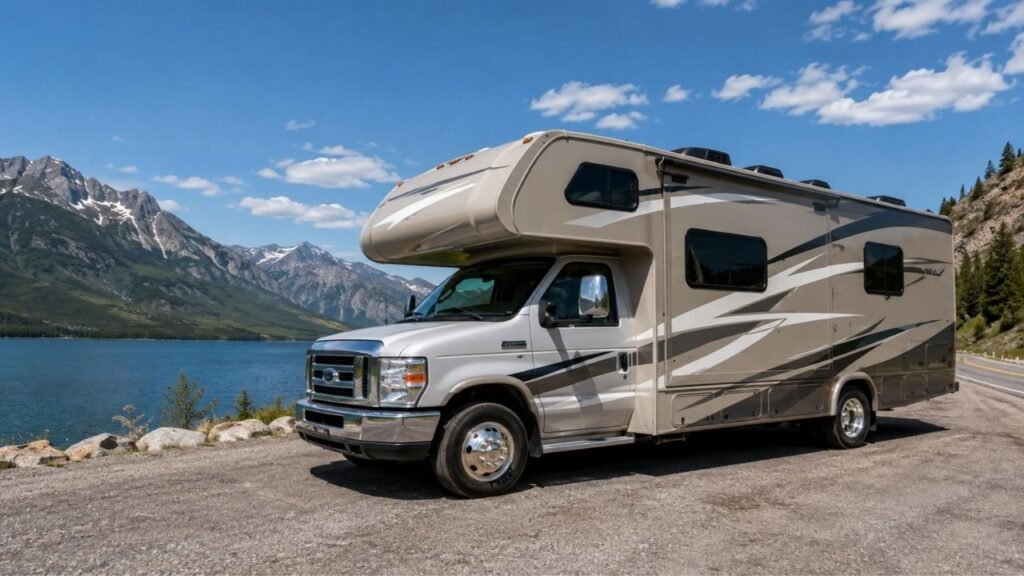
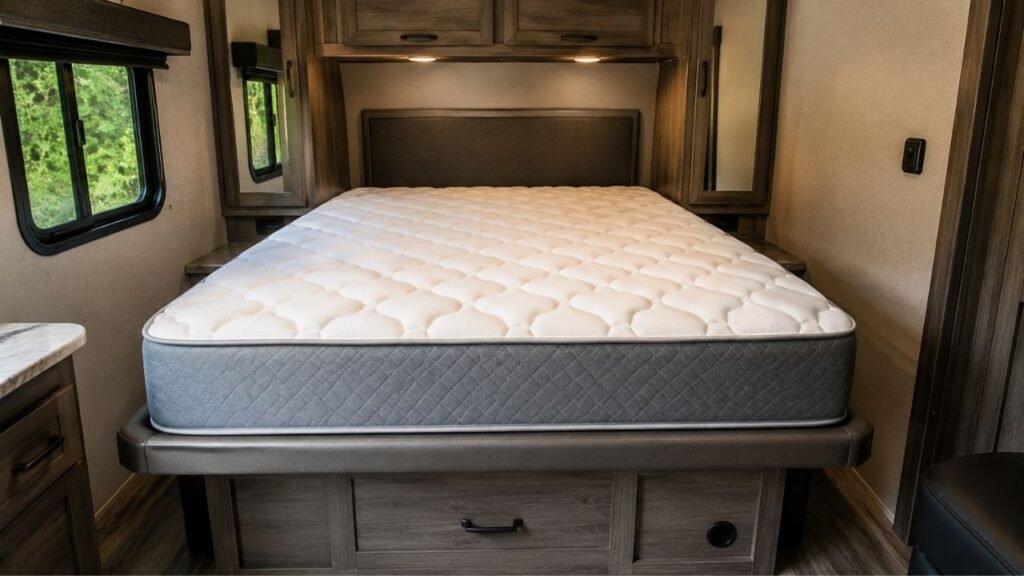
Yes, you can put a standard queen mattress in an RV if your RV has enough room for its 60-inch by 80-inch size. Many RVs use a short queen measuring around 60 by 75 inches, so those extra five inches can block walkways, cabinets, doors, or slide-out movement.
Before you replace your RV mattress, there are a few more things to check besides length and width. I’ll walk you through mattress size, platform support, weight, thickness, slide clearance, bed-lift systems, and how to tell whether a standard queen really makes sense in your RV.
Key Takeaways
- A standard queen mattress measures 60 inches wide by 80 inches long.
- An RV short queen commonly measures about 60 by 75 inches.
- Some RVs are already designed for a full 60-by-80-inch queen.
- Always measure the actual bed platform instead of trusting the word “queen.”
- Check cabinets, doors, walkways, windows, and slide-outs before upgrading.
- Mattress weight counts toward your RV’s available carrying capacity.
- A heavier mattress can also affect an under-bed storage lift system.
- Your RV platform must meet the new mattress manufacturer’s support requirements.
- A residential mattress can work perfectly well if every fit and support check passes.
Can You Put a Regular 60 × 80 Queen Mattress in an RV?
You can use a regular 60-by-80-inch queen mattress in many RVs, but the mattress must fit the actual sleeping area rather than simply matching the word “queen” in your RV specifications.
This is where RV mattress shopping becomes confusing.
A residential queen normally measures 60 inches wide and 80 inches long. Many RV manufacturers, however, save bedroom space by installing a short queen that measures around 60 inches wide and 75 inches long.
That means width may not cause any trouble at all. The extra five inches at the foot of the mattress usually creates the problem.
Those five inches can extend into a narrow aisle, hit a wall, block a cabinet, or interfere with your slide-out.
At the same time, you should not automatically assume your RV has a short queen.
Some modern RV floorplans are designed around a full residential-size 60-by-80-inch queen. If yours is one of them, replacing the original mattress with a standard queen may be fairly straightforward.
The safest rule is simple:
Ignore the mattress name until you have measured the actual space.
Your tape measure will tell you much more than a brochure saying your RV has a “queen bed.”
Standard Queen vs RV Short Queen: What Is the Size Difference?
The main difference between a standard queen and an RV short queen is length. Both are commonly around 60 inches wide, while the short queen saves several inches at the foot of the bed.
| Feature | Standard Queen | RV Short Queen | Why It Matters in an RV |
| Width | 60 inches | Usually 60 inches | Width often stays the same |
| Length | 80 inches | Usually 74–75 inches | Standard queen needs 5–6 more inches |
| Sleeping space | More legroom | Less legroom | Taller sleepers may prefer 80 inches |
| Floor space needed | More | Less | Extra length may reduce aisle space |
| Shopping options | Very common | More specialized | Standard sizes offer more choices |
| Typical use | Homes and some RVs | Space-limited RV bedrooms | Actual RV dimensions decide |
The five-inch difference may sound small when you look at the numbers.
Inside an RV bedroom, five inches can be a lot.
You may have only a narrow strip of floor between the mattress and a wall. A cabinet might open directly across from the bed. Your slide could also need that space while retracting.
That is why I would never buy a replacement mattress based only on the terms “RV queen” or “queen bed.”
Measure first.
How to Measure Your RV for a Standard Queen Mattress
A proper fit check involves more than measuring the old mattress. You need to know the usable platform dimensions and what surrounds the bed in both camping and travel positions.
Measure the Actual Bed Platform
If possible, remove your existing mattress before measuring.
Measure the platform itself from side to side and from the head of the bed to the foot.
Write down:
- Platform width
- Platform length
- Wall-to-wall space
- Space between furniture around the bed
- Any raised edges around the platform
- Rounded or angled corners
- Hinges or folding sections
If you want to install a standard queen, you are looking for enough usable space to support a mattress measuring about 60 by 80 inches.
Do not rely entirely on the dimensions of your old mattress.
Foam mattresses can compress, stretch slightly, or measure differently after years of use. The actual platform gives you a better reference point.
Check the Extra Five Inches at the Foot of the Bed
This is probably the most important test when replacing a short queen.
Imagine extending your current mattress another five inches toward the foot of the bed.
Now look at what occupies that space.
Would the longer mattress:
- Narrow your bedroom walkway?
- Block the bathroom door?
- Prevent a drawer from opening?
- Cover part of a cabinet?
- Press against the opposite wall?
- Interfere with your slide-out?
- Extend into a hallway?
- Make it difficult to walk around the bed?
If the answer is yes, a regular queen probably isn’t the best direct replacement.
You may technically be able to squeeze it into the bedroom, but living with that setup every day can become frustrating.
Measure Mattress Height and Overhead Clearance
Length and width get most of the attention, but mattress thickness can cause just as many problems.
Residential mattresses can be considerably thicker than the basic mattress originally installed in an RV.
A taller mattress raises your sleeping surface closer to:
- Overhead cabinets
- Windows
- Shelves
- Reading lights
- Wall-mounted controls
- Low ceilings
It can also make sitting upright in bed uncomfortable.
Instead of choosing a mattress because 10, 12, or 14 inches sounds more comfortable, measure how much vertical space your bedroom actually provides.
Compare that measurement with the exact thickness of the mattress you want to purchase.
Test Everything With the Slide Open and Closed
If your RV bedroom is located in or beside a slide-out, check the bed area in both positions.
This matters more than many owners realize.
Your mattress might fit beautifully once the slide is fully extended at the campground.
Then you retract the slide for travel and discover that the mattress presses against a cabinet or prevents the slide from closing completely.
Watch how the bed, walls, cabinets, and nearby furniture move while the slide operates.
If the bed itself moves, measure carefully in every usable position.
Never force a slide closed against a mattress that is too long or too thick.
Check Rounded Corners and Other RV-Specific Shapes
Some RV beds are not simple rectangles.
Manufacturers often use unusual mattress shapes to squeeze more usable space from compact bedrooms.
You may find:
- Rounded corners
- Angled corners
- Radius corners
- Notched sections
- Folding sections
- Hinged mattresses
- Cut corners beside cabinets
A standard rectangular queen could measure correctly from head to foot and still fail to fit because of one corner.
If your existing mattress has a special shape, replacing it with another mattress designed for that shape is usually easier than trying to force a standard queen into the space.
Check Mattress Weight Before Replacing an RV Queen
Mattress weight matters differently in an RV than it does in a house. The new mattress becomes part of the weight your RV carries, and it can also affect the bed platform and storage-lift system.
Check Your RV’s Cargo Carrying Capacity
Every mattress adds weight to your RV.
A few extra pounds may not matter much in an RV with plenty of unused carrying capacity. A large difference becomes more important when your rig is already carrying water, food, tools, camping equipment, batteries, clothing, and other gear.
Check your RV’s cargo carrying capacity or occupant-and-cargo information.
Then look up the actual weight of the mattress you want to buy.
Avoid relying on broad statements such as “RV mattresses weigh this much” or “regular mattresses weigh that much.”
Mattress construction varies too much for those numbers to be dependable.
A foam mattress from one company might weigh more than a hybrid from another company.
Use the manufacturer’s actual mattress weight whenever possible.
You also want to consider everything else you regularly carry.
The mattress may be only one item, but every added pound contributes to your overall load.
Check the Bed Platform’s Capacity
A mattress fitting on the platform does not automatically mean the platform can support the entire setup safely.
Remember that the platform ultimately carries:
mattress weight + sleeper weight + bedding + anything else placed on the bed.
RV bed bases vary significantly.
Some use substantial framing beneath a plywood deck. Others are lightweight structures designed around the original mattress.
If you are making a major jump from a light factory mattress to a much heavier residential model, check the RV manufacturer’s information or inspect the platform carefully before proceeding.
Do not assume thicker plywood alone means the whole bed structure can carry unlimited weight.
The framing underneath matters too.
Check the Under-Bed Storage Lift
Many RV queen beds lift upward to reveal storage underneath.
Gas struts or lift mechanisms make that heavy platform easier to raise.
Changing the mattress can affect how well that system works.
Imagine replacing a lightweight foam mattress with a substantially heavier residential mattress.
The lift system now has to raise additional weight every time you access storage.
You may notice that the bed:
- Feels harder to lift
- Drops instead of staying open
- Opens only partially
- Puts more strain on hinges
- Requires both hands to control safely
If you frequently use the storage area beneath your bed, this deserves serious consideration.
Check your bed-lift system’s weight requirements before installing a much heavier mattress.
Will a Standard Queen Work on an RV Plywood Platform?
Yes, many standard queen mattresses can work on an RV plywood platform, but you should check the support requirements for the exact mattress you are buying.
Many modern mattresses do not require traditional box springs.
Platform beds are common in homes as well as RVs.
The issue is that mattress manufacturers have different foundation requirements.
One company may approve a solid platform.
Another may specify slats with maximum spacing between them.
Another may require additional center support.
Ignoring those requirements can affect comfort, mattress life, and sometimes warranty coverage.
Before placing a residential queen on your RV platform, check:
- Whether solid plywood is approved
- Whether ventilation is required
- Maximum allowed slat spacing
- Center-support requirements
- Foundation warranty requirements
- Whether the mattress can be used directly on a platform
If your RV has a completely solid plywood base, also pay attention to ventilation under the mattress.
RVs can experience substantial condensation because the mattress stays warm while the platform underneath becomes cooler.
Providing airflow beneath the mattress can help reduce moisture buildup.
Can You Extend an RV Short-Queen Platform From 75 to 80 Inches?
Sometimes you can extend a short-queen platform to accommodate an 80-inch mattress, but only when the bedroom has enough space and the extension can properly support the mattress.
An extension may make sense when:
- There are at least five unused inches at the foot of the bed.
- The longer platform will not block the walkway.
- Cabinets and drawers can still open.
- The slide-out can operate normally.
- The platform extension can be properly supported.
- Under-bed storage remains accessible.
- The longer bed does not interfere with other RV components.
Do not assume the manufacturer accidentally made the bed five inches short.
In many RVs, that space exists for a reason.
It may provide room for a slide to close, give you enough aisle space to move around, or allow cabinet doors to open.
If extending the platform changes any structural part of the RV bed or slide system, have the modification checked by someone familiar with RV construction.
I would rather see you use the right mattress size than gain five inches of sleeping space while creating another problem elsewhere.
Can a Standard Queen Hang Over an RV Bed Platform?
A small amount of mattress overhang may physically fit, but that does not automatically make it a good long-term setup.
Suppose your platform measures 60 by 75 inches and your mattress measures 60 by 80 inches.
That leaves approximately five inches unsupported if the mattress simply extends beyond the foot of the platform.
Some flexible foam mattresses may appear to tolerate that arrangement.
However, unsupported sections can sag or bend depending on mattress construction.
More importantly, mattress manufacturers often have specific requirements for proper foundation support.
An unsupported foot section could also extend into your walkway or interfere with how the bed lifts.
If you are considering overhang, check the manufacturer’s support requirements first.
Full support is generally the cleaner solution.
Can You Cut a Standard Queen Mattress to Fit an RV?
You should not automatically cut a new mattress just because it is made from foam.
Yes, some foam materials can physically be cut.
That does not mean the finished mattress was designed to be modified.
A modern foam mattress can contain several layers with different densities, cooling materials, edge-support systems, fire-resistant components, and a fitted cover.
Cutting it may:
- Damage its internal construction
- Reduce edge support
- Affect comfort
- Damage the cover
- Affect fire-barrier materials
- Make returns impossible
- Void the warranty
Some mattress manufacturers specifically prohibit cutting their products.
If you already know your RV requires an unusual dimension, I would look for an RV-size or custom-size mattress before cutting a new residential queen.
You will usually get a cleaner fit and avoid turning an expensive mattress into a DIY experiment.
What Type of Standard Queen Mattress Works Best in an RV?
Several residential mattress styles can work in an RV. The best choice depends more on your available space, weight capacity, and comfort preferences than on whether the mattress says “RV” on the label.
Some options worth considering include:
- Bed-in-a-box foam mattress: Convenient because you can usually carry the compressed box through the RV before allowing the mattress to expand.
- Low-profile mattress: Helpful when you have limited headroom or overhead cabinets.
- Memory foam mattress: Flexible and easier to maneuver than many rigid mattress designs.
- Hybrid mattress: Offers foam comfort with coil support but may be heavier or harder to bend through tight spaces.
- Innerspring mattress: Can work well when dimensions match, although maneuvering it through narrow RV interiors may be harder.
- Lightweight mattress: Useful when your cargo capacity or bed-lift system is already close to its practical limit.
I would not choose based on construction alone.
Look at the specific mattress’s weight, thickness, flexibility, support requirements, and dimensions.
Those numbers tell you much more about RV suitability than the material name.
Can You Get a Standard Queen Mattress Through an RV Door?
A mattress can fit your RV bed perfectly and still be incredibly difficult to get into the bedroom.
Before ordering, think about the entire path the mattress must travel.
Measure:
- RV entry-door opening
- Interior hallway width
- Bedroom doorway
- Tight corners
- Ceiling height at turns
- Space between fixed furniture
- Narrow passages beside kitchen cabinets
A traditional queen mattress can be awkward to rotate inside a compact RV.
This is one reason boxed foam mattresses are popular for RV replacements.
You can bring the compressed package inside first, position it in the bedroom, and then unpack it.
Just be certain the mattress is where you want it before it fully expands.
Trying to move an expanded queen mattress through a narrow RV hallway can quickly become a two-person wrestling match.
Standard Queen or RV Short Queen: Which Should You Choose?
Neither size is automatically better. Your best option depends on your RV’s available space and whether the additional five inches of sleeping length gives you more benefit than inconvenience.
Choose a Standard Queen If:
A standard 60-by-80-inch queen makes sense when:
- Your bed area provides at least 60 by 80 inches of usable space.
- The mattress will be fully supported.
- You have enough room at the foot of the bed.
- Cabinets and drawers remain accessible.
- Walkways remain comfortable.
- Slide-outs can fully open and close.
- Mattress thickness fits beneath cabinets and windows.
- The mattress weight works with your RV’s carrying capacity.
- Your bed-lift system can handle the mattress.
- You can physically get the mattress into the bedroom.
- You want the additional length for taller sleepers.
If all of those conditions are satisfied, there is no inherent reason you must choose an RV-specific mattress.
Choose an RV Short Queen If:
A short queen is usually the better choice when:
- Your current platform measures about 60 by 75 inches.
- Bedroom floor space is limited.
- A regular queen would block the walkway.
- Cabinets sit close to the foot of the bed.
- Your bed moves with a slide-out.
- Your mattress requires rounded or cut corners.
- Under-bed storage is difficult to lift with extra weight.
- You need a lower-profile or lightweight mattress.
- You do not want to modify the existing platform.
A correctly sized short queen can make a small RV bedroom considerably easier to live with.
Giving up five inches of sleeping length may be worthwhile if it preserves your entire walkway.
Common Mistakes When Putting a Regular Queen Mattress in an RV
Most problems happen because buyers measure only one part of the sleeping area. Avoid these common mistakes before ordering your replacement mattress.
- Assuming every RV queen measures 60 by 75 inches
- Assuming every RV queen measures 60 by 80 inches
- Buying based on the RV brochure instead of measuring
- Measuring only the old mattress
- Forgetting the extra five inches at the foot
- Ignoring bedroom walkways
- Forgetting cabinet and drawer clearance
- Checking the slide only while it is open
- Ignoring mattress thickness
- Forgetting overhead cabinets
- Ignoring your RV’s available carrying capacity
- Guessing mattress weight based only on mattress type
- Forgetting under-bed gas struts
- Assuming any plywood platform supports every mattress
- Forgetting mattress foundation warranty requirements
- Buying before measuring the RV doorway
- Letting a mattress hang over without checking support requirements
- Cutting a new mattress without checking the manufacturer’s instructions
Taking ten minutes to check these details can save you from dealing with a mattress that technically enters the RV but does not actually work in it.
Final Verdict: Can You Put a Standard Queen Mattress in an RV?
Yes, you can put a standard queen mattress in an RV when the RV genuinely has enough space and support for a 60-by-80-inch mattress.
Do not make the decision based only on whether your RV advertises a “queen bed.” Some RVs use short queens, while others already accommodate residential-size queens.
Before buying, check five things: space, clearance, weight, support, and installation access.
Measure the platform, inspect the extra space at the foot, test doors and slides, verify your mattress weight, and check foundation requirements.
If everything passes those checks, a standard residential queen can be a perfectly practical RV mattress.
Related FAQs
Is an RV Queen the Same Size as a Regular Queen?
Not always. A regular queen normally measures 60 by 80 inches, while an RV short queen commonly measures around 60 by 75 inches. However, some RVs use a full 60-by-80-inch queen, so always measure the actual bed platform.
Will a 60 × 80 Mattress Fit on a 60 × 75 RV Platform?
A 60-by-80-inch mattress is about five inches longer than a 60-by-75-inch platform. It may physically sit there with an overhang, but you should verify full support requirements and surrounding clearance before using that setup.
Are RV Mattresses Required in an RV?
No. You do not necessarily need a mattress specifically labeled for RV use. A residential mattress can work if its dimensions, weight, thickness, support requirements, and shape match your RV sleeping area.
Does a Standard Queen Mattress Need a Box Spring in an RV?
Not necessarily. Many modern mattresses can be used on platform foundations, including RV bed platforms. Check the mattress manufacturer’s instructions because foundation and slat requirements vary between models.
Will a Heavier Mattress Affect My RV?
A heavier mattress adds to the total weight carried by your RV and may also make an under-bed storage platform harder to lift. Check your available carrying capacity and bed-lift requirements before making a significant weight increase.
Can I Use Queen Sheets on an RV Short Queen?
Usually, but the fit may be loose. Both mattresses are commonly around 60 inches wide, while the short queen is about five inches shorter, leaving extra fitted-sheet material near the foot.
Can I Cut a Memory Foam Queen Mattress to Fit My RV?
Some foam can physically be cut, but modifying a finished mattress may damage its layers, cover, edge support, or warranty. Check the manufacturer’s instructions first, and consider ordering the correct RV or custom size instead.
Is a Standard Queen More Comfortable Than an RV Short Queen?
Not automatically. Comfort depends on mattress construction, firmness, materials, and your sleeping preferences. A standard queen mainly gives you extra sleeping length, which can be helpful for taller sleepers.
How Much Longer Is a Standard Queen Than an RV Short Queen?
A standard queen is normally 80 inches long, while a typical RV short queen is around 75 inches long. That makes the standard queen approximately five inches longer.
Should I Measure the Mattress or the RV Bed Platform?
Measure the actual bed platform and surrounding usable space. Your old mattress may have compressed or changed slightly over time, while the platform shows how much room you really have for a replacement.

Ethan Walker writes about travel routes, outdoor exploration, and road-based adventures. His guides focus on simple planning, dependable gear, and realistic travel advice. He values comfort, safety, and practical experience over hype.