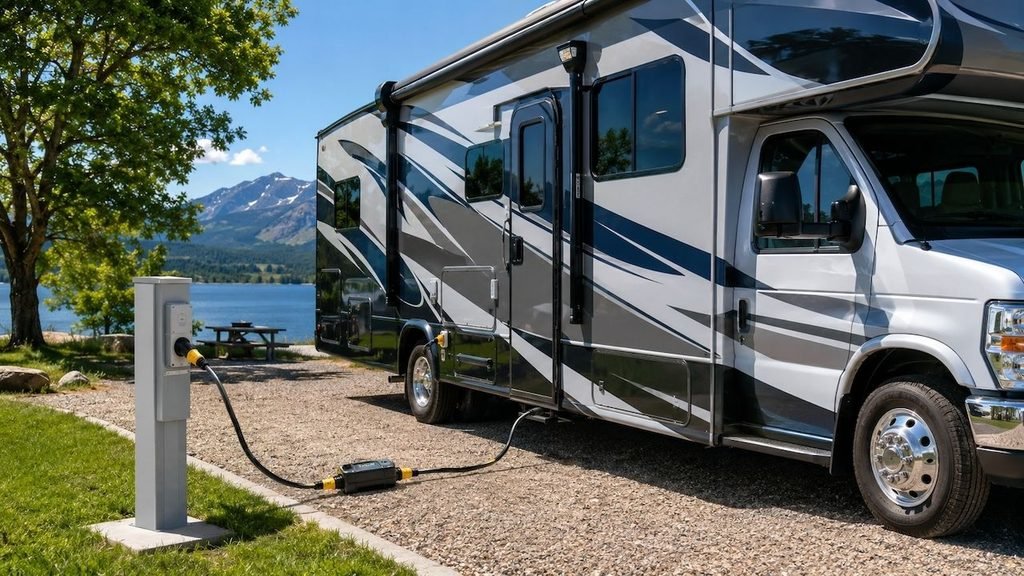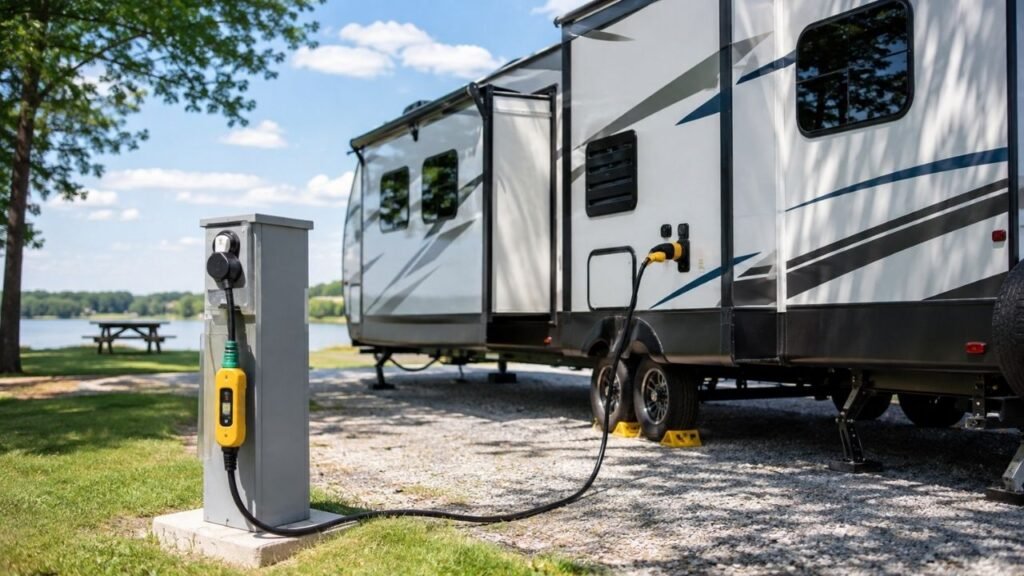
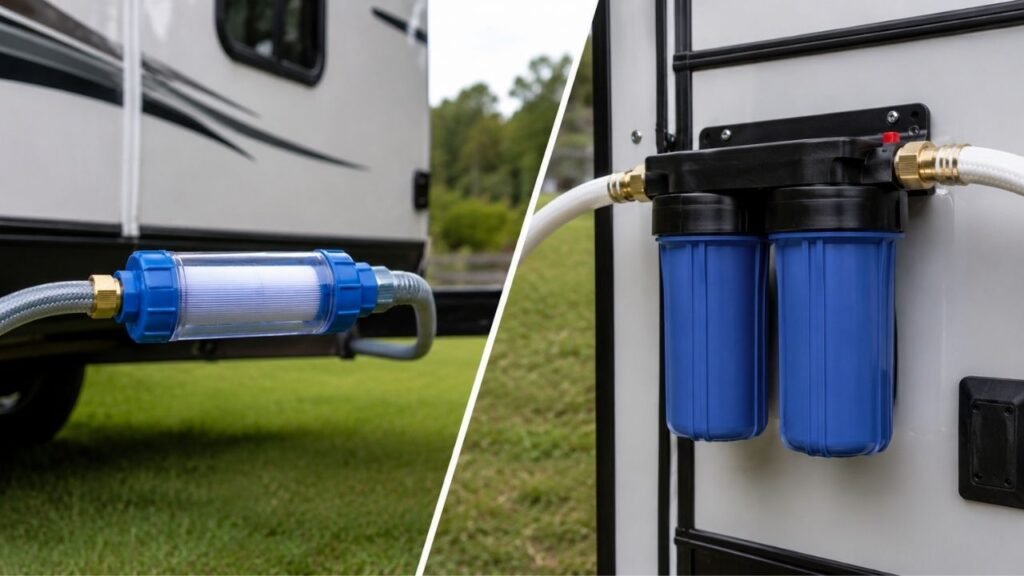
An inline RV water filter is compact, simple, and easy to connect, while a canister system uses reusable housings with replaceable cartridges. Canister systems usually offer more capacity and filtration flexibility. However, the filter media and cartridge determine what contaminants are actually reduced.
In this guide, I’ll compare filtration, water flow, maintenance, cost, storage, and everyday RV use. By the end, you should know which setup fits your camping style and water concerns.
Key Takeaways
- Inline RV filters are compact, affordable, and quick to install.
- Canister systems provide more filter capacity and cartridge choices.
- Canisters can use single, dual, or triple filtration stages.
- Neither system automatically makes questionable water safe to drink.
- Filter media matters more than the shape of the housing.
- Fine filtration can reduce water flow if the system is restrictive.
- Canisters usually handle sediment-heavy water better over longer periods.
- Inline filters work well for simple and occasional campground use.
- Frequent RVers may benefit from a customizable canister setup.
- Water hardness usually requires treatment beyond standard filtration.
Inline RV Water Filter vs Canister System at a Glance
Both systems can improve your RV water, but they solve different problems. This quick comparison shows where each option has an advantage.
| Feature | Inline RV Water Filter | Canister System |
| Basic design | Compact filter connected directly to the water line | Reusable housing containing a replaceable cartridge |
| Setup | Very quick | Requires more setup |
| Portability | Excellent | Moderate |
| Storage space | Very little | More space required |
| Filtration options | Depends on the filter | Highly customizable |
| Multiple stages | Less common | Easy with dual or triple housings |
| Sediment capacity | Usually lower | Usually higher |
| Flow potential | Depends on filter design | Often better with larger cartridges |
| Maintenance | Replace the filter or cartridge | Change cartridges and clean housings |
| Upfront cost | Usually lower | Usually higher |
| Long-term flexibility | Limited | Excellent |
| Best for | Occasional and simple RV use | Frequent use and changing water conditions |
The main difference is therefore not simply filtration quality. Inline filters prioritize convenience, while canister systems prioritize capacity and customization.
What Is an Inline RV Water Filter?
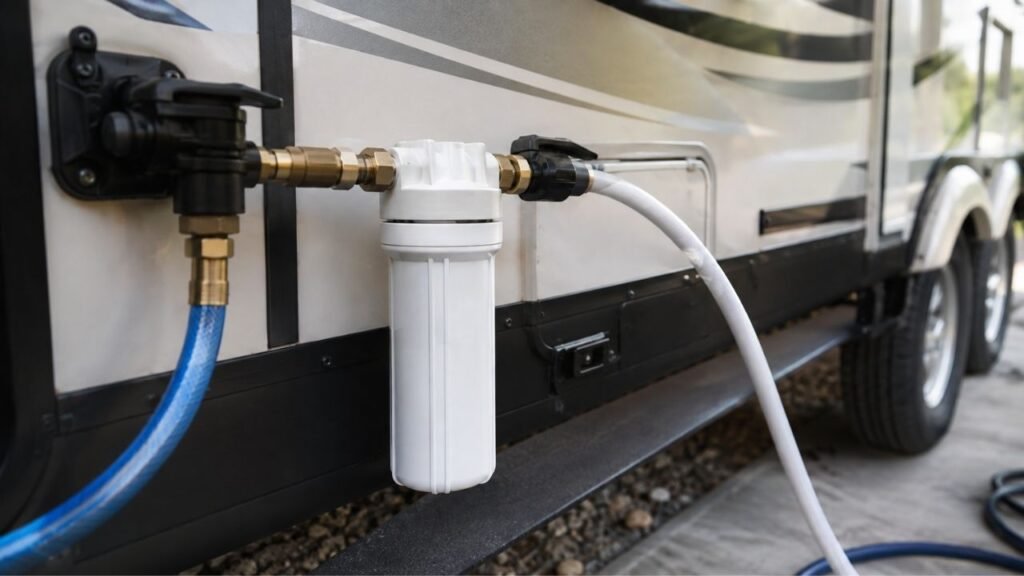
An inline RV water filter sits directly in your incoming water line. Most RVers connect one between the campground water supply and potable water hose.
How an Inline Filter Connects to Your RV
A typical campsite setup looks something like this:
Campground spigot → filter → potable water hose → RV city water inlet
Some RVers position the filter closer to the RV instead. Your filter manufacturer’s instructions should determine the final arrangement.
Installation usually requires no special plumbing work. You connect the threaded fittings, flush the filter, and begin using it.
That simplicity explains why inline filters are so common at campgrounds.
What Is Usually Inside an Inline Filter?
Inline filters can contain several types of filtering media. The exact combination depends on the product.
Common materials include:
- Sediment filtering material
- Activated carbon
- Granular activated carbon
- Carbon blocks
- KDF media in some models
- Other specialized filtering materials
Activated carbon is commonly used for chlorine taste and odors. Sediment media helps trap visible particles such as sand or rust.
However, don’t assume every inline filter removes the same contaminants. Two filters that look nearly identical may perform very differently.
Always judge filtration by the actual cartridge specifications and claims.
Main Advantages of an Inline RV Water Filter
Inline filters are popular because they remove unnecessary campsite complexity.
Their main advantages include:
- Fast installation
- Compact size
- Easy storage
- Low initial cost
- No permanent installation
- Easy replacement
- Good portability
- Simple setup for occasional campers
If you move campsites frequently, that convenience can matter considerably.
You can disconnect the filter, drain it, and pack everything quickly.
Main Limitations of an Inline RV Water Filter
The convenience comes with several possible compromises.
Common limitations include:
- Smaller filtering capacity
- Less cartridge customization
- Faster clogging in sediment-heavy water
- Possible flow reduction as the filter loads
- Fewer multi-stage options
- More frequent replacement in poor water conditions
This does not mean inline filters are ineffective. It simply means they have different design priorities.
What Is an RV Canister Water Filter System?
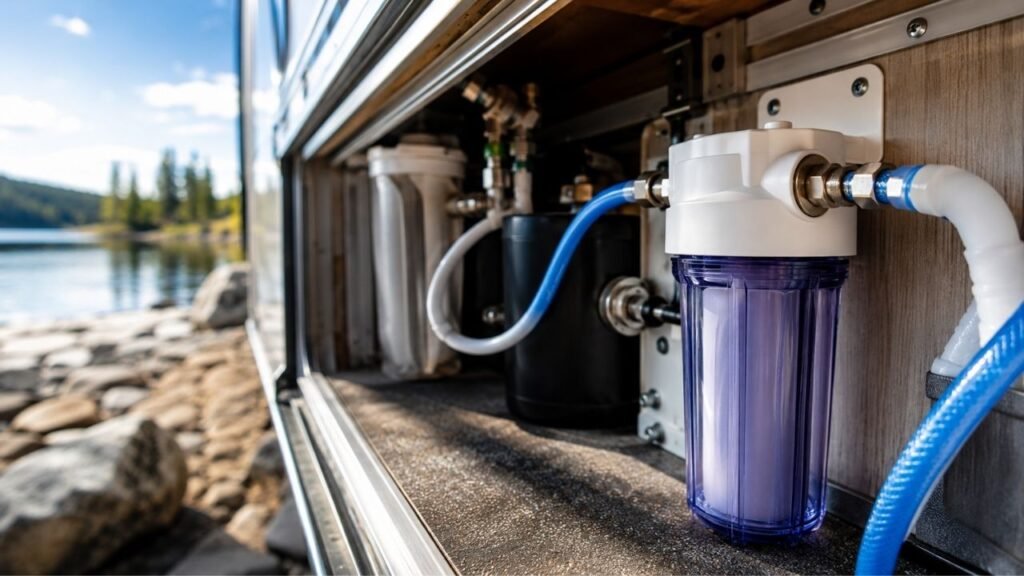
A canister system separates the filter housing from its replaceable cartridge. This design lets you choose cartridges based on specific water problems.
Canister systems are available with one, two, or several housings. Additional housings allow each filtration stage to perform a different job.
Single-Canister Systems
A single-canister system uses one housing and one cartridge.
You might install a sediment cartridge if debris is your main concern. Another option is a combination cartridge handling sediment and chlorine-related taste issues.
Single-canister systems offer more flexibility than many disposable inline filters.
They can also provide more filtering capacity because cartridges are often larger.
Dual-Canister Systems
A dual-canister system gives you two separate filtration stages.
A common configuration looks like this:
Stage 1: Sediment filtration
Stage 2: Carbon filtration
The sediment filter catches larger particles before they reach carbon media. That arrangement can help prevent the carbon cartridge from loading unnecessarily.
However, there is no universal cartridge arrangement for every RV.
Your water conditions should guide your filtration choices.
Triple-Canister Systems
A triple-canister setup gives you another filtration stage.
For example, an RVer dealing with significant sediment might use progressively finer sediment cartridges before the final treatment stage.
Another traveler might select a different third cartridge for another concern.
The advantage is customization rather than simply having more filters.
Adding unnecessary stages can increase cost, resistance, and maintenance.
Main Advantages of Canister Systems
A canister system becomes appealing when your filtration needs increase.
Important advantages include:
- Larger cartridge capacity
- Replaceable internal filters
- Greater filtration flexibility
- Easy multi-stage setups
- More sediment-handling capability
- Wide cartridge selection
- Better suitability for frequent RV use
- Reusable filter housings
You can also change cartridge types without replacing the whole system.
That flexibility becomes valuable when campground water conditions keep changing.
Main Limitations of Canister Systems
Canisters require more involvement than basic inline filters.
Potential disadvantages include:
- Higher initial cost
- Larger storage footprint
- More campsite setup
- Housing cleaning
- O-ring maintenance
- Additional fittings and connections
- More complicated winter storage
- Greater weight and bulk
For a small camper, those disadvantages can outweigh additional filtration capacity.
Inline vs Canister RV Filters: The Differences That Actually Matter
Housing design is only part of the decision. You should also compare filtration capability, capacity, flow, maintenance, and campsite practicality.
Filtration Capability
A canister system does not automatically filter better than an inline filter.
The cartridge inside the system determines much of its actual performance.
A good inline filter could outperform a poorly selected canister cartridge. Likewise, a properly designed multi-stage canister can provide much broader treatment.
Look at what the filter specifically claims to reduce.
That matters more than whether the housing is blue, clear, inline, or canister-shaped.
Sediment-Holding Capacity
Sediment is one area where larger canisters often have an advantage.
Campground water can occasionally contain sand, rust, dirt, or pipe debris. These particles slowly fill available filter media.
Larger cartridges usually provide more filtering surface and capacity.
That means they may continue working longer before noticeable restriction develops.
If your inline filters clog rapidly, sediment could be the problem.
A larger sediment pre-filter may be a better long-term solution.
Water Flow and Pressure Drop
Every water filter creates some resistance to incoming water.
You may notice weak shower flow when that resistance becomes excessive.
Several factors can contribute:
- Fine filtration
- Small filter media area
- Dirty cartridges
- Low campground pressure
- Restrictive pressure regulators
- Long hoses
- Kinked hoses
- Several faucets operating together
Canisters can sometimes provide better usable flow because larger cartridges offer more surface area.
However, don’t assume every canister has better flow.
Compare the manufacturer’s flow rating and operating requirements instead.
Filter Life and Replacement Frequency
There is no universal replacement schedule for every RV filter.
Filter life depends heavily on:
- Water quality
- Sediment concentration
- Gallons processed
- Cartridge size
- Filter media
- Travel frequency
- Manufacturer specifications
One campground may barely dirty your filter. Another could load it quickly with fine sediment.
Watch for declining flow and changing water quality.
Also follow the filter manufacturer’s replacement limits.
Installation and Campsite Setup
Inline filters win this category for simplicity.
You usually connect the filter, flush it, and attach your hose.
Portable canister systems require more equipment. You may need hoses between housings, a stand, mounting brackets, or additional fittings.
The difference may not matter during long campground stays.
However, it becomes noticeable when moving every few days.
Storage and Portability
Storage space is valuable inside any RV.
An inline filter fits easily inside most storage compartments.
A dual- or triple-canister system takes considerably more room. You also need space for hoses, fittings, spare cartridges, and possibly a mounting frame.
That makes inline filters especially attractive for Class B vans and small trailers.
Larger motorhomes may have enough storage for either option.
Maintenance
Inline filter maintenance is usually straightforward.
When replacement time arrives, you change the filter and continue traveling.
Canister maintenance requires a few additional steps.
You may need to:
- Open each housing
- Remove used cartridges
- Clean the housing
- Inspect O-rings
- Lubricate approved seals when required
- Install new cartridges
- Reassemble the housing carefully
- Check connections for leaks
This is not difficult, but it requires more attention.
Long-Term Cost
Inline filters normally cost less when first purchasing a setup.
Canister systems require housings, fittings, and possibly several cartridges.
Over time, the comparison becomes less straightforward.
A canister owner replaces individual cartridges instead of discarding the housing. An inline user may replace the complete filter more frequently.
Actual long-term cost depends on your water conditions and usage.
Avoid choosing solely from the purchase price.
Cold-Weather and Winter Storage
Any water-filled filter can be damaged by freezing.
That includes both inline filters and canister housings.
Before freezing temperatures arrive, drain exposed filtration equipment according to manufacturer instructions.
Portable canisters may need to be disconnected and stored somewhere protected.
Inline filters should also be drained before winter storage.
Never assume a filter can safely remain outside because the RV is winterized.
Which One Filters Water Better?
Neither design automatically provides better filtration. A canister system offers more capacity and cartridge choices, while actual contaminant reduction depends on the filtering media and product specifications.
Sediment, Sand, and Rust
Sediment filters physically capture suspended particles in the water.
This can include:
- Sand
- Rust
- Dirt
- Pipe scale
- Other visible debris
Both inline and canister systems can remove sediment.
The difference usually comes down to cartridge design and capacity.
For frequent sediment problems, a larger canister filter is often easier to manage.
Chlorine Taste and Odor
Activated carbon is commonly used to improve chlorine-related taste and smell.
Both inline and canister filters may contain carbon media.
Therefore, a canister isn’t automatically better for chlorine reduction.
You should check the filter’s stated treatment performance.
The quality and quantity of carbon can make a meaningful difference.
Cysts and Microorganisms
This is where RV water filtration becomes more serious.
A standard sediment or carbon filter should not automatically be considered a purifier.
Some specialized filters are designed to reduce certain microorganisms. Others are primarily intended for sediment, chlorine, taste, or odor.
Micron rating also needs context.
A nominal micron rating does not mean every particle above that size will always be captured.
An absolute rating provides a more defined maximum pore specification.
If microorganisms are a concern, choose treatment specifically designed for them.
Lead, PFAS, and Other Chemicals
Don’t assume a multi-stage filter removes every chemical contaminant.
Different contaminants require different treatment technologies.
A carbon cartridge might reduce certain chemicals while doing little against others.
Reverse osmosis and specialized cartridges address different treatment needs.
The practical rule is simple:
Identify the contaminant first, then choose equipment specifically rated for it.
Buying the largest canister available does not solve the wrong water problem.
Hard Water and Mineral Scale
Hard water is another commonly misunderstood issue.
Standard sediment and carbon filtration generally do not soften water.
Hardness primarily comes from dissolved minerals such as calcium and magnesium.
Those minerals can create:
- Faucet deposits
- Showerhead scale
- Water heater buildup
- Spots on dishes
- Soap performance problems
If hardness is your main issue, consider appropriate water-softening treatment.
Don’t expect a standard inline carbon filter to perform that job.
Micron Ratings Matter, but They Do Not Tell the Whole Story
Micron ratings help describe particle filtration, but they are only one specification. The filter media, rating method, flow, and target contaminant also matter.
Nominal vs Absolute Micron Ratings
A micron is a very small unit used to describe particle size.
You may see filters advertised as 20 micron, 5 micron, or 1 micron.
However, also look at how that rating is defined.
A nominal rating generally describes the approximate filtering performance.
An absolute rating gives a more defined maximum pore-size performance standard.
This distinction becomes especially important when addressing microorganisms.
Don’t compare two filters only because both display the same micron number.
Why a Lower Micron Number Is Not Automatically Better
Smaller micron numbers can capture smaller particles.
That sounds automatically better, but there is a trade-off.
Finer filters may also create more resistance.
They can clog quickly when source water contains heavy sediment.
A very fine sediment cartridge also does not automatically remove dissolved chemicals.
Different filtration technologies perform different jobs.
Choose the micron level according to your actual water problem.
NSF/ANSI 42 vs 53 vs 58
You may notice NSF/ANSI standards when comparing water filters.
Three common standards include:
- NSF/ANSI 42: Commonly covers aesthetic effects such as chlorine, taste, and odor.
- NSF/ANSI 53: Covers specific health-related contaminant reduction claims.
- NSF/ANSI 58: Applies to reverse osmosis drinking water treatment systems.
These numbers are not rankings.
NSF/ANSI 53 is not simply a “better version” of 42.
Each standard covers different performance requirements and treatment claims.
Check the specific certification and contaminant reduction claim you need.
Does an RV Water Filter Reduce Water Pressure?
Yes, an RV water filter can make water flow feel weaker because the filter adds resistance. The effect usually becomes worse when the cartridge becomes dirty or the campground already has weak supply pressure.
Common causes of reduced flow include:
- A clogged filter cartridge
- Very fine filtration
- An undersized filter
- A restrictive pressure regulator
- Low campground supply pressure
- Long water hoses
- Kinked hoses
- Multiple fixtures running together
Before blaming the filter, check the entire water path.
Start with the campground supply, hose, regulator, filter, and RV inlet.
If the filter is old, compare flow before and after replacement.
A larger canister can sometimes maintain stronger flow because it provides more filtering surface area.
Still, compare the actual GPM rating rather than housing size alone.
Can You Use an Inline Filter and Canister System Together?
Yes, you can use an inline filter with a canister system when the combination serves a specific purpose. You do not always have to choose one system and completely abandon the other.
For example, a coarse upstream filter could catch larger sediment before water reaches finer downstream filtration. That can reduce the amount of debris reaching more expensive cartridges.
However, stacking filters without a reason can create unnecessary restriction.
Every additional filter, fitting, and hose introduces some resistance.
Design each filtration stage around a specific water problem.
Also follow the manufacturer’s instructions regarding filter and pressure regulator placement.
Inline or Canister: Which Is Better for How You RV?
Your travel habits matter almost as much as filtration performance. The better system is the one that matches your water conditions, available space, and campsite routine.
Weekend or Occasional Campers
An inline filter is often enough for occasional campground trips.
It packs easily and takes only a few moments to install.
If you mainly use treated potable campground water, the simplicity is attractive.
Just confirm that the filter addresses your actual water concerns.
Full-Time RVers
Full-time RVers use far more water throughout the year.
A canister system may therefore make more practical sense.
Larger cartridges offer greater capacity, while separate stages allow easier customization.
You can adjust cartridges when your water conditions change.
That flexibility becomes useful when traveling across several states.
RVers Frequently Facing Heavy Sediment
Heavy sediment can overwhelm smaller filters quickly.
If you keep finding brown debris or rapidly clogged cartridges, consider a larger sediment stage.
A canister system gives you more room for dedicated sediment filtration.
You can then protect downstream carbon or specialized cartridges.
RVers With Already-Low Campground Flow
Don’t automatically choose the finest filter available.
Weak incoming flow combined with restrictive filtration can create frustrating showers.
Compare:
- Rated flow
- Cartridge size
- Pressure requirements
- Hose condition
- Regulator restrictions
Sometimes fixing the water supply setup matters more than changing filter type.
Small Campers and Class B Vans
Inline filters are difficult to beat when space is limited.
They fit almost anywhere and add very little equipment.
A large multi-canister system may consume valuable storage space.
For minimalist travel, simplicity may provide greater everyday value.
RVers Staying for Months at One Site
Canisters become easier to justify during extended stays.
You only set up the filtration system once.
Portability becomes less important, while cartridge capacity becomes more useful.
A larger setup may therefore provide better long-term convenience.
RVers Using Private Wells
Don’t assume well water is unsafe, but don’t guess either.
If you depend on a private well with uncertain quality, testing provides better information.
Once you know the concern, choose treatment designed for that contaminant.
A random multi-stage canister is not a substitute for proper treatment selection.
Boondockers Using Untreated Water
Untreated water requires a different mindset.
A typical campground inline filter may improve appearance or taste without providing appropriate microbial treatment.
If your source might contain disease-causing organisms, use treatment designed for that risk.
This could involve specialized filtration, disinfection, UV, reverse osmosis, or another appropriate method.
The important point is not to confuse filtered-looking water with verified safe water.
When Should You Upgrade From an Inline Filter to a Canister?
An inline filter can work perfectly for years. However, several recurring problems suggest that a canister system may suit you better.
Consider upgrading when:
- Your inline filter clogs repeatedly.
- Water flow drops soon after replacing filters.
- Campground water frequently contains heavy sediment.
- You want separate sediment and carbon stages.
- You need more cartridge options.
- You travel for much of the year.
- You replace disposable filters frequently.
- You want greater filter capacity.
- Your RV has enough storage space.
- You want treatment matched to specific water concerns.
Upgrade because you have a practical reason.
Don’t switch simply because a larger system looks more advanced.
When an Inline Filter Still Makes More Sense
A canister system isn’t automatically an upgrade for every RVer. Sometimes the simplest solution remains the best solution.
Stick with an inline filter when:
- You camp only occasionally.
- Storage space is very limited.
- You mainly use established potable campground connections.
- Light sediment is your main concern.
- Chlorine taste is your primary complaint.
- You change campsites frequently.
- You rent RVs.
- You dislike complicated campsite setups.
- Your current filter provides acceptable flow.
- Your filter already addresses your identified water concerns.
If your current setup works reliably, there is no reason to complicate it.
Common RV Water Filter Mistakes to Avoid
Water filtration works best when you know what each component actually does. Avoiding these mistakes can save money and prevent false confidence.
- Choosing only by micron rating: Micron size tells only part of the story. Media type and rating method also matter.
- Assuming canisters automatically purify water: A housing cannot remove contaminants by itself. The installed cartridge determines filtration performance.
- Assuming good-tasting water is safe: Dangerous contaminants do not always change water taste, smell, or appearance.
- Ignoring nominal and absolute ratings: Two filters displaying similar micron numbers may perform differently.
- Buying based on “multi-stage” marketing: More stages do not automatically mean better treatment. Every stage should serve a useful purpose.
- Ignoring specific contaminant claims: Choose filters based on what they are actually designed to reduce.
- Using cartridges too long: A loaded cartridge can reduce flow and stop performing as intended.
- Ignoring sudden flow loss: Falling water flow may indicate a clogged filter or another restriction.
- Forgetting canister maintenance: Reusable housings need cleaning, careful reassembly, and O-ring inspection.
- Allowing filters to freeze: Trapped water can expand and damage filter housings or internal components.
- Expecting filtration to soften water: Sediment and carbon filters generally do not remove hardness minerals.
- Trusting unknown water because it looks clear: Clear water can still contain contaminants you cannot see.
Inline RV Water Filter vs Canister System: Which Should You Choose?
You can simplify the decision by focusing on your biggest priority. Use this table as a starting point rather than an absolute rule.
| Your Priority | Better Starting Point |
| Simplest campsite setup | Inline |
| Smallest storage footprint | Inline |
| Occasional camping | Inline |
| Frequent travel | Canister |
| Heavy sediment | Canister |
| Multiple filtration stages | Canister |
| Custom cartridge choices | Canister |
| Higher filtering capacity | Canister |
| Unknown contaminant concern | Test water first |
| Untreated water source | Use appropriate purification treatment |
| Already weak campground flow | Compare GPM and restriction first |
If you’re still unsure, remember one simple rule:
Choose the cartridge based on the water problem. Choose the housing based on capacity, space, flow, maintenance, and travel style.
That approach keeps you from buying more filtration equipment than you actually need.
Final Verdict
For most weekend campers using established campground hookups, an inline RV water filter is convenient, affordable, and easy to manage. It takes little storage space and provides a fast way to handle common sediment, taste, or odor concerns when the chosen filter supports those uses.
A canister system makes more sense when you RV frequently, encounter heavy sediment, want larger cartridges, or need multiple filtration stages. The ability to change individual cartridges also gives you much greater control.
Most importantly, don’t assume a canister automatically produces safer water. The filter media, cartridge specifications, certifications, source-water quality, and operating conditions determine what your system can actually accomplish.
Related FAQs
Is a Canister RV Water Filter Better Than an Inline Filter?
A canister filter is not automatically better. It normally offers greater capacity, replaceable cartridges, and more customization. An inline filter can still be the better choice when you value portability, quick installation, and minimal storage space.
Do Canister Filters Reduce RV Water Pressure?
Canister filters can reduce available flow because water must pass through filtering media. However, larger cartridges often provide more surface area than small inline filters. Actual performance depends on the cartridge, flow rating, sediment loading, campground supply, and pressure regulator.
How Long Does an Inline RV Water Filter Last?
Inline filter life depends on water quality, gallons used, sediment levels, and manufacturer specifications. A filter handling clean municipal water may last longer than one exposed to sediment-heavy campground water. Replace it according to its rated limits or sooner if performance drops.
Can You Put Two RV Water Filters in Line?
Yes, two filters can be installed in sequence when each performs a useful function. For example, a sediment stage may protect a finer downstream filter. Avoid adding unnecessary filters because each additional stage can create more resistance and reduce water flow.
What Micron Filter Is Best for an RV?
There is no single micron rating that works best for every RV. Coarser filters handle larger sediment with less restriction, while finer filters catch smaller particles. Choose the rating according to your water problem, desired flow, and whether the rating is nominal or absolute.
Does an RV Water Filter Remove Bacteria?
Some specialized filters can reduce certain bacteria, but ordinary RV sediment or carbon filters should not automatically be assumed to do so. If bacteria are a concern, select treatment specifically designed and verified for microbial reduction.
Does an RV Water Filter Remove Chlorine?
Many RV filters containing activated carbon can reduce chlorine-related taste and odor. Actual performance depends on the carbon media, filter design, water flow, and product claims. Check the specific filter’s stated chlorine reduction performance before purchasing.
Do RV Water Filters Remove Hard Water Minerals?
Standard sediment and carbon RV filters generally do not remove the dissolved calcium and magnesium responsible for hard water. If mineral scale is your main concern, you will usually need a water-softening system or another treatment specifically designed for hardness.
Can You Drink Campground Water After Running It Through an RV Filter?
That depends on the original water source and your filter’s capabilities. A basic filter can improve taste and capture sediment without making contaminated water microbiologically safe. Start with a potable source whenever possible and use treatment appropriate for any known risks.
Should the Water Filter Go Before or After the RV Pressure Regulator?
Either arrangement may appear in RV setups, but you should follow the instructions supplied with your filter and regulator. The important goals are protecting your RV plumbing from excessive pressure while keeping every component within its approved operating pressure range.

Ethan Walker writes about travel routes, outdoor exploration, and road-based adventures. His guides focus on simple planning, dependable gear, and realistic travel advice. He values comfort, safety, and practical experience over hype.