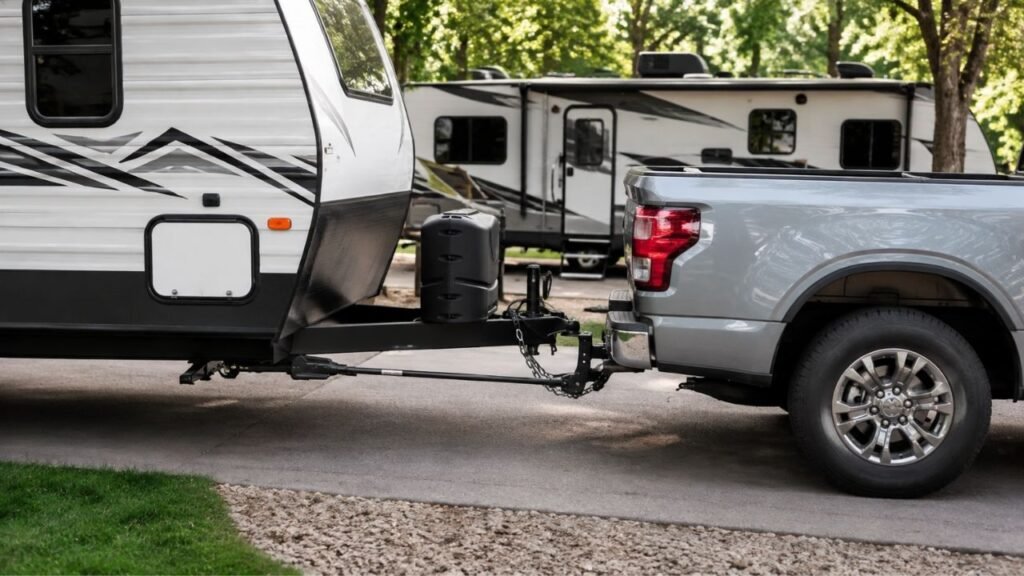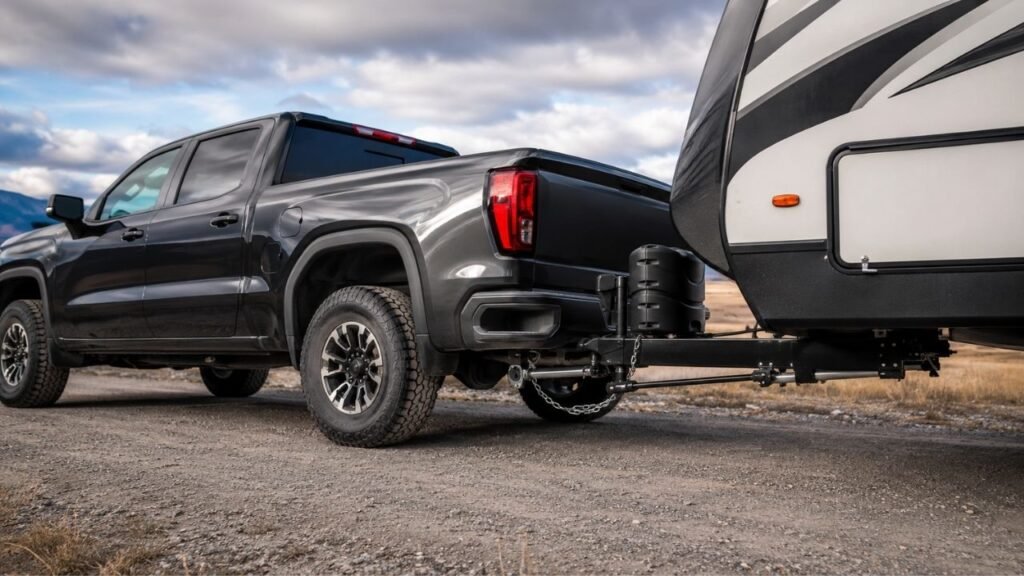
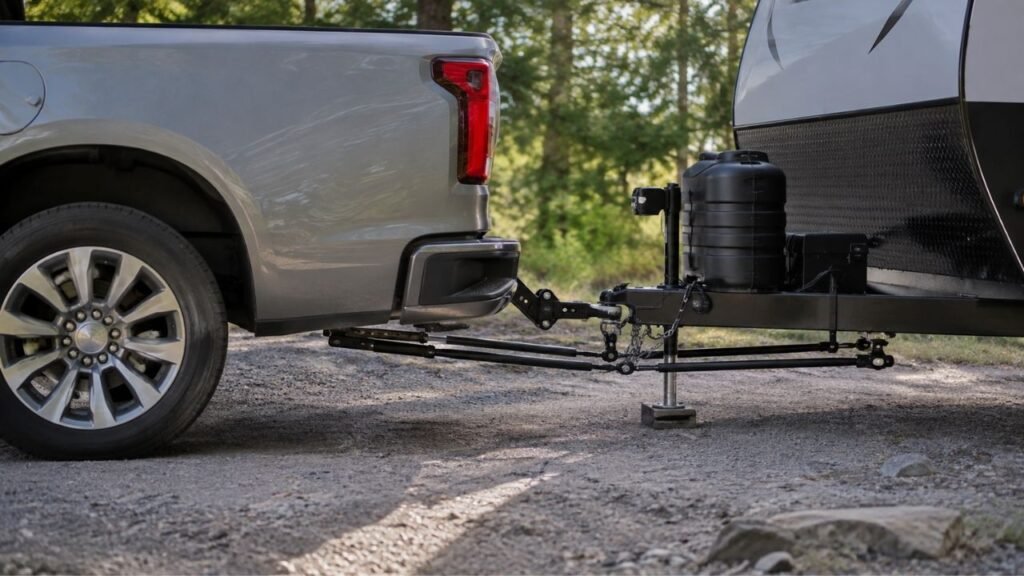
A weight distribution hitch is over-adjusted when it transfers more weight toward the tow vehicle’s front axle than the vehicle or hitch manufacturer recommends. One of the clearest warning signs is a front wheel-well measurement that ends up lower than its original unloaded height after the spring bars are engaged.
You may also notice unusually stiff towing, sensitive steering, or too much weight being removed from the rear axle. Below, I’ll show you how to identify these signs, measure your setup correctly, and reduce the adjustment safely.
Key Takeaways
- A front fender sitting lower than its original height can indicate over-adjustment.
- Your truck does not need to look perfectly level for the hitch to work correctly.
- Too much spring-bar tension can transfer excessive weight toward the front axle.
- Harsh riding or unusually sensitive steering can accompany over-adjustment.
- Wrong ball height can sometimes look like a weight distribution problem.
- The correct front axle restoration target varies between tow vehicles.
- Make adjustments gradually and measure again after every change.
- A truck scale can confirm how much axle weight the hitch actually transfers.
What Does an Over-Adjusted Weight Distribution Hitch Mean?
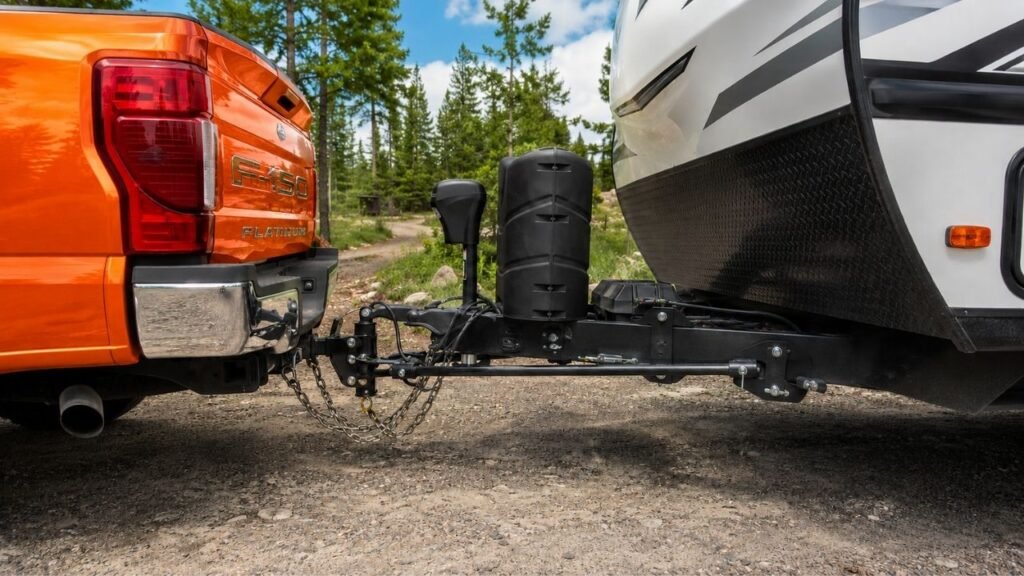
A weight distribution hitch uses spring bars to redistribute some trailer tongue weight. Without weight distribution, tongue weight pushes down behind your tow vehicle’s rear axle. That makes the rear suspension compress while some weight comes off the front axle.
Engaging the spring bars creates leverage. Some of that lost front axle load is restored while part of the load is also transferred toward the trailer axles.
That is exactly what you want, but only to a point.
An over-adjusted hitch applies more weight distribution than your setup requires. Instead of simply restoring enough front axle loading for stable towing, the hitch keeps transferring weight until the front end becomes too heavily loaded relative to the manufacturer’s target.
This is why I would not judge your setup by asking whether your truck looks perfectly level.
A properly adjusted truck may still sit slightly lower at the rear. The goal is correct axle loading and stable handling, not making every wheel opening sit at exactly the same height.
Also remember that a weight distribution hitch does not increase your truck’s payload, GVWR, axle ratings, receiver rating, or towing capacity. It only redistributes the load you already have.
What Are the Signs That Your Weight Distribution Hitch Is Over-Adjusted?
You will usually get the best answer from measurements, but several physical and driving symptoms can give you clues. If you notice more than one of the following signs, I would stop guessing and measure the setup before your next long tow.
The Front Fender Drops Below Its Original Height
This is one of the strongest warning signs.
Measure from level ground through the center of the front wheel to a consistent point on the wheel opening. Take this measurement before connecting the trailer.
After connecting the trailer and engaging the weight distribution system, measure that same location again.
If the front wheel opening is now lower than its original measurement, the hitch may be transferring too much weight forward.
However, your tow vehicle’s manual should still determine the correct final target. Different manufacturers can specify different amounts of front axle restoration.
The Rear of the Tow Vehicle Feels Unusually Light
Weight distribution is supposed to remove some of the load placed on the rear axle, but removing too much can create another problem.
The rear tires still need enough loading to provide predictable traction.
If excessive hitch tension transfers too much load away from the rear axle, the truck can feel less settled, particularly over uneven pavement or during quick steering corrections.
A visibly high rear end would be an obvious warning, but you do not need to see such an extreme condition before checking your measurements.
Steering Feels Too Sharp or Skittish
You might notice the steering feels different after increasing spring-bar tension.
Instead of feeling planted, the truck may respond too aggressively to small steering movements or feel nervous on rough pavement.
Do not diagnose over-adjustment from steering feel alone, though.
Incorrect tire pressure, trailer sway, alignment problems, strong crosswinds, poor trailer loading, and suspension issues can produce similar symptoms.
Use the road feel as a clue, then confirm it with measurements.
The Ride Becomes Extremely Stiff or Harsh
A correctly matched weight distribution hitch can feel firm because its spring bars are working under significant tension.
But it should not make every expansion joint or small bump feel unnecessarily violent.
An excessively harsh ride can indicate too much spring-bar tension. It can also mean your spring bars are rated considerably higher than your actual loaded tongue weight.
If the problem began immediately after increasing hitch adjustment, I would definitely recheck the setup.
Spring Bars and Brackets Are Under Excessive Tension
Spring bars are designed to bend and flex. Seeing them flex does not automatically mean something is wrong.
What you should look for is a combination of excessive tension and other warning signs.
For example, you might see unusual bracket movement, rapid wear, excessive pressure against contact surfaces, or difficulty engaging the bars compared with your normal setup.
Inspect the hitch hardware as well.
Loose brackets, damaged components, or improperly positioned hardware can sometimes create symptoms that look like an adjustment problem.
The Tow Vehicle or Trailer Has an Unnatural Stance
Sometimes you can immediately see that something looks wrong.
Perhaps the truck’s front end is noticeably lower than normal, or the entire combination looks strangely pitched after you tension the spring bars.
Appearance can tell you that the setup deserves attention, but I would not use appearance alone to decide how much adjustment to remove.
Always confirm it with measurements.
Over-Adjusted vs Under-Adjusted vs Properly Adjusted Weight Distribution Hitch
It helps to compare these conditions side by side because excessive and insufficient weight distribution can both create poor towing behavior. Wrong ball height can also make the combination look incorrectly adjusted even when spring-bar tension is not the real problem.
| Hitch Condition | Front Fender Behavior | Possible Towing Feel | What to Check |
| Under-adjusted | Remains higher than the specified target | Light steering, excessive rear squat, reduced stability | More weight distribution may be needed |
| Properly adjusted | Reaches the manufacturer’s recommended target | Stable and predictable | Confirm trailer attitude and weight ratings |
| Over-adjusted | Drops below the required target and may fall below its original height | Harsh ride or unusually sensitive handling | Reduce weight distribution tension |
| Wrong ball height | Front measurement may look acceptable while trailer sits incorrectly | Poor towing despite reasonable WDH measurements | Correct hitch ball height first |
| Spring bars too stiff | Difficult to achieve a balanced setting | Harsh or rigid ride | Verify actual tongue weight and spring-bar rating |
The important point is that you should diagnose the condition instead of simply adding or removing tension until the rig looks level.
How Do You Measure Whether a Weight Distribution Hitch Is Over-Adjusted?
The easiest home check uses three front wheel-well measurements. Perform the test on firm, level ground and load your tow vehicle and trailer as close as possible to normal travel conditions.
Step 1: Load Your Tow Vehicle and Trailer for Travel
Start with the rig configured the way you actually tow it.
Include normal cargo, propane, batteries, tools, camping supplies, and other significant equipment.
If you normally tow with fresh water in the tank, account for that too.
The reason is simple. Changing trailer loading changes tongue weight, and changing tongue weight can change how much weight distribution your setup needs.
Step 2: Measure the Front Fender With the Trailer Disconnected
Park the tow vehicle on level ground.
Measure vertically from the ground through the centerline of the front wheel to the same point on the wheel opening.
Write down the number.
We can call this Measurement A.
For example:
Measurement A = 36 inches
Make sure you use exactly the same measuring point during the entire test.
Step 3: Connect the Trailer Without Engaging Weight Distribution
Couple the trailer normally but leave the spring bars disengaged.
Lower the trailer jack until the full tongue weight is resting on the hitch.
Measure the front wheel opening again.
This is Measurement B.
For example:
Measurement B = 37 inches
In this example, attaching the trailer raised the front of the tow vehicle by one inch.
That happens because tongue weight behind the rear axle creates leverage that unloads some weight from the front axle.
Step 4: Engage the Weight Distribution Hitch
Now engage the spring bars according to your hitch manufacturer’s procedure.
Retract the tongue jack completely so the combination is resting normally on its axles.
Measure the front wheel opening again.
This becomes Measurement C.
For example:
Measurement C = 36.5 inches
The weight distribution hitch has brought the front end halfway back toward its original position.
Step 5: Compare Your Final Measurement With the Required Target
This is where many people make a mistake.
Do not automatically assume Measurement C must equal Measurement A.
Some tow vehicles call for partial restoration rather than returning the front suspension completely to its original position.
Others may use a different procedure altogether.
Your vehicle owner’s manual and hitch instructions should tell you what target applies to your combination.
If the hitch brings the front end farther down than the required target, you have too much weight distribution.
A front measurement that falls below the original baseline is an especially strong reason to inspect the setup.
What Does 50% Front Axle Load Restoration Mean?
You may see the term front axle load restoration, often shortened to FALR, when researching weight distribution hitch setup.
It simply describes how much of the front axle load removed by trailer tongue weight is restored by the hitch.
Here is an easy ride-height example.
Suppose your original front wheel-well height is:
36 inches
After attaching the trailer without weight distribution, it becomes:
37 inches
The front suspension rose by one inch.
If your vehicle calls for approximately 50% restoration, you would bring the front halfway back toward its original position.
That would give you an approximate target of:
36.5 inches
This does not mean every tow vehicle should use 50%.
That number is only an example.
Your pickup, SUV, receiver, and hitch manufacturer may specify another method or target. Always follow the instructions for your exact vehicle before deciding that more tension is better.
Why Isn’t Returning the Front Fender to Its Original Height Always Correct?
It seems logical to think the front suspension should return exactly where it started.
That is not always what the vehicle manufacturer wants.
Modern towing recommendations can call for partial front axle restoration on certain vehicles rather than restoring everything removed by tongue weight.
So if your truck originally measured 36 inches at the front wheel opening, you should not automatically keep increasing spring-bar tension until it reaches exactly 36 inches again.
Doing that could move beyond the recommended target.
This is also why I would avoid advice that says, “Just keep tightening the hitch until the truck sits level.”
A level-looking truck is not necessarily a correctly loaded truck.
The right amount of weight distribution is the amount your specific combination requires for proper axle loading and handling.
What Causes a Weight Distribution Hitch to Become Over-Adjusted?
Too much spring-bar tension is the basic cause, but several setup choices can create that excessive tension. Before changing anything, identify which adjustment is actually responsible.
Too Much Spring-Bar Tension
This is the most straightforward cause.
The spring bars are applying more leverage than necessary, transferring too much load toward the tow vehicle’s front axle.
That extra tension may come from your bracket position, chain setting, hitch-head adjustment, or another tensioning mechanism.
Hitch-Head Angle Is Too Aggressive
Many weight distribution hitches allow you to change the angle of the hitch head.
Changing that angle changes the amount of leverage available to the spring bars.
A more aggressive setting can significantly increase weight distribution even though you have not changed the bars themselves.
This is also why I would not give every owner the same washer instructions.
Some systems use spacer washers. Others use serrated washers, adjustment blocks, bolts, pins, or completely different mechanisms.
Follow the adjustment procedure for your hitch.
L-Brackets or Chain Settings Apply Too Much Leverage
Bracket-style weight distribution systems often let you change the spring-bar contact position.
Chain-style systems normally change tension by altering the working chain position or another part of the hookup geometry.
Moving one adjustment point can noticeably change front axle restoration.
If your measurements suddenly changed after moving a bracket or selecting a different chain link, reverse that change one step and measure again.
Your Spring Bars Are Too Stiff for the Actual Tongue Weight
Spring bars need to match the loaded tongue weight they are being asked to control.
If you use bars rated far above your actual tongue weight, the system may become unnecessarily stiff and difficult to fine-tune.
You might experience a harsh ride even when the rig does not look dramatically over-adjusted.
Ideally, determine your real loaded tongue weight rather than estimating it from the trailer’s empty brochure weight.
Remember to account for cargo carried behind the tow vehicle’s rear axle if the hitch manufacturer includes that load in its sizing procedure.
Trailer Loading Changed After the Hitch Was Adjusted
A weight distribution hitch is adjusted for a particular loading condition.
Move enough weight around and that condition changes.
Common examples include:
- Filling or emptying a fresh water tank.
- Adding batteries.
- Carrying additional propane.
- Installing a generator.
- Loading bikes.
- Adding cargo to a front storage compartment.
- Moving heavy cargo toward the rear of the trailer.
- Carrying significantly more gear in the truck bed.
If your trailer loading changes substantially, recheck the hitch instead of assuming the previous setting is still correct.
Automatic Leveling or Air Suspension Changed the Measurements
Air suspension can make WDH measurements confusing because the vehicle may automatically correct its ride height.
Some manufacturers require a particular sequence when setting up weight distribution on an air-suspension vehicle.
For example, you may need to disable automatic leveling temporarily, place the suspension in a specific mode, or allow leveling to occur at a particular point in the procedure.
Do not guess.
Check the towing section of your vehicle manual before using wheel-well measurements on an automatically leveling vehicle.
Could Wrong Hitch Ball Height Look Like Over-Adjustment?
Yes. Incorrect hitch-ball height can make the combination look poorly adjusted even when spring-bar tension is not the real problem.
Suppose your trailer sits noticeably nose-high.
You might be tempted to increase weight distribution because the truck and trailer do not look level together.
But spring-bar tension is not meant to correct improper ball height.
The better approach is to check these items separately:
- Trailer attitude.
- Uncoupled coupler height.
- Hitch ball height.
- Shank rise or drop.
- Hitch-head position.
- Spring-bar adjustment.
Your trailer should generally sit level or in the attitude required by its manufacturer after you have established the correct hitch-ball position.
Once the ball height is correct, adjust weight distribution.
Trying to fix trailer pitch by aggressively tensioning the spring bars can create an over-adjusted hitch while leaving the original ball-height problem unresolved.
How Do You Fix an Over-Adjusted Weight Distribution Hitch?
The goal is not to remove as much tension as possible. You only want to reduce weight distribution enough to bring the front axle back to the correct target for your tow vehicle.
Verify Trailer Loading and Tongue Weight First
Before touching the hitch, make sure the trailer is loaded correctly.
Confirm that tongue weight falls within a reasonable range for your particular trailer and tow vehicle combination.
Also confirm that the hitch and spring bars are sized for that actual loaded tongue weight.
If the basic loading is wrong, adjusting the hitch around it will not solve the underlying problem.
Check Hitch Ball Height
Set the trailer and tow vehicle on level ground and verify the hitch-ball position.
If the trailer is sitting badly nose-high or nose-low, correct the rise or drop according to your hitch instructions before fine-tuning weight distribution.
This keeps you from using spring-bar tension to compensate for a completely different setup problem.
Reduce Weight Distribution One Adjustment at a Time
Make one small adjustment.
Then measure again.
Depending on the hitch design, reducing weight distribution may involve:
- Changing hitch-head tilt.
- Removing a spacer washer.
- Repositioning an L-bracket.
- Changing a chain setting.
- Adjusting another manufacturer-specific tension point.
Do not randomly remove washers because you read that recommendation online.
That method works for certain hitches, but the adjustment direction and procedure are not universal.
Use your hitch manual.
Re-Measure After Every Adjustment
Repeat the three-measurement procedure after each meaningful change.
You want to know exactly how your adjustment affected the front suspension.
Keep a simple record of:
- Measurement A.
- Measurement B.
- Measurement C.
- Washer count or head setting.
- Bracket position.
- Chain setting.
- Trailer loading condition.
This makes future troubleshooting much easier.
Inspect the Spring Bars and Hitch Hardware
Once the weight distribution looks correct, inspect the complete system.
Check:
- Spring-bar installation.
- Frame bracket position.
- Chain placement.
- Retaining pins.
- Clips.
- Hitch-head bolts.
- Shank bolts.
- Coupler engagement.
- Receiver pin.
- Safety chains.
- Breakaway cable.
Tighten hardware to the torque specifications provided by the manufacturer.
Do not rely on “very tight” as a substitute for an actual torque value where one is specified.
Perform a Careful Road Test
Start with a low-speed test in a safe area.
Pay attention to steering response, braking, trailer stability, and ride quality.
If everything feels predictable, gradually move to normal towing speeds.
Measurements should remain your primary setup method. The road test is simply a final confirmation that the combination behaves normally.
Should You Use a CAT Scale to Check Weight Distribution?
Wheel-well measurements are convenient, but axle weights tell you what the hitch is actually doing. If you tow frequently or want greater confidence in your setup, a public truck scale can be extremely useful.
Pass 1: Tow Vehicle Without the Trailer
Drive the loaded tow vehicle onto the scale without the trailer attached.
Record the front and rear axle weights.
Try to have the same passengers and cargo aboard that you normally carry while towing.
Pass 2: Trailer Connected Without Weight Distribution
Connect the trailer but disengage the weight distribution spring bars.
Place the combination on the scale so the front axle, rear axle, and trailer axles are recorded separately.
This shows how much load trailer tongue weight removed from the tow vehicle’s front axle.
Pass 3: Trailer Connected With Weight Distribution Engaged
Engage the hitch exactly as you normally tow.
Weigh the complete combination again.
You can now see how much load returned to the front axle and how much moved between the rear and trailer axles.
Calculate Front Axle Load Restoration
Here is a simple example.
Suppose your tow vehicle alone has:
Front axle: 3,400 pounds
After connecting the trailer without weight distribution:
Front axle: 3,100 pounds
The trailer removed:
300 pounds
Now engage the WDH and weigh again.
Suppose the front axle becomes:
3,250 pounds
The hitch restored:
150 pounds
Divide the restored load by the load originally removed:
150 ÷ 300 = 0.50
Multiply by 100:
50% front axle load restoration
Again, I am using 50% only to explain the calculation.
Your actual target should come from the towing guidance for your particular vehicle and hitch.
Also use the scale ticket to verify that your front axle, rear axle, trailer axles, vehicle, trailer, and combination remain within their applicable ratings.
Can You Have Too Much Weight Distribution Even If the Truck Looks Level?
Yes. A truck can look perfectly level and still have incorrect axle loading.
Ride height alone can be affected by many things, including:
- Air suspension.
- Helper springs.
- Supplemental bump springs.
- Heavy-duty rear suspension.
- Uneven pavement.
- Tire pressure.
- Cargo distribution.
- Trailer attitude.
For example, upgraded rear suspension may prevent visible squat even though tongue weight has still removed significant load from the front axle.
The opposite can also happen.
Your truck might still show some rear squat even though the WDH has restored the correct amount of front axle load.
That is why I would use measurements and manufacturer instructions rather than trying to make the truck look perfectly flat.
Is an Over-Adjusted Weight Distribution Hitch Dangerous?
An excessively adjusted weight distribution hitch can negatively affect handling because it changes how load is shared among the tow vehicle and trailer axles.
Potential problems can include reduced rear-axle loading, an unnecessarily harsh ride, unusual steering response, and excessive loads on hitch components.
The important thing is not to panic if your measurement is slightly outside the target.
Instead, correct the setup before continuing serious highway towing.
Also avoid blaming every sway problem on over-adjustment.
Trailer sway can result from insufficient tongue weight, improper cargo placement, tire problems, excessive speed, strong wind, suspension issues, or a trailer that is simply not properly matched to the tow vehicle.
Measure first, then troubleshoot the specific condition you find.
When Should You Recheck Your Weight Distribution Hitch Adjustment?
Your hitch does not necessarily need a complete setup every time you connect the trailer. However, I would recheck it whenever something meaningfully changes.
Good times to check include:
- After the initial installation.
- After your first meaningful towing trips.
- After major cargo changes.
- After filling or relocating water tanks.
- After adding batteries or propane cylinders.
- After installing a generator.
- After adding a bike rack or cargo carrier.
- After carrying substantially more truck-bed cargo.
- After switching tow vehicles.
- After switching trailers.
- After replacing spring bars.
- After changing hitch components.
- After changing ball height.
- After suspension modifications.
- After unexplained changes in steering or handling.
A quick measurement now can prevent a frustrating towing problem later.
Final Words
The easiest way to tell whether a weight distribution hitch is over-adjusted is to stop judging the rig only by appearance and start measuring what happens at the tow vehicle’s front suspension.
Take your unloaded travel-ready measurement, connect the trailer without weight distribution, then measure again with the spring bars engaged. Compare that final result with the front axle restoration procedure specified for your vehicle and hitch.
If the hitch is transferring too much weight forward, reduce the adjustment gradually and remeasure after each change. Once the numbers are right, verify your trailer attitude, hardware, axle ratings, and road behavior before your next trip.
Related FAQs
Can You Put Too Much Tension on Weight Distribution Bars?
Yes. Excessive spring-bar tension can transfer more weight toward the tow vehicle’s front axle than intended, potentially causing harsh handling and an over-adjusted setup.
Should the Front of My Truck Be the Same Height With a Weight Distribution Hitch?
Not necessarily. Some tow vehicles call for only partial restoration of the front suspension, so the correct final height should come from your vehicle’s towing instructions.
Should a Weight Distribution Hitch Completely Eliminate Rear Squat?
No. Some rear suspension compression can remain even when the hitch is correctly adjusted. The goal is proper axle loading and stable handling rather than making the truck perfectly level.
Can Too Much Weight Distribution Cause Sway?
Too much weight distribution can contribute to poor towing behavior, but sway has many possible causes. Trailer loading, tongue weight, tires, speed, wind, and suspension problems should also be checked.
Can Weight Distribution Bars Be Too Stiff?
Yes. Spring bars rated considerably above the trailer’s actual loaded tongue weight can create a harsh ride and make the hitch harder to adjust properly.
Does Adding More Washers Increase Weight Distribution?
On some hitch designs, changing the number of spacer washers changes head angle and weight distribution. The direction and adjustment method vary, so follow the instructions for your specific hitch.
Can Air Suspension Affect Weight Distribution Hitch Adjustment?
Yes. Automatic leveling can change ride-height measurements and interfere with normal setup procedures. Follow your tow vehicle manufacturer’s instructions for using a WDH with air suspension.
How Often Should I Check My Weight Distribution Hitch Setup?
Recheck the setup whenever trailer loading changes significantly or you modify the hitch, suspension, ball height, tow vehicle, spring bars, or other major towing components.
Is a CAT Scale Better Than Measuring Fender Height?
A truck scale gives you actual axle weights and is excellent for confirming weight transfer. Fender measurements are easier at home, but your vehicle’s recommended setup procedure still determines the proper target.

Ethan Walker writes about travel routes, outdoor exploration, and road-based adventures. His guides focus on simple planning, dependable gear, and realistic travel advice. He values comfort, safety, and practical experience over hype.