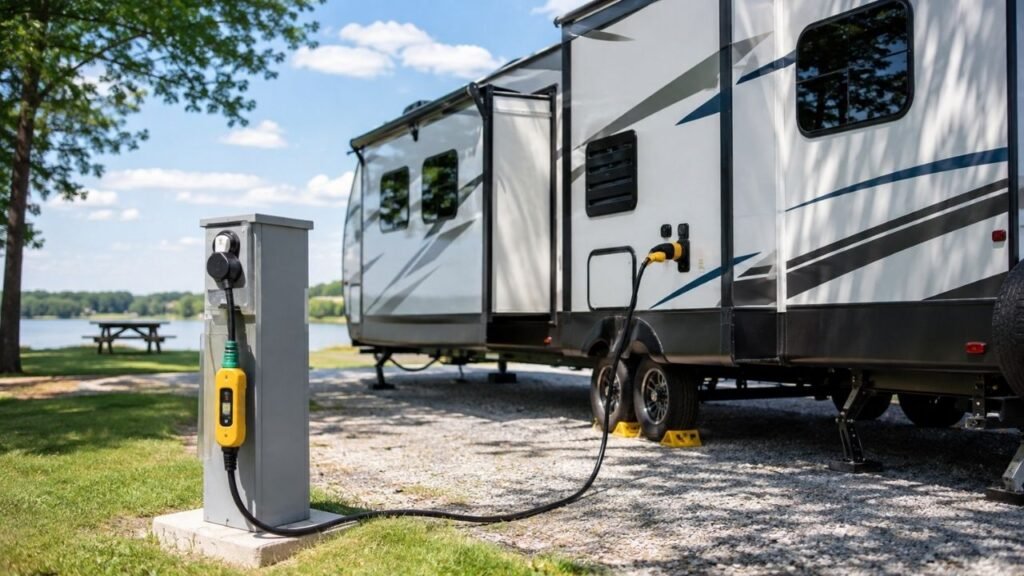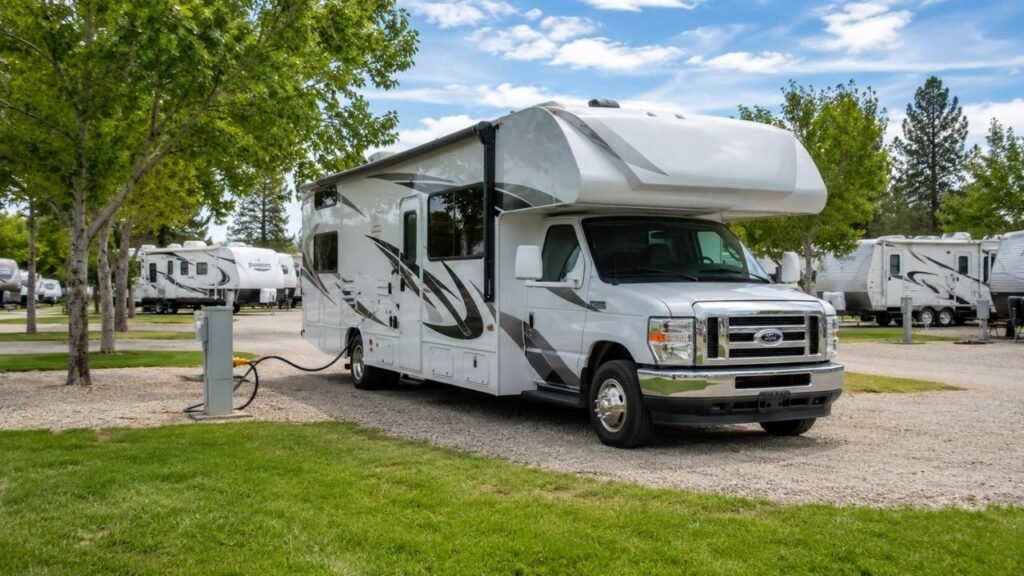
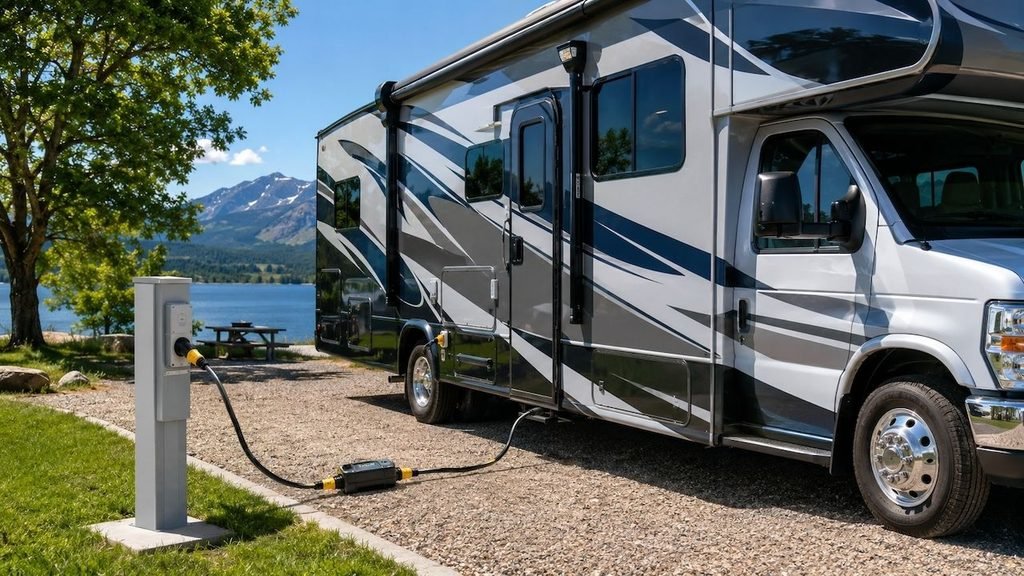
Your RV surge protector keeps shutting off power because it is detecting an electrical condition it considers unsafe. Common triggers include low voltage, high voltage, open ground, open neutral, reverse polarity, unstable generator power, overheating connections, or other faults monitored by your specific protection system.
The shutdown can feel frustrating when you need your AC or appliances. However, it often means the protector is doing its job. Below, I’ll help you identify the likely cause, narrow down where the problem is coming from, and decide what to do safely.
Key Takeaways
- Repeated shutdowns often indicate unsafe incoming campground power.
- Low voltage commonly appears during heavy campground electrical demand.
- High voltage, open neutral, and wiring faults need immediate attention.
- Not every RV surge protector automatically disconnects unsafe power.
- Full EMS units provide more protection than basic surge-only devices.
- Shutdown voltage thresholds vary between brands and models.
- A restart delay after power returns is usually normal.
- Problems following your RV between campgrounds need further inspection.
- Never ignore or bypass an active electrical safety warning.
First, Check Whether You Have a Surge Protector or an EMS
RV owners often call every shore-power protection device a surge protector. However, the device you actually own makes a big difference.
A basic RV surge protector mainly protects against sudden voltage spikes. Some models also show basic wiring conditions. However, they may not automatically disconnect your RV during sustained low voltage.
An Electrical Management System, usually called an EMS, provides broader protection. It continuously watches incoming campground electricity and can disconnect your RV when unsafe conditions appear.
A full EMS may monitor low voltage, high voltage, open ground, open neutral, reverse polarity, frequency problems, and other conditions.
Some manufacturers use names like EPO, total electrical protection, or smart surge protection. The features still vary considerably between models.
So, if your device completely removes power from the RV, you probably have an EMS or another protector with automatic shutoff capability.
What Is Your RV Surge Protector Trying to Tell You?
Your protector’s display or warning lights provide your best starting point. Check them before unplugging anything because the fault may disappear afterward.
| What the Display Shows | Possible Reason | Typical Interpretation | Recommended First Step |
| Low voltage warning | Voltage sag | Campground voltage has fallen below the unit’s safe range | Reduce electrical loads and check the source |
| High voltage warning | Excessive incoming voltage | Pedestal or campground voltage is outside the safe range | Stop using the source |
| Open ground | Missing grounding connection | Ground path is missing somewhere upstream | Do not bypass the warning |
| Open neutral | Neutral connection problem | Shore-power wiring may be unsafe | Disconnect and report the problem |
| Reverse polarity | Hot and neutral reversed | Pedestal or outlet may be miswired | Use another properly wired source |
| Frequency error | Unstable AC frequency | Generator or incoming supply may be unstable | Check the power source |
| Overheat warning | Hot plug or receptacle | Loose or damaged electrical connection may exist | Shut down and inspect connections |
| High current warning | Excessive load on supported models | RV may be drawing more current than allowed | Reduce large loads |
| Delay or countdown | Normal restart protection | EMS is intentionally waiting before reconnecting | Wait for the delay to finish |
| Surge protection warning | Surge components may be depleted | Surge protection section may need service | Follow your model’s instructions |
| Normal voltage but no power | Delay or internal/downstream issue | Source may be good, but power is not reaching the RV | Continue troubleshooting |
Error codes are not universal. One manufacturer’s E3 may mean something entirely different on another unit.
Always check the label, manual, or manufacturer information for your specific protector.
Why Does My RV Surge Protector Keep Shutting Off Power?
Several electrical conditions can make an RV EMS repeatedly disconnect your shore power. Understanding each one helps you troubleshoot without guessing.
Low Campground Voltage Is Triggering the EMS
Low voltage is one of the most common reasons an RV EMS shuts power down.
Campground electrical demand can rise dramatically during hot weather. Hundreds of air conditioners, refrigerators, water heaters, and other appliances may operate simultaneously.
As demand increases, pedestal voltage can begin dropping.
Many RV electrical management systems disconnect somewhere around the low 100-volt range. The exact cutoff depends on your model.
Some popular units disconnect around 104 volts. Others may allow voltage to fall slightly lower before disconnecting.
The EMS shuts down because running motors on low voltage can increase current and heat. Your RV air conditioner compressor is particularly vulnerable.
You may notice this problem most often during hot afternoons.
Voltage might look fine at breakfast and become unstable later.
If the protector reconnects during the evening, campground demand may be the underlying problem.
Incoming Voltage Is Too High
High voltage can damage sensitive RV electronics just as easily.
Your converter, refrigerator electronics, microwave, television, control boards, chargers, and other devices expect reasonably stable power.
A full EMS continuously checks that incoming voltage remains acceptable.
When voltage rises beyond its programmed limit, the unit disconnects your RV.
Some protectors use a cutoff around 132 volts. Others have different upper thresholds.
Do not assume every unit follows one exact number.
Repeated high-voltage warnings should be treated seriously.
Moving to another site may help if only one pedestal is affected. However, campground staff should inspect the electrical system.
The Pedestal Has an Open Ground
An electrical ground provides a safety path during certain electrical faults.
If that ground connection is missing, damaged, or disconnected, your EMS may refuse to power the RV.
The issue could be inside the pedestal.
It can also happen because of a damaged adapter, cord, generator configuration, or another connection between the source and your EMS.
An open-ground warning is not something I recommend trying to work around.
Try another approved power source or campground pedestal instead.
If the warning disappears there, the first electrical source likely needs professional attention.
There Is an Open Neutral
An open neutral can create particularly dangerous electrical conditions.
The neutral conductor provides the normal return path for 120-volt RV circuits.
A damaged or disconnected neutral can cause unstable voltage conditions.
The risk becomes especially important on 50-amp RV electrical systems.
A 50-amp RV normally receives two separate 120-volt legs. A neutral problem can allow those leg voltages to become badly unbalanced.
One leg may experience unusually high voltage while the other drops.
A properly equipped EMS should prevent power from reaching the RV when it detects this condition.
If you receive an open-neutral warning, stop using that source.
Ask campground management or a qualified electrician to inspect it.
The Power Source Has Reverse Polarity
Reverse polarity generally means the hot and neutral conductors are incorrectly connected.
Your appliances may appear to operate normally despite this wiring mistake. However, the electrical system is not wired as intended.
That is why many protection devices identify reverse polarity before supplying power.
If your EMS repeatedly reports reverse polarity at one campsite, try another properly approved pedestal.
Do not open the campground pedestal and attempt to repair it yourself.
Campground electrical equipment should be handled by qualified personnel.
Generator Voltage or Frequency Is Outside the Allowed Range
A generator can also make an RV EMS refuse power.
Most RV appliances expect approximately 120-volt, 60-hertz AC electricity.
If a generator produces unstable voltage or frequency, the protector may disconnect your RV.
This can happen when:
- The generator engine speed is unstable.
- The generator is overloaded.
- Eco mode struggles with changing loads.
- Voltage regulation is malfunctioning.
- Fuel or engine problems cause unstable output.
- The generator’s electrical configuration conflicts with the EMS.
Generators can introduce another issue as well.
Many portable generators use a floating-neutral design. Certain EMS devices interpret that configuration as an open-ground condition.
That does not automatically mean your generator is defective.
Check both the generator and EMS instructions before making electrical changes.
The Plug or Receptacle Is Overheating
Not every shutdown is caused by voltage alone.
Some advanced RV protection systems monitor plug or receptacle temperature.
A worn campground outlet may no longer grip your shore-power plug tightly.
That weak connection creates electrical resistance.
Resistance produces heat.
The hotter the connection becomes, the greater the risk of melted plugs, damaged adapters, or electrical fire.
Watch for:
- Discolored plug blades
- Melted plastic
- Dark marks around receptacles
- Burning smells
- Loose-fitting campground outlets
- Extremely warm adapters
- Heat warnings from your protector
Turn off the pedestal breaker before touching or disconnecting overheated equipment.
A damaged campground receptacle should be reported rather than reused.
Your RV Is Drawing Too Much Current
This cause requires an important distinction.
Not every RV surge protector monitors excessive amperage.
In many RV electrical systems, the campground breaker and RV breaker panel provide the primary overcurrent protection.
However, certain advanced protection devices can also monitor current draw.
If your model provides high-current protection, running too many large appliances can trigger a shutdown.
For example, a 30-amp RV might have these loads operating together:
- Air conditioner
- Electric water heater
- Microwave
- Hair dryer
- Converter or battery charger
- Portable heater
- Coffee maker
The combined demand can exceed available service.
Turn off unnecessary high-draw appliances and see whether the warning stops.
If the campground breaker is actually tripping instead, investigate the RV’s electrical load separately.
Your EMS Is Protecting Against an Accidental 240-Volt Condition
A standard 30-amp RV electrical connection uses 120 volts.
Unfortunately, incorrectly wired electrical outlets can sometimes expose an RV to inappropriate voltage.
This risk often appears when someone creates a homemade RV outlet without understanding RV wiring.
A 30-amp RV receptacle may look somewhat similar to other high-amperage receptacles. However, it should not be wired like a typical 240-volt appliance circuit.
Full-protection EMS units can detect dangerously high incoming voltage and refuse to energize the RV.
That shutdown can save multiple appliances at once.
Never bypass the protector after an unusually high-voltage warning.
Why Does It Shut Off and Then Come Back On by Itself?
Automatic shutdown followed by automatic reconnection is usually normal EMS behavior. The system is monitoring incoming electricity continuously.
Suppose campground voltage falls too low.
Your EMS disconnects the RV.
Later, fewer campers may be using electricity. Voltage rises back into the acceptable range.
The EMS detects that improvement but may not reconnect immediately.
Most quality systems intentionally wait before restoring power.
That delay protects equipment, especially your air conditioner compressor.
Depending on the manufacturer and model, the delay may be around 90 seconds, two minutes, or slightly longer.
That is why you should not assume every EMS uses the same delay.
If the screen shows a countdown or delay message, allow it to finish.
Repeated shutdown and restart cycles are different.
If the unit keeps disconnecting every few minutes, incoming power may be hovering near its cutoff threshold.
Why Does My Surge Protector Shut Off When the RV Air Conditioner Starts?
Your air conditioner creates one of the largest electrical loads inside your RV. Starting the compressor can expose weak campground power immediately.
Imagine the pedestal voltage sitting only slightly above your EMS cutoff.
Your air conditioner starts.
The compressor briefly increases electrical demand.
Voltage at the pedestal drops further.
Your EMS sees voltage fall outside its safe range and disconnects power.
This does not automatically mean your air conditioner is bad.
You should first consider campground voltage and electrical connections.
Other contributing factors can include damaged adapters, loose receptacles, poor connections, and inappropriate extension cords.
Try turning off other heavy loads before restarting the air conditioner.
For example, switch the electric water heater and microwave off.
If voltage still collapses when the AC starts, the source needs closer inspection.
Why Does It Keep Shutting Off During Hot Afternoons?
Hot afternoons create the perfect conditions for campground voltage problems. Nearly every occupied RV may be running air conditioning simultaneously.
Common reasons afternoon shutdowns happen include:
- Campground-wide electrical demand becomes unusually high.
- Older campground feeders may struggle with modern RV loads.
- Sites farther from distribution equipment may experience greater voltage drop.
- Loose pedestal connections can heat under prolonged demand.
- Neighboring RV loads may affect an already weak campground system.
- Your voltage may fall below the EMS threshold only during peak periods.
Watch the voltage reading throughout the day if your EMS displays it.
A pattern tells you a lot.
For example, 119 volts early morning followed by repeated low-voltage shutdowns at 4 p.m. strongly suggests changing campground conditions.
You may reduce unnecessary loads temporarily.
However, your EMS should still remain connected and protecting your RV.
Is the Problem With the Campground or My RV?
One of the most useful troubleshooting steps is determining whether the problem stays at the campsite or follows your RV. You can often narrow this down without opening electrical equipment.
Signs the Campground Pedestal Is the Problem
Look for these patterns:
- Your EMS shows a fault immediately after connecting.
- Another campground pedestal works normally.
- Other campers report similar voltage problems.
- Voltage becomes worse during busy campground hours.
- Your EMS reports open ground or reverse polarity.
- One pedestal receptacle feels loose.
- The plug or receptacle shows visible heat damage.
- The same RV works normally somewhere else.
A problem that disappears after changing pedestals strongly points toward the original source.
Report the fault to campground staff so they can inspect it.
Signs the Problem May Be Inside Your RV
The RV deserves more attention when:
- The shutdown follows you between different campgrounds.
- Several known-good power sources produce the same issue.
- One appliance consistently causes the problem.
- Your shore-power inlet is damaged.
- Your power cord shows melted or burned connections.
- The problem started after recent electrical work.
- A hardwired EMS repeatedly reports an internal condition.
- RV breakers or wiring also show signs of overheating.
At that point, a qualified RV technician may need to inspect your electrical system.
Signs the Surge Protector Itself May Be Faulty
Surge protectors and EMS devices can eventually fail.
Suspect the unit itself when:
- The same unexplained fault appears everywhere.
- Verified incoming power is normal.
- The EMS displays normal conditions but never closes its contactor.
- The unit has water damage.
- The housing shows signs of overheating.
- The device has been physically damaged.
- Internal fault codes remain after proper reset procedures.
- Manufacturer troubleshooting points toward internal failure.
Do not replace the device just because it disconnects once.
A shutdown usually means it detected something worth checking.
How to Troubleshoot an RV Surge Protector That Keeps Cutting Power
Use a simple process instead of repeatedly unplugging and reconnecting. The goal is to identify whether the problem comes from incoming power, your connection, or the RV.
- Read the EMS display first: Write down the fault code, voltage, amperage, or warning message.
- Take a photo of the reading: It makes troubleshooting easier if the fault disappears later.
- Turn off major RV appliances: Shut down the air conditioner, microwave, electric water heater, and other heavy loads.
- Turn off the campground pedestal breaker: Do this before handling the shore-power plug or adapters.
- Inspect your visible connections: Check for burned blades, melted plastic, corrosion, loose adapters, or damaged cable insulation.
- Reconnect everything securely: Make sure adapters and shore-power plugs fit firmly.
- Restore pedestal power: Watch the EMS display before switching major appliances back on.
- Allow the normal restart delay: Do not mistake a countdown for another shutdown.
- Turn appliances on one at a time: Watch how the voltage changes when each major load starts.
- Try another approved pedestal when possible: Ask campground management before changing hookups.
- See whether the fault follows your RV: Problems that remain on multiple good sources deserve RV-side inspection.
- Stop if troubleshooting requires opening live equipment: That is the point to involve an electrician or qualified RV technician.
This process keeps you focused on evidence instead of assumptions.
Can a Bad RV Adapter or Shore-Power Cord Cause Repeated Shutdowns?
Yes. Adapters, plugs, and shore-power cords are frequently overlooked during electrical troubleshooting.
Every electrical connection adds another possible point of resistance.
A damaged connection can create voltage drop and heat.
For example, a worn dogbone adapter may appear completely normal from the outside. However, its internal connection can become loose or overheated.
You may notice:
- Darkened plug blades
- Soft or melted plastic
- Cracking around connectors
- Burning odors
- Loose-fitting adapters
- Unusually warm connections
- Voltage that drops heavily under load
A poor connection can make perfectly acceptable campground voltage look bad by the time electricity reaches your EMS.
Never continue using melted or burned power equipment.
Replace damaged adapters or cords with correctly rated equipment.
Why Does My Surge Protector Work at the Campground but Not at Home?
This happens frequently when owners connect their RV to a garage or household outlet.
A normal home receptacle may provide only 15 or 20 amps.
Your RV might normally receive 30 or 50 amps at a campground.
That means you cannot expect to run the same electrical loads at home.
Several things can cause trouble:
- Too many RV appliances running simultaneously
- A long household extension cord
- An undersized extension cord
- Loose adapters
- Voltage drop
- GFCI interaction
- Improperly wired household outlets
- Weak garage circuits
Start with almost everything inside the RV switched off.
Connect using properly rated equipment.
Then add small loads gradually.
Running your RV air conditioner from a household connection deserves extra caution because the compressor creates substantial startup demand.
If the EMS reports an actual wiring fault rather than simply low voltage, have the source checked before continuing.
Why Does My EMS Refuse Power From a Generator?
Generators can produce perfectly usable RV power while still creating conditions your EMS does not expect. Neutral configuration and output quality are common reasons.
Floating-Neutral Generator
Many portable generators use what is called a floating neutral.
This design can cause some EMS devices to report an open-ground condition.
The generator may be operating exactly as designed.
The issue is compatibility between the generator configuration and your protection system.
Do not automatically install a bonding plug based on general internet advice.
Check your generator manufacturer’s instructions first.
Also check how your EMS manufacturer recommends generator operation.
Generator Voltage or Frequency Is Out of Range
A generator must maintain both appropriate voltage and frequency.
Problems can appear when:
- Engine speed is unstable.
- The generator is overloaded.
- Fuel delivery is inconsistent.
- Eco mode responds poorly to sudden loads.
- Voltage regulation is failing.
- Mechanical problems affect generator speed.
Watch your EMS display when large appliances start.
If voltage or frequency changes significantly, investigate the generator.
Check Instructions Before Using a Bonding Plug
Neutral-ground bonding is configuration-dependent.
A bonding plug can be appropriate in some generator setups and inappropriate in others.
The safe approach is simple.
Follow the generator and EMS manufacturer’s instructions for your exact equipment.
If those instructions are unclear, ask a qualified RV electrical technician.
Does 30-Amp vs 50-Amp Service Change the Troubleshooting?
Yes. A 30-amp RV and 50-amp RV receive shore power differently, so the protector may report different information.
A typical 30-amp RV receives one 120-volt hot conductor.
Its maximum theoretical supply is approximately 3,600 watts.
A 50-amp RV receives two separate 120-volt hot legs.
Each leg can provide up to 50 amps under normal service.
That gives a 50-amp RV much more available power.
A 50-amp EMS may therefore show separate voltage readings for L1 and L2.
It may also display separate fault conditions for each leg.
Neutral problems deserve particular attention on 50-amp systems because the neutral helps balance the two 120-volt legs.
If your 50-amp EMS reports an open neutral, stop using that source.
Is the Surge Protector Bad If It Keeps Shutting Off?
Possibly, but I would not make the protector your first suspect. Repeated shutdowns often mean the device is repeatedly detecting the same underlying condition.
Possible signs of a faulty unit include:
- The same error appears at several verified-good power sources.
- Voltage readings are obviously inaccurate.
- The display shows normal conditions but power never passes through.
- The internal contactor repeatedly fails to close.
- The device has visible water or heat damage.
- Internal error codes do not clear.
- The manufacturer identifies an internal component failure.
Also understand the difference between a protective shutdown and depleted surge protection.
Some units can report that their surge-protection components need replacement while still passing normal power.
That warning does not necessarily mean the entire device has failed.
Check what the specific warning means before replacing the whole protector.
Should You Bypass an RV Surge Protector or EMS to Restore Power?
Do not bypass an EMS simply because you want your electricity back.
The device may be warning you about high voltage, low voltage, bad grounding, neutral problems, reverse polarity, or another unsafe condition.
Bypassing it removes the protection without fixing the underlying problem.
Some hardwired systems include a manufacturer-designed bypass function.
That feature may be intended for specific equipment failures.
It does not mean you should bypass a known dangerous power source.
Only use bypass features according to your manufacturer’s instructions.
When there is any doubt about the incoming electrical supply, choose another pedestal or power source.
When Should You Move to Another Campsite?
Sometimes changing campsites is the safest and fastest solution.
Request another site when:
- Open ground warnings continue.
- Open neutral remains present.
- Reverse polarity is detected.
- High voltage continues.
- Low voltage repeatedly reaches the EMS cutoff.
- The pedestal receptacle is burned.
- Your shore-power plug becomes unusually hot.
- The receptacle is loose.
- Campground management cannot correct the problem.
- Several shutdowns continue despite reducing your RV load.
If the same issue appears throughout the campground, changing parks may be necessary.
An inconvenient move is much cheaper than replacing damaged RV electronics.
When Should You Call an RV Technician or Electrician?
Some troubleshooting belongs in professional hands.
Get help when:
- The problem follows your RV between good power sources.
- Your shore-power inlet has burned connections.
- Wiring inside the RV smells hot.
- One appliance repeatedly creates electrical faults.
- A hardwired EMS may have installation problems.
- The RV has suspected neutral or grounding issues.
- Breakers repeatedly trip for no obvious reason.
- Electrical components show melting or discoloration.
- Troubleshooting would require opening energized equipment.
Campground pedestal repairs should be handled by campground personnel or licensed electricians.
Your job is to identify the warning and avoid unsafe power.
Final Verdict
Your RV surge protector usually shuts power off because it has detected something outside its safe operating range. Low campground voltage is common, but high voltage, open ground, open neutral, reverse polarity, unstable generator power, overheating connections, and other faults can also trigger protection.
Start with the warning displayed on your unit.
Then determine whether the fault stays at one pedestal or follows your RV.
Inspect your cord and adapters, reduce large electrical loads, and allow any normal restart delay to finish.
Most importantly, do not treat repeated shutdowns as something you simply need to defeat.
Your EMS may be preventing a much more expensive electrical problem.
Related FAQs
Why Does My RV Surge Protector Keep Clicking On and Off?
Your surge protector may keep clicking when campground voltage repeatedly moves above and below its automatic cutoff point. The internal contactor disconnects unsafe power, waits for acceptable voltage, and reconnects before another voltage change causes the cycle to repeat.
Why Does My RV Surge Protector Shut Off Only When the AC Starts?
Your air conditioner creates a large electrical load when its compressor starts. If campground voltage is already weak, that additional demand can push voltage below your EMS cutoff and cause an immediate protective shutdown.
How Long Does an RV Surge Protector Take to Turn Power Back On?
The restart delay depends on the manufacturer and model. Many EMS units wait roughly 90 seconds to slightly more than two minutes after safe power returns, helping protect air conditioner compressors from restarting too quickly.
Can Low Campground Voltage Damage an RV Air Conditioner?
Yes. Sustained low voltage can make an air conditioner motor or compressor draw more current and create additional heat. That is one reason full RV electrical management systems disconnect power when voltage becomes too low.
Can a Bad Campground Pedestal Cause My Surge Protector to Trip?
Yes. Worn receptacles, loose connections, low voltage, high voltage, open ground, open neutral, reverse polarity, and other campground wiring issues can all cause a properly equipped EMS to refuse or disconnect power.
Can a Bad RV Power Cord Cause an EMS Fault?
Yes. Damaged plugs, overheated connectors, corrosion, loose blades, or poor adapter connections can create voltage drop and excessive heat. Inspect your cord and connections whenever electrical problems follow your RV.
Does an RV Surge Protector Shut Off for Too Many Amps?
Some advanced RV protection devices monitor excessive current, while others do not. In many setups, the campground pedestal breaker and RV breaker panel provide the primary overcurrent protection rather than the surge protector itself.
Why Does My RV Surge Protector Say Open Ground?
An open-ground warning means the protection system cannot detect a proper grounding path from the electrical source. The problem may be the pedestal, adapter, generator configuration, or another connection, so avoid bypassing the warning.
Why Does My RV Surge Protector Say Open Neutral?
An open-neutral warning means the normal return conductor is missing or disconnected somewhere in the power source. This can create unstable and potentially damaging voltage conditions, especially on 50-amp RV electrical systems.
Why Is My RV Surge Protector Showing Normal Voltage but No Power?
The unit may be completing its restart delay, experiencing an internal contactor problem, or supplying power to an RV with another downstream issue. Check the display, campground breaker, RV main breaker, and manufacturer troubleshooting information.
Can an RV Surge Protector Be Used With a Generator?
Yes, many RV protectors work with generators. However, generator voltage, frequency, neutral configuration, and grounding arrangement must be compatible with the protection device, so check both manufacturers’ instructions before changing anything.
Should I Replace My Surge Protector After It Shuts Power Off?
Not usually. A normal protective shutdown often means the unit worked correctly. Replacement may be necessary if the device has physical damage, depleted surge components, inaccurate readings, persistent internal faults, or a failed contactor.

Ethan Walker writes about travel routes, outdoor exploration, and road-based adventures. His guides focus on simple planning, dependable gear, and realistic travel advice. He values comfort, safety, and practical experience over hype.